This scenario plays out at ports worldwide every day. The IPPC stamp, also called the ISPM 15 mark, isn't a formality you can skip or fake. It's a mandatory phytosanitary requirement for wood packaging material moving across international borders.
This guide breaks down what the stamp actually means, decodes its components, clarifies which materials need it, and shows you how to source compliant pallets without adding a new burden to your procurement process.
Key Takeaways
- The IPPC stamp confirms wood packaging was heat-treated or fumigated under ISPM 15.
- Valid marks include a country code, provider number, and treatment code (HT or MB).
- Plywood, OSB, and particleboard are exempt since manufacturing eliminates pest risk.
- Invalid or missing stamps trigger shipment rejection, re-treatment, or cargo destruction.
- Sourcing from a supplier with a vetted treatment network removes the compliance guesswork.
What Does the IPPC Stamp Mean?
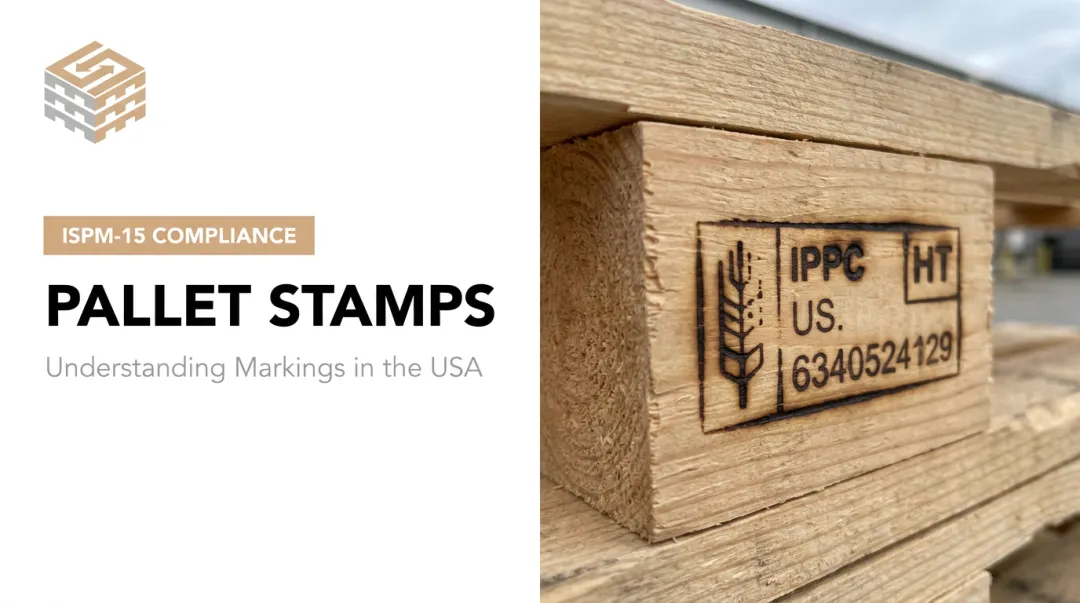
The IPPC stamp is the internationally recognized mark applied to wood packaging material to prove it's been treated under ISPM 15, the International Standard for Phytosanitary Measures No. 15. You'll often hear it called the "wheat stamp" because of its wheat-stalk graphic, though that's a nickname, not the official term.
The Convention behind it dates back further than most people realize. The FAO Conference adopted the International Plant Protection Convention on December 6, 1951, and it entered into force in 1952 to stop plant pests from spreading through international trade. ISPM 15 came later as a specific rule targeting wood packaging.
Think of the stamp as a passport for pallets, crates, and dunnage. It lets customs officials verify treatment status on sight, without requiring a separate phytosanitary certificate for every single shipment.
The scale here is massive. Roughly 80% of all consignments moving in global trade include some form of wood packaging material, according to the IPPC's own guidance on wood packaging. That's why a single missing stamp can ripple through an entire supply chain.
Why the Stamp Matters for Global Supply Chains
The stamp isn't red tape for red tape's sake. It delivers real operational value:
- Speeds customs clearance by replacing paperwork with a visible, verifiable mark
- Protects forest ecosystems from invasive pests like the emerald ash borer and pine wood nematode
- Reduces fines and rejected shipments that stall cargo at the border
- Confirms treatment actually happened, not just that it was supposed to happen
Decoding the Components of an IPPC Stamp
A compliant mark has to be permanent, legible, and non-transferable. Current ISPM 15 guidance recommends placing it on at least two opposite faces of the wood packaging, though the standard treats this as a best practice rather than an absolute requirement.
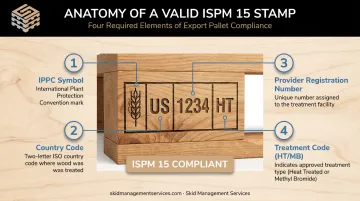
Every valid stamp includes four core pieces of information:
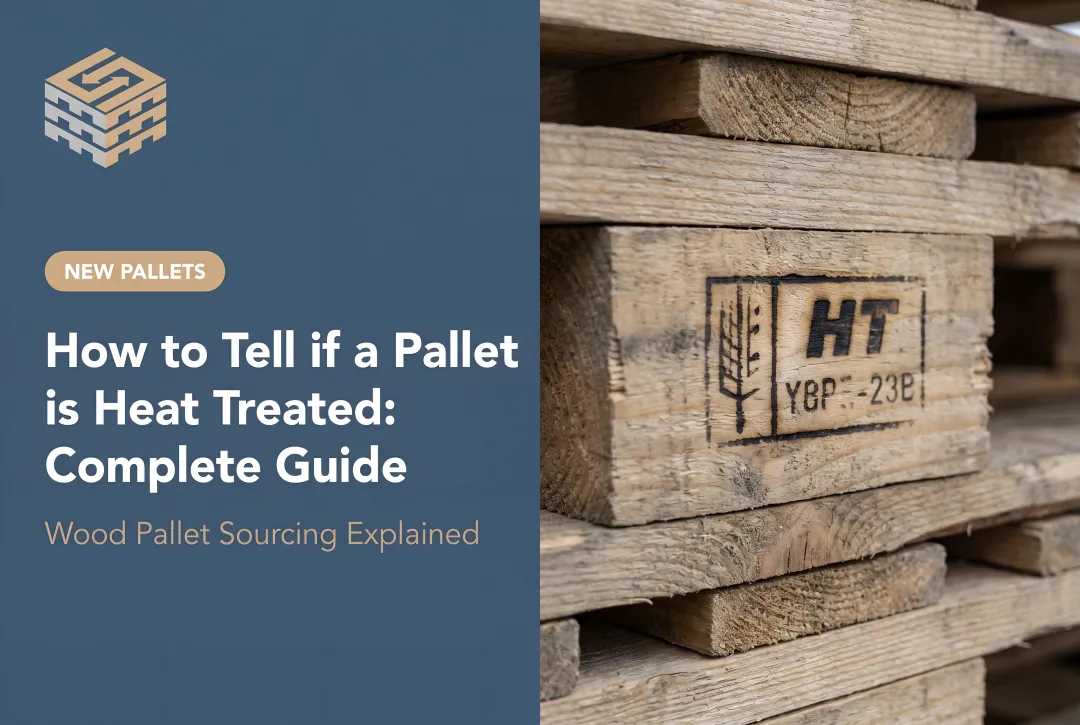
- The IPPC symbol: the dedicated wheat-stalk logo confirming the mark follows the Convention's official format
- A two-letter country code: based on ISO 3166-1 alpha-2 standards, identifying where treatment occurred (US, CA, CN, and so on)
- A provider registration number: a unique ID assigned by the National Plant Protection Organization (NPPO) that traces the mark back to the exact treating facility
- A treatment code: most commonly HT for heat treatment or MB for methyl bromide fumigation
You may also spot DH (dielectric heating) or SF (sulphuryl fluoride) on some marks, since both are current Annex 2 treatment methods.
Codes like DB and KD sometimes show up informally, but they aren't standalone treatment codes. DB indicates debarking was performed. KD-treated wood only qualifies for the mark if it also hits the required heat schedule, in which case it's marked HT.
Sample Stamp Breakdown
Take a mark reading US-1234-HT. Here's what it tells you:
- US: treatment occurred in the United States
- 1234: the unique ID of the certified treatment provider
- HT: the wood was heat-treated, not fumigated
That's the entire story of a pallet's compliance history, condensed into nine characters. Because a single incorrect character can trigger a customs hold, many exporters rely on treatment providers like Skid Management Services to verify stamp accuracy before pallets leave the yard, particularly for Port of Baltimore-bound export loads.
Which Wood Packaging Materials Require the Stamp?
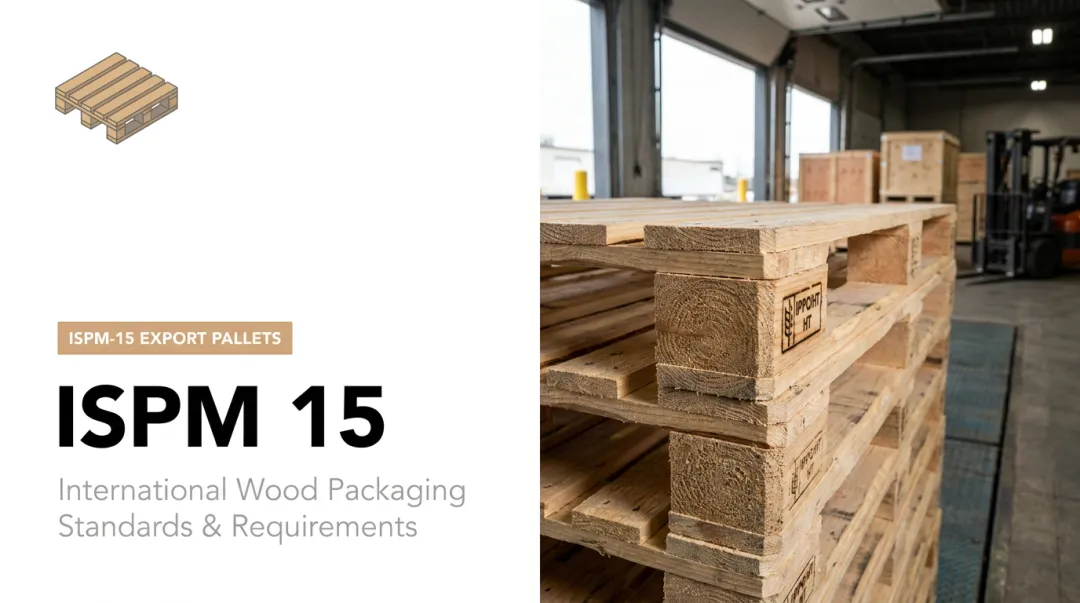
ISPM 15 applies to solid, raw wood packaging used to support, protect, or brace cargo. This covers:
- Pallets
- Crates and boxes
- Loose dunnage (the wood used to fill gaps in shipping containers)
Not all wood packaging needs stamping, though. Processed wood products, including plywood, oriented strand board (OSB), particleboard, and veneer, are exempt because the heat, glue, and pressure used in manufacturing already eliminate pests as a byproduct of production.
A few other exemptions worth knowing: raw wood 6mm thick or less skips the requirement entirely, and barrels or casks for wine and spirits qualify if they were heated during manufacture. This barrel exemption doesn't extend to every cask, only those meeting the specific heating condition.
ISPM 15 Treatment Methods for Compliance
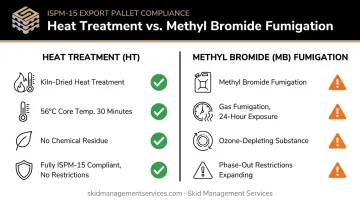
Only two treatment methods currently earn a wood packaging unit its stamp: heat treatment and methyl bromide fumigation. They're not interchangeable in terms of long-term viability.
Heat Treatment (HT)
Heat treatment involves placing wood in a kiln or chamber until its core temperature reaches at least 56°C for a minimum of 30 continuous minutes, per the official ISPM 15 standard. No chemicals involved. It's become the globally preferred method precisely because it leaves no residue and carries no environmental baggage.
Methyl Bromide (MB) Fumigation
MB fumigation uses a gaseous chemical to eliminate pests inside the wood. It works, but it comes with a growing problem: methyl bromide depletes the ozone layer.
Under the Montreal Protocol, controlled uses of methyl bromide were phased out for non-Article 5 countries by January 1, 2005, and for Article 5 countries by January 1, 2015. Quarantine and pre-shipment applications remain exempt from those specific control measures.
That exemption won't last forever as environmental policy tightens. Procurement teams should specify HT-treated pallets over MB to avoid compliance friction, particularly for shipments headed to regions with stricter environmental enforcement.
Suppliers like Skid Management Services supply HT-treated export pallets with stamp verification built in, taking that specification decision off your plate.
How to Get an IPPC Stamp on Your Pallets
Here's something a lot of businesses don't realize until they've already wasted time: you can't self-apply the IPPC stamp. It's not a stencil you buy and use on your own wood packaging. Certification only comes through NPPO-accredited treatment providers and licensed facilities.
In the United States, the USDA's Animal and Plant Health Inspection Service (APHIS) oversees the program, working alongside the American Lumber Standard Committee (ALSC) to audit and accredit treatment facilities.
Getting a facility certified typically involves:
- Enrolling with an accredited inspection agency that oversees quality-mark issuance
- Qualifying the treatment process and equipment, proving the kiln or chamber can consistently hit required temperatures
- Establishing a documented quality-control program with ongoing recordkeeping
- Receiving a unique provider ID tied permanently to the facility's stamp
- Passing recurring inspections, with nonconformities requiring correction or risking suspension
Once certified, the facility brands or stencils the mark directly onto the wood using contrasting, permanent ink, typically on two opposite faces of the unit.
Simplify Compliance by Sourcing Certified Pallets from Skid Management Services
Most exporters don't want to manage treatment facility relationships, audit schedules, or stamp verification on top of everything else on their plate. That's the gap Skid Management Services fills.
As a national provider of wood pallets and packaging products, Skid Management Services sources ISPM 15 heat-treated export pallets through its network of USDA APHIS-recognized treatment providers. Customers receive pallets that are already properly stamped and ready to ship internationally.
The program covers a few distinct needs:
- Stamp verification on existing inventory — checking that all four required mark elements are present, legible, and correctly applied before pallets enter the export stream
- Re-treatment and re-stamping coordination for pallets with degraded, missing, or invalid marks, routed through APHIS-licensed providers
- Sourcing of pre-stamped, HT-only pallets in standard sizes (GMA 48x40, 48x48, 42x42, 44x44, 36x36, Euro-size) plus custom export builds
- Documentation support for export-compliance audits, particularly useful for high-enforcement destinations like China, the EU, Australia, and New Zealand
Notably, Skid Management Services supplies HT-treated pallets exclusively and doesn't offer methyl bromide fumigation, since methyl bromide is an ozone-depleting compound many exporters are moving away from.
For exporters in the Port of Baltimore corridor, Central Pennsylvania, or Maryland's Delmarva region, this means consolidated delivery scheduling and volume pricing for corridor-scale export programs. Owned inventory plus an expansive supplier network keep pallets available even during high-demand shipping periods.
Reach Skid Management Services at 717-202-0304 or Info@SkidManagementServices.com to set up a program.
Frequently Asked Questions
What does IPPC stamp mean?
It's the ISPM 15 mark confirming wood packaging material has been heat-treated or fumigated to eliminate pests before crossing international borders. It functions as proof of treatment, replacing the need for a separate phytosanitary certificate.
How do I get an IPPC stamp?
Only NPPO-accredited treatment facilities can apply the stamp, so individual businesses can't do it themselves. The practical path is sourcing pre-stamped pallets from a certified supplier, such as Skid Management Services, rather than attempting certification in-house.
Does plywood need an IPPC stamp?
No. Plywood, OSB, particleboard, and other processed wood products are exempt from ISPM 15 because the manufacturing process, which uses heat, glue, and pressure, already eliminates pest risk.
What happens if a pallet arrives without an IPPC stamp?
Customs may reject the shipment, order quarantine and treatment, or require destruction of the wood packaging entirely. In every scenario, the cost lands on the shipper.
Can IPPC-stamped pallets be reused?
Yes, as long as the pallet remains intact and unaltered. Any repair involving replaced wood components requires re-treatment and re-stamping by a certified provider before the pallet can ship internationally again.
Is the IPPC stamp required for domestic shipments?
No. ISPM 15 and the IPPC stamp apply only to wood packaging used in international trade. Domestic shipments within the same country aren't subject to this requirement, though some businesses standardize on treated pallets anyway for consistency.