Get it wrong and the consequences aren't small. Businesses shipping internationally, or supplying major retailers and food companies, risk shipment holds, fines, or destroyed loads if their pallets aren't properly certified. A rejected container at a foreign port doesn't just cost money. It costs time, customer trust, and sometimes the entire shipment.
This guide breaks down what pallet certification actually means, covers ISPM 15 in depth (the standard buyers ask about most), reviews the other major certification systems, and clarifies training requirements for the people operating pallet jacks and forklifts.
Key Takeaways
- Certified pallets meet a defined standard, like ISPM 15, and carry a visible compliance stamp
- ISPM 15 is required for nearly all wood packaging in international trade to prevent pest and disease spread
- EPAL, GMA, and ISTA govern quality, food-industry fit, and shipping durability, but none replaces ISPM 15
- Operator training under OSHA 29 CFR 1910.178 is separate from pallet certification but equally critical for compliance
What Is Pallet Certification?
Pallet certification is verification, by a recognized standards body, that a pallet's material, construction, or treatment meets a defined safety, quality, or phytosanitary requirement. It's proof, checked against a specific published standard, not a marketing claim.
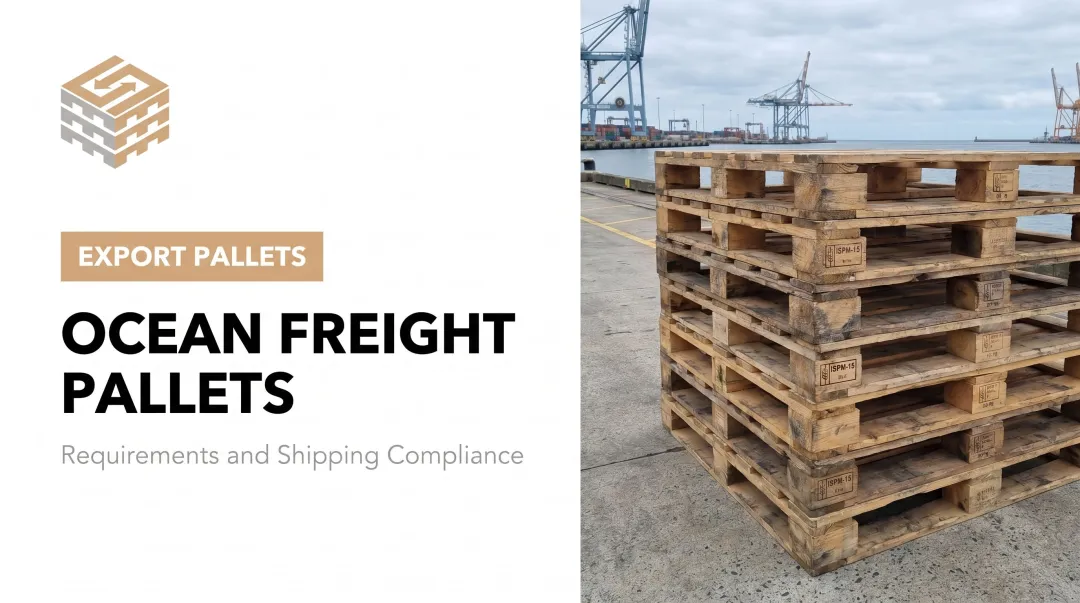
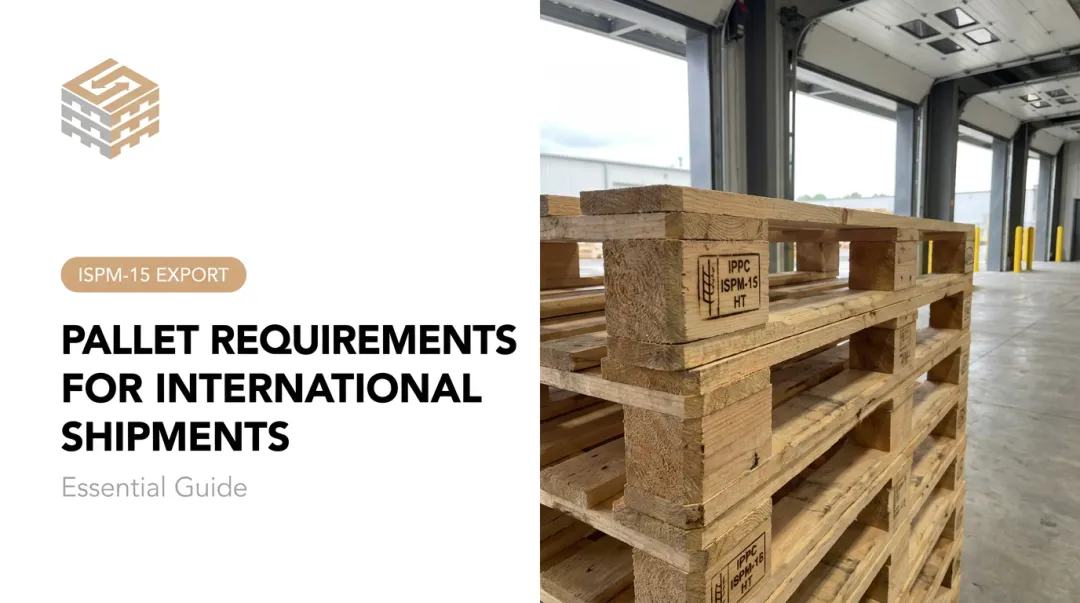
A certified pallet, most commonly, means one treated or manufactured to an official standard and marked with a stamp or label as evidence. A genuine ISPM 15 stamp includes:
- The IPPC logo (the two-leaf symbol)
- A two-letter country code
- The treatment facility's registration number
- A treatment code (HT for heat treatment, MB for methyl bromide)
Certifications fall into two categories. Mandatory certifications like ISPM 15 are legally required for cross-border wood shipments, with no exceptions or workarounds. Voluntary certifications like EPAL or GMA are industry-driven, adopted for quality assurance and supply chain compatibility rather than legal necessity.
Who actually checks for this in practice? More parties than most businesses expect:
- Customs and border agents at ports of entry
- Freight forwarders processing export documentation
- Retailers running vendor compliance programs (Walmart, Costco, Kroger, and similar chains)
- Food and pharmaceutical companies with strict supply chain audits
Certified vs. Non-Certified Pallets: Key Differences
The gap between certified and non-certified pallets comes down to three things: treatment, traceability, and risk.
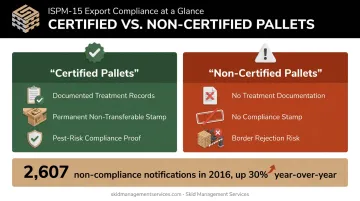
Certified pallets carry documented treatment records and a permanent, non-transferable stamp. Non-certified pallets carry neither — meaning there's no proof of pest-risk treatment if a border inspector asks.
This isn't a hypothetical concern. The European Commission recorded 2,607 notifications for non-compliant wood packaging material in 2016, a 30% increase from the prior year, according to the European Commission's EUROPHYT interception data. Every one of those notifications represents a shipment that ran into a compliance problem at the border.
ISPM 15: The International Standard for Wood Packaging
ISPM 15 (International Standards for Phytosanitary Measures No. 15) exists to stop pests and tree diseases from hitching a ride across borders inside wood packaging. It applies to pallets, crates, dunnage, cable drums, and similar wood products used internationally.
Two treatment methods are currently accepted:
- Heat treatment (HT): the wood's core must reach at least 56°C (132.8°F) for a continuous 30 minutes, throughout the entire wood profile, not just the surface
- Fumigation with an approved chemical: methyl bromide (MB) remains accepted, though the IPPC's 2018 revised standard recommends reducing its use because of ozone-depletion concerns
Debarking is also required, with only small residual bark patches permitted.
What Is an ISPM 15 Certificate?
Here's where a lot of confusion happens. There's no per-shipment paper certificate for ISPM 15. The stamp on the wood itself is the certificate.
Once a facility treats wood packaging and applies the official mark, that mark satisfies the phytosanitary requirement on its own. Customs officials check the stamp for four required elements:
- IPPC logo
- Country code
- Treatment provider's registration number
- Treatment abbreviation (HT or MB)
If any element is missing, smudged, or hand-drawn instead of officially applied, the wood isn't considered compliant, regardless of accompanying paperwork.
How Do I Get ISPM 15 Certification?
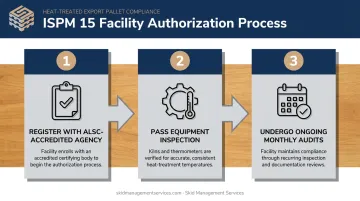
Getting a facility authorized to stamp wood packaging is a multi-step regulatory process, not a form you fill out once:
- Register with an accredited agency: in the US, that means enrolling through an ALSC-accredited third-party agency recognized by USDA APHIS
- Pass equipment inspection: treatment chambers and monitoring equipment must be inspected and calibrated
- Undergo ongoing audits: facilities face roughly monthly inspections to keep their authorization active
That's a real operational commitment, and it's exactly why many businesses skip it entirely. Rather than registering a facility, calibrating kilns, and managing audit cycles in-house, companies can source pre-treated, pre-stamped pallets from a supplier that already works with USDA APHIS-recognized treatment providers.
Skid Management Services runs its ISPM 15 export pallet program this way. Pallets are heat-treated to the 56°C/30-minute threshold and stamped by an authorized provider before they ever reach a customer's dock. Stamp verification and re-stamping coordination are also available for pallets already sitting in a customer's inventory.
Other Major Pallet Certification Standards
ISPM 15 isn't the only standard in play. Depending on your industry, buyers may ask about several others.
EPAL (European Pallet Association)
EPAL governs the open pallet exchange pool widely used across Europe. It defines exact specifications for the EPAL 1 pallet:
- Dimensions: 800 x 1,200 x 144mm
- Construction: 11 boards, 9 blocks, 78 nails
- Load rating: 1,500kg safe working load
- Quality classes: New, A, B, C, each with defined repair rules
Nail patterns and quality grading stay tightly controlled, and pallets carry the EPAL logo stamped directly on the block.
GMA (Grocery Manufacturers Association)
GMA-style pallets define the dominant U.S. grocery and food & beverage pallet format: 48x40 inches, three-stringer, partial four-way entry. Historically, this size represented roughly a quarter of all U.S. pallets in circulation. GMA defines dimensions and construction only, with no phytosanitary requirement attached. It remains, however, the specification most U.S. retail supply chains are built around.
ISTA (International Safe Transit Association)
ISTA certification tests how well packaging and pallets survive actual shipping conditions. Procedures simulate vibration, shock, drop, and compression to verify products arrive intact. ISTA measures performance, not treatment or dimensions. A pallet can pass ISTA testing with zero relevance to ISPM 15 or EPAL requirements.
NWPCA & OSHA
NWPCA's Pallet Design System (PDS) works as an engineering calculator rather than a certification stamp. It calculates safe load capacity and structural performance based on engineering principles. OSHA, meanwhile, doesn't certify pallets at all. It enforces safe pallet condition and use in the workplace through general material-handling rules, requiring damaged or unstable pallets to be pulled from service.
Pallet Jack & Handling Training Requirements
Here's a distinction that trips up a lot of warehouse managers: pallet certification applies to the physical product. Operator training applies to the people moving it. They're governed by completely different rules.
Under OSHA 29 CFR 1910.178, powered pallet jacks are classified as Class III powered industrial trucks. Operating one legally requires:
- Formal classroom-style instruction
- Hands-on practical demonstration
- A documented performance evaluation by a qualified trainer
Manual (non-powered) pallet jacks fall outside this rule, but training is still smart practice — a fully loaded manual jack can still cause serious injury.
Refresher training isn't automatically triggered every three years, despite what some warehouses assume. Per OSHA's powered industrial truck standard, it's required when:
- An operator is caught operating unsafely
- An accident or near miss occurs
- An evaluation reveals unsafe operation
- The operator switches to a different truck type
- Workplace conditions change in ways that affect safe operation
What's fixed on a three-year cycle is the operator performance evaluation, a separate requirement from full refresher training.
Why Sourcing Certified Pallets Matters for Your Business
Non-certified pallets create risk in three directions at once:
- Customs holds and fines at ports of entry when phytosanitary marks are missing or invalid
- Rejected loads from retail partners with vendor compliance programs — Walmart, Costco, Target, and Kroger can refuse noncompliant pallets and bill suppliers for return freight
- Contamination liability in food and pharma supply chains where FDA, GFSI (SQF, BRCGS, FSSC 22000), or cGMP audits evaluate pallet condition directly
Managing in-house treatment, facility registration, and ongoing audits to avoid these risks is a heavy lift for most manufacturers. It's usually more practical to partner with a supplier that already handles it.
Skid Management Services is a national provider of wood pallets and packaging products, with an inventory base plus an expansive supplier network that keeps compliant, properly treated pallets flowing without interruption.
Food and beverage manufacturers like Knouse Foods and Campbell Snacks rely on this model for GMA 48x40 and custom food-grade pallets built to FDA and GFSI-aligned specifications. The result is competitive pricing and consistent supply, without the burden of managing treatment certification in-house.
Frequently Asked Questions
How do I get ISPM 15 certification?
A facility registers with an ALSC-accredited agency recognized by USDA APHIS, undergoes equipment inspection, and passes required audits. Most businesses skip this process entirely by sourcing already-certified pallets from an established supplier like Skid Management Services instead.
What is an ISPM 15 certificate?
An ISPM 15 certificate is an official IPPC stamp applied directly to the wood packaging by an authorized treatment provider once treatment is complete, not a paper certificate issued per shipment.
What is a certified pallet?
A certified pallet is one manufactured, treated, or inspected according to a recognized standard and marked with visible proof of compliance, such as an IPPC stamp or an EPAL logo.
How can you tell if a pallet is ISPM 15 certified?
Look for the IPPC logo, a two-letter country code, the treatment provider's registration number, and a treatment code (HT or MB) stamped directly onto the wood block.
Are all wood pallets required to be ISPM 15 certified?
No. ISPM 15 only applies to wood packaging used in international shipments. Pallets used strictly for domestic shipping don't need this certification.
Do plastic pallets need certification too?
Plastic pallets are exempt from ISPM 15 since it only covers raw wood packaging. They may still need to meet GMA dimensional specs, ISTA transit testing, or customer-specific quality requirements.