That mix-up trips up a lot of buyers. Many businesses order pallets without asking about moisture content at all, then get blindsided by mold on arrival, pallets that weigh far more than expected, or shipments rejected at a foreign port. Moisture content isn't a minor spec footnote — it drives weight, durability, and whether your cargo stays clean.
This article breaks down what green wood pallets actually are, their defining characteristics, where they make sense, and how they stack up against kiln-dried and ISPM-15 heat-treated alternatives.
Key Takeaways
- Unseasoned lumber gives green pallets moisture content above 19%, past the kiln-dried threshold
- Lower upfront costs and better load flex trade off against mold, staining, and shrinkage risks
- Green lumber can pass ISPM-15 heat treatment; moisture level and pest treatment are separate issues
- Your choice depends on product moisture sensitivity, budget, and destination
What Are Green Wood Pallets?
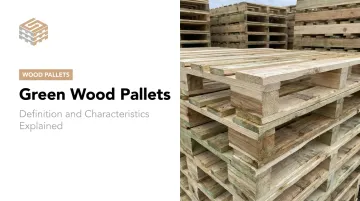
Green lumber is wood that's been cut and milled but never dried in a kiln or seasoned by air-drying. A green wood pallet is built straight from that raw material, with no drying step added before assembly.
The industry has an actual number attached to this. Under the American Softwood Lumber Standard (PS 20-20), lumber under 5 inches thick is classified as dry at 19% moisture content or below, and green above that threshold. That's the exact grading boundary published by NIST.
Grade stamps make the distinction visible right on the lumber:
| Grade Stamp | Moisture Content |
|---|---|
| S-DRY / KD | 19% or less |
| MC-15 / KD-15 | 15% or less |
| S-GRN | Over 19% |
Matching these stamps against a supplier's quote tells you exactly what moisture class you're buying.
You'll also see the figure 30% mentioned alongside green lumber. That's the fiber-saturation point — the moisture level where wood cells stop holding free water and dimensional shrinkage starts becoming significant. It's a different concept from the grading cutoff, but both matter for understanding how a pallet will behave in service.
One thing green wood pallets are not: a sustainability designation. That's a separate, similarly-named category built around recycled or reclaimed material. Green here refers strictly to drying state, not origin or environmental impact.
Because of the moisture risk, green wood pallets tend to show up in:
- One-way or expendable shipments where the pallet won't be reused
- Applications where the cargo itself doesn't care about ambient humidity
- Situations where cost per unit matters more than long-term durability
Green pallets are also almost always newly manufactured rather than recycled. The term describes how fresh the lumber is, not whether it's been through a prior life as packaging.
Key Characteristics of Green Wood Pallets
Once you know what "green" means, spotting it in the field gets easier. A few characteristics show up consistently.
Moisture Content and Weight
Moisture content can be checked with a handheld meter during inspection, though the method has real limits. Electrical resistance and dielectric meters work best below roughly 30% MC; above that, they get less reliable, and oven-drying remains the true reference method.
That retained water adds real weight. One trade example put it plainly: a new 48x40-inch green hardwood pallet can hold 3 to 4 gallons of water — weight you're paying to ship whether it's cargo or not.
Flex, Look, and Feel
Green boards flex more under load than dry, rigid lumber. That extra give can actually help lock a unit load tighter during transit, since the boards conform slightly around the stacked goods rather than staying stiff.
You can usually identify green stock without a meter:
- Darker coloration compared to dried boards
- Cool or damp to the touch
- Visible sap seeping from the grain
- A noticeably "green" or fresh-cut wood smell
Shrinkage and Contamination Risk
As green lumber air-dries after the pallet is built, it keeps shrinking. Species vary quite a bit. USDA data shows volumetric shrinkage from about 12.3% for loblolly pine to 16.3% for white oak, going from green to fully dry. In practice, that means warped boards, loosened nails, and shifting deck boards over a pallet's service life.
The bigger operational concern is mold. Wet pallets can stay damp long enough during air-drying for mold to establish and spread, which is exactly why moisture-sensitive cargo (certain foods, paper goods, electronics) doesn't pair well with green stock.
Pros and Cons of Green Wood Pallets
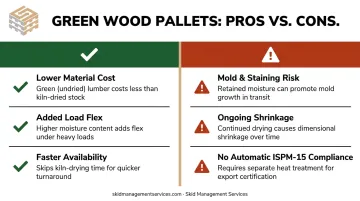
Green wood pallets offer real savings and speed advantages, but those same unseasoned boards create trade-offs that matter for certain applications.
Advantages of Green Wood Pallets
- Lower material cost — green lumber skips the kiln-drying step entirely, which is one of the most energy-intensive parts of lumber production, translating into real savings for high-volume buyers
- Added flex under load — this extra give helps stabilize a unit load compared to stiffer, fully dried boards
- Faster availability — no drying time means suppliers can turn around urgent orders quicker than with seasoned stock
Disadvantages and Limitations
- Mold, mildew, and staining risk — makes green pallets a poor fit for moisture-sensitive goods, food-contact applications, or anything shipped in a sealed container where trapped humidity has nowhere to go
- Ongoing shrinkage after manufacturing — boards keep drying post-assembly, which can lead to warping and nails backing out over time
- No automatic phytosanitary compliance — untreated green lumber does not meet ISPM-15 on its own; it needs a separate heat-treatment step to qualify for international shipment
Green Wood vs. Kiln-Dried vs. ISPM-15 Heat-Treated Pallets
These three terms get confused constantly, but they answer different questions: how dry is the wood, and has it been treated for pests. Here's how they compare.
| Factor | Green Lumber Pallet | Kiln-Dried Pallet | ISPM-15 Heat-Treated Pallet |
|---|---|---|---|
| Moisture content | Above 19% (PS 20-20 green threshold) | 19% or below (KD19), sometimes 15% (KD-15) | No moisture limit specified |
| Treatment | None | Kiln drying for moisture removal | Heat to 56°C core for 30+ continuous minutes |
| Typical cost | Lowest | Higher, reflects drying energy cost | Varies; often built on kiln-dried stock |
| Best fit | One-way domestic shipments, non-moisture-sensitive goods | Food-grade, cold storage, moisture-sensitive cargo | Any international shipment requiring phytosanitary compliance |
The nuance buyers often miss: green lumber can still be heat-treated to satisfy ISPM-15. The standard governs pest and pathogen risk, not final moisture content, so wood doesn't need to be kiln-dried first to pass. That said, in practice, kiln-dried stock tends to hold heat treatment more reliably, since it doesn't reabsorb moisture the way green wood can during long ocean transits.
Cost Factors for Green Wood Pallets
There's no widely published price benchmark separating green from kiln-dried pallets at the national level. Pricing depends on species, size, and order volume, so supplier quotes are the most reliable source. A few things do move the needle:
- Regional mill proximity affects freight cost baked into the final price
- Order volume spreads fixed production costs across more units, lowering the per-pallet rate
- Repeat ordering through an established supplier relationship typically beats one-off spot buys on price
Sourcing ISPM-15 Certified and Green Wood Pallets
If you're shipping internationally, verify the stamp before it leaves your dock. Under IPPC's ISPM-15 standard, a compliant mark includes four elements:
- The IPPC two-leaf logo
- The ISO country code
- A unique treatment-provider ID number
- The treatment code (HT for heat treatment, sometimes DB for debarked)
Smudged, hand-drawn, or incomplete stamps are grounds for rejection at a foreign port — that's not a risk worth taking on a technicality.
This is where working with an established supplier network pays off. Skid Management Services sources both kiln-dried heat-treated pallets and standard new pallets through its own inventory and an expansive supplier network.
Its ISPM-15 program adds stamp verification on existing inventory plus re-stamping coordination through USDA APHIS-recognized treatment providers. For businesses juggling domestic and export needs at the same time, that combination keeps supply moving without gambling on compliance.
Industries That Commonly Use Green Wood Pallets
Green pallets show up most often in one-way shipments where the product itself isn't fussy about moisture. Think building materials like bundled shingles or cinderblock, bagged limestone and aggregate, rolled plastic film, and beverage cases sturdy enough to handle a bit of ambient humidity. In these cases, the pallet is disposable freight infrastructure rather than a long-term asset, so the lower cost outweighs the drawbacks.
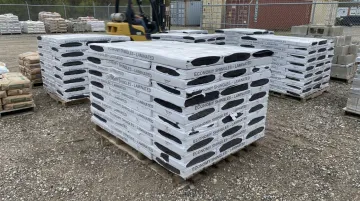
Contrast that with food, pharmaceutical, and cold-storage operations, where mold risk and GFSI audit standards make kiln-dried stock the only real option.
Frequently Asked Questions
What does a green wood pallet mean and what are green wood pallets used for?
A green wood pallet is built from unseasoned lumber that hasn't been kiln-dried, typically above 19% moisture content. They're most common in one-way shipments for goods that aren't sensitive to moisture, like construction materials or bagged aggregate.
How much does a typical green wood pallet cost?
Green pallets generally cost less than kiln-dried alternatives since they skip the energy-intensive drying process, but no fixed national price benchmark exists. Cost depends on species, size, volume, and your supplier's regional lumber access.
Where can I buy ISPM-15 certified wood for pallets?
Look for a valid four-element stamp: IPPC logo, country code, provider ID, and treatment code, applied by a USDA APHIS-recognized treatment provider. Working with a national supplier network like Skid Management Services simplifies stamp verification and sourcing.
How long does it take for green wood pallets to dry out?
Air-drying timelines vary widely with climate, wood thickness, and species, anywhere from a couple of months to nearly a year for thicker stock. As it dries, expect some shrinkage, warping, and loosened fasteners along the way.
Can green wood pallets be heat treated for ISPM-15 compliance?
Yes. ISPM-15 addresses pest and pathogen risk through heat treatment, not moisture content, so green lumber can be treated without being kiln-dried first. In practice, kiln-dried stock often holds the treatment more reliably over long transit times.
Are green wood pallets safe for food packaging?
Not usually. Their higher moisture content creates favorable conditions for mold and staining, which conflicts with GFSI and FDA food-safety standards. Kiln-dried or heat-treated pallets are the standard choice for food-grade applications.