Pallet exchange programs get discussed constantly in industry articles, but the real value shows up somewhere else entirely: in daily dock operations, in invoice line items, and in how smoothly a shipper and receiver work together over time.
This article skips the textbook definition and gets into what a pallet exchange program actually delivers — the features, the advantages, and where it tends to break down when nobody's watching the details.
Key Takeaways
- Exchange programs swap loaded pallets for empties at delivery, cutting new purchases
- Standardized pallet specs speed up dock turnaround and reduce handling errors
- Reused pallets cut landfill waste and support ESG reporting goals
- Poorly managed exchanges create "pallet debt" and unplanned fees
- Partnering with a dependable pallet supplier prevents most common failure points
What Is a Pallet Exchange Program?
A pallet exchange program is a straightforward arrangement: for every loaded pallet a driver drops off, the receiver hands back an equal number of usable empty pallets. No invoice for new pallets, no long-term ownership transfer — just a continuous swap that keeps pallets circulating between trading partners.
This model shows up most often in specific corners of the supply chain:
- LTL and pool distribution: carriers frequently build exchange terms directly into their tariffs
- Intermodal freight: trucks making multiple stops need pallets to reload immediately
- Grocery and retail distribution: high-frequency routes between the same partners make exchange practical
These arrangements share one requirement: the exchange model is a circulation mechanism, not a purchase or a transfer of ownership. It keeps pallets moving between the same trading partners instead of each party buying and discarding on its own.
Key Advantages of a Pallet Exchange Program
The advantages below aren't abstract claims. Each one ties to a metric that operations and procurement teams already track: dollars spent, hours lost, waste generated. Here's how exchange programs move those numbers.
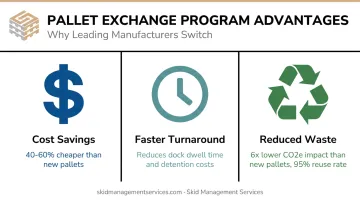
Cost Savings on Pallet Procurement
When pallets already in circulation get reused instead of replaced, businesses stop writing purchase orders for new pallets on every outbound shipment. Instead of a weekly pallet order, dock teams simply track exchange ratios with their delivery partners.
Why this matters for procurement:
- Eliminating repeat pallet purchases frees up working capital for other logistics priorities
- Fewer emergency pallet buys mean more predictable, line-item procurement costs
- Teams can plan pallet spend months ahead instead of reacting to shortages
Recycled and remanufactured pallets typically run 40–60% cheaper than new pallets while performing adequately for most internal handling and outbound shipments, based on Skid Management Services' own program data. That gap makes exchange participation financially worthwhile for high-frequency shippers.
KPIs impacted: cost per shipment, pallet procurement spend, replacement pallet frequency.
This advantage hits hardest for high-frequency shippers moving similar pallet types daily between the same trading partners — think grocery distributors or food manufacturers running the same routes week after week.
Faster Dock Turnaround and Operational Efficiency
Exchanging pallets right at the point of delivery means a truck can reload immediately instead of waiting for empty pallets to come back on a separate trip. That's the operational core of the program, and it's where the time savings actually live.
Standardized pallet dimensions within an exchange agreement reduce handling errors and speed up loading. When every pallet on the dock is the same footprint, forklift operators aren't guessing at fit or rearranging loads mid-shift.
The cost of not solving this problem is well documented. The Department of Transportation's Inspector General found that driver detention costs for-hire commercial drivers between $1.1 billion and $1.3 billion annually in lost earnings. A 15-minute increase in average dock dwell time also raises expected crash rates by 6.2%, according to the DOT OIG's detention study.
KPIs impacted: truck turnaround time, dock dwell time, detention and demurrage charges.
This benefit matters most at high-volume distribution centers and retail or grocery accounts working within tight delivery appointment windows.
Reduced Waste and Environmental Impact
Every pallet that gets reused through exchange is one less pallet manufactured from new lumber. That reduction compounds across a supply chain that moves hundreds of millions of pallets a year.
A peer-reviewed life-cycle study found the gate-to-gate global-warming impact of a repaired pallet is just 0.36 kg CO2e, compared to a minimum of 2.2 kg CO2e for a newly manufactured pallet (roughly a sixfold difference). The same study found that 95% of US wood pallets are repurposed rather than landfilled, per CORRIM's life-cycle assessment of wood pallet repair.
Fewer abandoned or single-use pallets also means:
- Lower disposal costs for both shipper and receiver
- Less pressure on landfill capacity
- Better alignment with retailer sustainability mandates
KPIs impacted: pallet waste volume, disposal costs, sustainability and ESG reporting metrics.
This advantage carries the most weight for companies operating under retailer sustainability mandates or building out formal ESG and circular-economy commitments. Pallet recycling documentation increasingly shows up on corporate sustainability scorecards.
What Happens When a Pallet Exchange Program Is Poorly Managed
Exchange programs sound simple on paper. In practice, a few recurring problems show up when nobody's enforcing discipline:
- Pallet debt accumulates. More pallets leave a facility than return, creating a shortage that snowballs over weeks.
- Inconsistent quality causes rejected shipments. A receiver refuses damaged pallets, delaying or damaging the goods sitting on them.
- Disputes erupt over exchange ratios. Without clear documentation, shippers and receivers argue over how many pallets actually changed hands.
- Unplanned fees stack up. Carrier tariffs show real-world exchange charges from $3.50 to $19+ per pallet when counts don't match.
- Scaling becomes harder during demand spikes. Without a reliable pallet source, sudden volume increases expose every weakness in the program at once.
None of these problems are inevitable. They're symptoms of a program running without documentation discipline or a backup supply source, both fixable with the right operational habits.
How to Get the Most Value from a Pallet Exchange Program
Exchange programs work best when documentation happens at the moment of the transaction, not days later from memory. Record these details every time a swap occurs:
- Pallet counts for each transaction
- Condition notes covering grade, damage, and defects
- Signatures from both parties on the pallet note
This habit alone prevents most pallet debt before it starts.
Standardizing on one or two pallet types and grades across all trading partners also cuts down on disputes. A GMA 48x40 pallet accepted by one partner and rejected by another creates friction that documentation can't fix on its own.
Even with tight documentation and standardized specs, exchange ratios fall short sometimes. That's where having a dependable pallet supply source becomes the difference between a minor hiccup and a stalled production line.
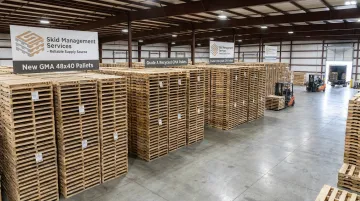
Skid Management Services works with food and beverage manufacturers running exchange-dependent operations like this one. The company supplies new, Grade A, and Grade B recycled GMA 48x40 pallets on scheduled or on-demand cadences, backed by an expansive network of pallet and packaging suppliers.
That combination of SMS's own inventory plus its supplier network means clients maintain competitive pricing and uninterrupted supply, even when a trading partner's exchange ratio comes up short.
Conclusion
The real value of a pallet exchange program lies in the control and cost discipline that come from running it correctly, day after day, not in the concept of swapping pallets itself.
Cost savings and faster dock turnaround don't show up as one-time wins. They compound over months of active, well-documented exchange activity, while consistent pallet quality reduces waste along the way. A program left on autopilot eventually drifts into pallet debt, quality disputes, and unplanned fees.
Treat a pallet exchange program as an ongoing operational practice, not a one-time setup. Back it with reliable pallet sourcing from a partner like Skid Management Services, and the advantages keep compounding.
Frequently Asked Questions
What is a pallet exchange fee?
It's a charge assessed when a receiver doesn't return an equal number of usable pallets. Carrier tariffs show real fees ranging from roughly $3.50 to $19 or more per pallet, depending on the carrier and specification.
How does pallet pooling work?
A third party owns, rents, and reconditions the pallets in a pooling system, collecting them after use. Exchange works differently: it's a direct swap between the shipper and receiver, with no third-party ownership involved.
Who will collect pallets for free?
Some pallet suppliers, recyclers, and pooling companies offer free pickup in exchange for reusable stock. Skid Management Services, for example, provides pallet buy-back and free removal for qualifying loads, typically 100+ pallets in good condition.
What is pallet debt and how is it resolved?
Pallet debt happens when exchange ratios go unbalanced over time, leaving one party short. It's typically resolved through consistent documentation, clearinghouse platforms, or a direct settlement between the trading partners involved.
Is a pallet exchange program better than pallet pooling for my business?
It depends on shipment frequency and trading partner consistency. Businesses that prefer direct control over pallet quality often choose exchange; those wanting to outsource management often choose pooling.
What pallet quality standards are required for exchange?
Exchanged pallets generally need to be structurally sound, standard-sized, and free of major damage such as missing deck boards or broken stringers. Damaged pallets should be repaired before being offered for exchange.