The GS1 Logistic Label Guideline governs pallet label sizing globally, and it frames size as a function of data volume — what you're encoding determines which label format you need. This guide covers the two GS1-recommended standard sizes, the three-section label structure that drives those sizing decisions, correct placement rules, and what happens when suppliers get it wrong.
Key Takeaways
- Two standard sizes: A6 (4×6 in) for SSCC-only labels; A5 (6×8 in) for full logistics data
- Barcode minimums are non-negotiable: GS1-128 requires at least 31.75 mm bar height with mandatory quiet zones on each side
- Placement matters as much as size: Barcodes must sit 16–32 inches from the pallet base on pallets over 16 inches tall
- Retailer requirements exceed GS1 minimums — verify vendor guides before printing
What Pallet Label Size Actually Means in Supply Chain Compliance
Label size is not a preference — it's a governed output of the data you need to encode.
The GS1 Logistic Label Guideline Release 1.3 describes the pallet label as the physical interface between a logistic unit and the electronic supply chain. Scanning the SSCC barcode on a pallet triggers a match with electronic business messages — Advance Ship Notices (ASNs), EDI 856 documents, EPCIS events — that update warehouse stock and receiving workflows automatically. A label too small to scan reliably breaks that chain entirely.
Label size is determined by the data you need to encode — not the other way around. The amount and type of data you include — SSCC only versus SSCC plus GTIN, lot number, expiration date, and shipping destination — determines which label format you need. Choosing the size first and squeezing data in afterward is how compliance failures happen.
Pallet dimensions also influence label placement, which affects minimum usable label size. A consistent pallet spec — like the GMA 48×40 — lets you calculate placement requirements once and apply them across every shipment. Working from a non-standard or variable pallet size forces that calculation to be redone per load, increasing the risk of placement errors.
What Drives Label Size in Practice
Three factors set the floor:
- GS1-128 barcode minimums: Per the GS1 General Specifications Release 26.0, the minimum bar height is 31.75 mm (1.25 inches), the X-dimension range is 0.495–0.940 mm, and quiet zones must be at least 10× the X-dimension on both sides. These are not adjustable.
- Data volume: An SSCC-only label is compact. A label encoding GTIN, lot number, expiration date, batch number, and ship-to destination requires substantially more physical space for both the barcode and human-readable text.
- Environmental conditions: GS1 recommends using an X-dimension at the higher end of the permitted range for cold storage and other harsh environments. A wider X-dimension produces a wider barcode and a wider label — which is how scan reliability is maintained through freeze-thaw cycles.
Standard Pallet Label Sizes: GS1 Specifications
The GS1 Logistic Label Guideline identifies two standard label formats. The choice between them is determined by data content, not personal preference.
A6 / 4×6 Inch — The Compact Format
- Dimensions: 105 mm × 148 mm (approximately 4.1 × 5.8 inches)
- Use case: SSCC-only labels, or labels with minimal additional data encoded
- Key constraint: GS1 Rule [6-14] explicitly prohibits concatenating the SSCC with other data on A6/4×6 labels. This makes A6 unsuitable any time full trade item data is required.
A6 works well for pre-printed SSCC-only labels applied at production time, or internal warehouse labels where no retailer-facing compliance requirement exists. Outside those scenarios, it's the wrong choice.
A5 / 6×8 Inch — The Full Logistics Label
- Dimensions: 148 mm × 210 mm (approximately 5.8 × 8.3 inches)
- Use case: Any label encoding GTIN, batch/lot number, expiration date, item count, or shipping destination alongside the SSCC
- Industry status: The standard format for outbound shipping pallets across North American retail and CPG supply chains
Most retail supplier pallet labeling requirements align to this format. For commercial outbound shipments, A5/6×8 is the correct default.
USPS and Carrier-Specific Formats
If your pallets move through postal channels rather than commercial supply chains, different standards apply. The USPS Domestic Mail Manual specifies:
- Standard pallet label size: at least 8 × 11 inches (DMM section 705.8.6.2)
- Intelligent Mail container labels: at least 8 × 11 inches (DMM section 204.3.4.3)
- Optional mailer-generated container labels with Intelligent Mail container barcodes: no less than 4 × 7 inches (DMM section 204.3.4.6)
These specifications apply to postal/mailing pallets only. They are separate from and should not be confused with GS1 logistics label standards for commercial supply chain shipments.
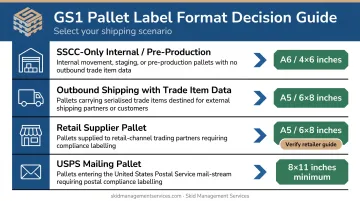
Quick decision framework:
| Scenario | Label Size |
|---|---|
| SSCC-only, internal/pre-production | A6 / 4×6 |
| Outbound shipping with trade item data | A5 / 6×8 |
| Retail supplier pallet | A5 / 6×8 (verify retailer guide) |
| USPS mailing pallet | 8×11 inches minimum |
What Must Fit on a Pallet Label: The Three-Section Structure
GS1 divides the pallet label into three building blocks. Only the bottom section is mandatory, but most commercial applications require all three — and understanding each section is what makes label sizing decisions defensible.
Top Building Block (Optional)
Contains company name, logo, and non-barcoded information such as an internal reference number. Format is free-form, but GS1 requires all text to be at least 3 mm (0.118 inches) in height. This section adds real estate requirements even when its contents seem minimal.
Middle Building Block (Human-Readable Data)
Contains the plain-text version of all barcoded data, displayed using standardized GS1 Data Titles — "SSCC," "BATCH/LOT," "EXPIRY," and so on. GS1 requires data-content characters to be at least 7 mm (0.28 inches) high.
This section cannot be treated as optional in practice. Barcodes are routinely scratched, smudged, or covered by shrink wrap during transit. Human-readable text is the fallback that keeps a shipment moving when the barcode fails.
Bottom Building Block (Mandatory)
The only required section. Must contain a GS1-128 barcode encoding the SSCC using Application Identifier (AI) 00. Additional AIs may be concatenated on A5 labels:
- AI (01): GTIN
- AI (02): GTIN of contained trade items (must be used with AI 37, never with AI 01)
- AI (10): Batch/lot number
- AI (17): Expiration date
- AI (37): Item count
Beyond data content, the barcode itself must meet strict physical print specifications:
Technical requirements for the GS1-128 barcode:
- Orientation: Horizontal (picket fence) — bars perpendicular to the pallet base
- Minimum bar height: 31.75 mm / 1.25 inches
- X-dimension range: 0.495–0.940 mm
- Minimum quiet zone: 10× the X-dimension on both sides
A barcode that falls below these minimums will fail verification and may not scan reliably at automated dock doors or scan tunnels.
Pallet Label Placement Rules
A correctly sized label in the wrong position will still fail. GS1 placement rules are normative — meaning they're required, not suggested.
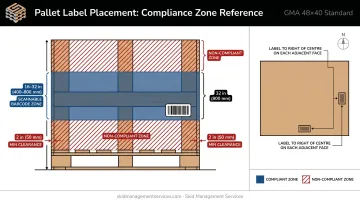
Pallets Over 16 Inches (400 mm) Tall
- Barcode must be positioned between 400 mm and 800 mm (16–32 inches) from the base of the pallet
- The label (including quiet zones) must be placed at least 50 mm (2 inches) from any vertical edge
- GS1 recommends labeling two adjacent sides with identical data so at least one label remains accessible
- Labels should be positioned to the right of each side — most forklift operators are right-handed, and right-side placement improves ergonomic scan access
Pallets Under 16 Inches (400 mm) Tall
Place the label as high as possible on the pallet while protecting barcode integrity. Avoid the bottom edge entirely: forklift forks obstruct scanning there, and labels near the base sustain the most environmental damage.
Shorter pallet formats — including half-pallets (24×40) and quarter-pallets — frequently fall below this threshold. Skid Management Services supplies both formats, so if your loaded height drops under 16 inches, this "as high as possible" rule applies directly to your configuration.
Stacked Pallets
Each pallet in a stacked configuration must carry its own unique SSCC label. If the stack is shrink-wrapped as a single unit for shipment, apply a master label with a new SSCC for the combined group to the outside of the wrap. The individual labels beneath are preserved and reactivated once the wrap is removed.
Retailer Requirements and the Consequences of Getting Label Size Wrong
GS1 sets the floor. Retailers set their own requirements above it — and non-compliance carries financial consequences.
Walmart's supplier compliance documentation specifies pallet labeling requirements including data fields, barcode quality standards, and placement. The 6×8 inch (A5) label is the format most commonly cited in retail supplier contexts. Walmart also requires that food pallets carry an SSCC-18 barcode linked to the corresponding ASN. For the current Walmart specification, verify directly through Walmart's supplier portal — requirements are updated periodically and the authoritative version is always the live vendor guide, not a third-party summary.
Costco, Target, Home Depot, and Kroger each maintain their own supplier compliance guides, but the failure sequence when labels don't pass is consistent across all of them:
- Failed dock scan — automated receiving systems can't process the shipment
- Manual intervention — someone physically re-labels the pallet, at the supplier's cost
- Receiving delay — the shipment sits while the issue is resolved
- Chargeback deduction — retailers invoice compliance failures back to the supplier
- Supplier performance demerit — repeat violations compound into de-listing risk
For suppliers shipping into any of these retailer DCs, pallet label compliance shows up on the P&L — not in an operations review.
Skid Management Services operates dedicated retail DC pallet programs for each of these retailers and works with suppliers to catch compliance issues before they reach the dock. One factor that's easy to overlook: label placement zones are fixed on the pallet face. A warped deck or an out-of-spec board height shifts the label out of the scannable window — so pallet consistency and label compliance are directly linked.
Common Pallet Label Sizing Mistakes
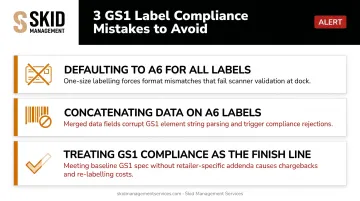
Three mistakes account for most pallet label compliance failures. Avoid them before going to print.
- Defaulting to A6 for everything. A6 is only appropriate for SSCC-only labels. When full trade item, lot, and shipping data is required, A6 forces either text below GS1's 7 mm minimum character height or barcodes compressed below minimum bar height — both fail compliance checks.
- Concatenating data on A6 labels. GS1 Rule [6-14] explicitly prohibits this. Encoding SSCC plus GTIN on an A6 label to save stock creates a non-compliant barcode regardless of whether it physically scans.
- Treating GS1 compliance as the finish line. GS1 standards define the minimum. Every major retailer — Walmart, Costco, and others — publishes vendor compliance guides that add requirements on top: specific sizes, barcode quality grades, placement tolerances, and mandatory data fields. A label that passes GS1 specs can still fail a retailer audit. Verify the receiving party's vendor guide before production, not after.
Frequently Asked Questions
What size are pallet labels?
The GS1 standard recommends two sizes: A6 (4×6 inches / 105×148 mm) for SSCC-only or minimal-data labels, and A5 (6×8 inches / 148×210 mm) for full logistics labels encoding trade item data. Most retailers specify the 6×8 inch format as their minimum for inbound supplier pallets.
Where should a pallet label be placed?
For pallets over 16 inches tall, the barcode must be positioned between 16 and 32 inches from the pallet base, at least 2 inches from any vertical edge. For shorter pallets, place the label as high as possible. GS1 recommends labeling two adjacent sides for maximum scan accessibility.
What information must be included on a pallet label?
The SSCC encoded in a GS1-128 barcode (AI 00) is the only mandatory element. Common optional fields include GTIN, batch/lot number, expiration date, item count, and ship-to information. Retail DC shipments typically require all of these optional fields.
What is the difference between an A5 and A6 pallet label?
A6 (4×6 inches) is a compact format for SSCC-only labels with limited data. A5 (6×8 inches) accommodates full trade item data, routing information, and multiple Application Identifiers, making it the right choice for most commercial outbound shipping scenarios.
Does Walmart have specific pallet label size requirements?
Walmart's supplier compliance documentation includes requirements for pallet label data fields, barcode quality, and placement. The 6×8 inch format is the standard for retail supplier pallets. Verify current specifications directly through Walmart's supplier portal before shipping.
What happens if a pallet label is the wrong size?
Undersized labels produce barcodes that fail automated dock scans, forcing manual intervention and delaying receiving. Under retailer vendor compliance programs, this typically results in chargeback deductions — and repeat violations can escalate to supplier performance reviews or de-listing.