](https://file-host.link/website/skidmanagementservices-4yg7r9/assets/blog-images/292a0a2c-e52d-45b9-8969-850774835d69/1785658180869300_1b8915576f3e4fad80410243f33934bb/360.webp)
Corner protectors look like a simple fix: slap them on, strap it up, done. But results vary a lot depending on material choice, placement, strap tension, and how the load is actually built. Get any one of those wrong, and the protector becomes decoration instead of protection.
This guide walks through the exact steps to stop load shifting with corner protectors, what you need before you start, the variables that determine success, and the mistakes that trip up even experienced dock crews.
Key Takeaways
- Corner protectors give straps a rigid anchor, turning tension into containment
- Overhang, wrong sizing, and under-tensioned straps cause most shifting failures
- Material choice should match load weight, moisture exposure, and reuse plans
- Success requires pairing protectors with proper strap alignment, tension, and stretch wrap
How to Reduce Pallet Load Shifting With Corner Protectors
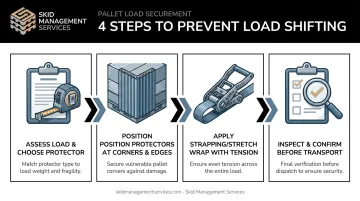
Following these four steps in order prevents the shifting failures that show up most often on receiving docks.
Step 1: Assess the Load and Choose the Right Protector
Before you touch a protector, confirm three things: load weight, stack height, and whether cartons sit fully within the pallet footprint. Overhang defeats the whole system before you even start.
Match material to conditions:
- Cardboard or paperboard: dry, single-use shipments where cost matters more than reuse
- Plastic: wet environments, reusable programs, or repeated handling cycles
- Wood or engineered board: heavy stacking loads needing maximum crush resistance
Select a leg length long enough to reach every point where a strap will make contact. A protector that's too short leaves the top or bottom strap unsupported, and that's exactly where cartons start to crush.
Skid Management Services stocks both cardboard and plastic corner protectors, along with the strapping and stretch film needed to complete the load, so sourcing stays simple.
Step 2: Position Protectors at Every Exposed Corner and Edge
Place protectors on all four corners, minimum. For heavier or taller loads, add mid-edge protectors under each strap intersection, not just the corners.
Align the longest leg toward the strap line. This gives you maximum contact area and spreads the force instead of concentrating it on one narrow edge.
Check that protectors sit flush against the load with no gaps. A gap means the protector can shift or twist during handling, which puts you right back where you started.
Step 3: Apply Strapping or Stretch Wrap With Correct Tension
Center straps directly over the protectors. Off-center straps concentrate tension on one side of the protector instead of distributing it evenly, and that's a common cause of slippage.
Pre-tension enough to secure the load without crushing cartons. Protectors let you run higher tension safely, but that doesn't mean unlimited tension. Restraint still matters. According to Mosca's strapping guidance, polypropylene strap operates in a 4%-10% working-stretch range, which affects how much tension actually reaches the load versus how much gets absorbed by the strap itself.
Wrap stretch film around the full perimeter, not just the corners. Film controls movement between individual cartons. Corner protectors alone won't stop a box in the middle of a layer from sliding.
Step 4: Inspect and Confirm Before Transport
Do a final walk-around before the load leaves the dock:
- Check every protector: confirm none has slipped, cracked, or been knocked loose during wrapping
- Confirm squareness: the load should sit inside the pallet profile, not bulging past any edge
- Tug-test the straps: tension can relax slightly after application, so verify it before dispatch
Skipping this step is how a properly built load still ends up damaged three states away.
When and What You Need Before Using Corner Protectors
When Corner Protectors Make Sense
This method works best for palletized loads secured with strapping or stretch wrap, particularly rigid cartons, ceramics, food cases, or stacked boxes prone to strap cutting.
It becomes less effective, or needs reinforcement, when cartons overhang the pallet footprint. Once that happens, the carton edge becomes the first point of contact instead of the protector, absorbing the impact directly.
Scale matters too. High-volume operations often benefit from automated applicator systems that place protectors consistently at line speed. Smaller operations can apply them manually without much added labor, as long as staff are consistent about placement.
What You Need to Get Started
Before running your first load with corner protectors, make sure you have:
- Protectors sized to load height, with enough leg length to reach every strap contact point
- A compatible strapping or wrapping system already in use on the dock
- Consistent supply so protector thickness and quality don't vary shipment to shipment
That last point matters more than most operations realize. If your protector stock changes suppliers every few months, your strap tension settings and placement habits have to change with it.
Sourcing pallets and packaging materials from a single national supplier helps avoid that problem. Skid Management Services works this way for food and beverage manufacturing clients, keeping perimeter protection consistent across multiple facilities and closing gaps in supply.
Operator training rounds this out. Straps centered correctly and loads squared before wrapping matter more than the protector brand you choose.
Key Parameters That Affect Load-Shifting Protection
The same corner protector can perform completely differently depending on four variables. Understanding these helps you troubleshoot before a shipment leaves, not after it arrives damaged.
Protector Material and Thickness
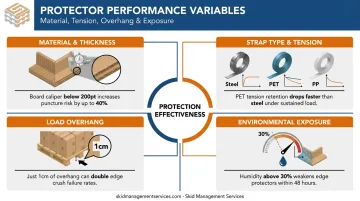
Thinner or undersized boards collapse under strap tension, losing their anchoring effect entirely. There's no universal "X-ply for Y pounds" rule that applies across every application; you need to match thickness to strap tension and validate it for the actual load, not assume it from a spec sheet.
Heavier stacked loads simply demand more rigid protectors, whether that's a thicker paperboard laminate or a heavier plastic gauge.
Strap Type and Tension Level
Steel, polyester, and polypropylene straps each apply different pressure profiles:
- Steel: high tension, low elongation, concentrated force
- PET (polyester): strong with better retained tension over time
- PP (polypropylene): more elastic, absorbs shock, but relaxes more over long transit
Proper tension paired with the right protector increases containment strength without crushing product. Mismatch the two, and you either get a load that's too loose or cartons that arrive crushed at the corners.
Load Footprint vs. Pallet Footprint (Overhang)
Overhanging cartons bypass the protector entirely and become the first point of impact. Research from Packaging Technology and Science found that even 1 centimeter of overhang caused a measurable drop in effective box compression strength. That's a small margin with a real consequence.
Even correctly placed protectors won't stop clipping, abrasion, or shifting if cartons hang past the deck edge.
Environmental Exposure
Moisture weakens paperboard protectors over time, reducing their ability to hold shape under tension. Clemson University research found that corrugated compression strength starts declining once relative humidity climbs above 30%, a threshold that's easy to hit in humid warehouses or during summer transport.
Plastic or coated protectors hold up better in humid or outdoor storage conditions, which is why environment should factor into material choice as much as weight does.
Common Mistakes and Troubleshooting When Using Corner Protectors
Common Mistakes to Avoid
- Using undersized or thin protectors that buckle under strap pressure, leaving edges unsupported
- Allowing cartons to overhang the pallet — this defeats the protector's purpose no matter how well it's placed
- Over-tensioning straps and assuming the protector alone will prevent crushing, rather than balancing both
Troubleshooting Common Load-Shifting Issues
Problem: Load still shifts during transit despite protectors. Likely cause: insufficient strap tension, or protectors placed off-center from the strap line. Re-align straps directly over the protectors and re-test tension before dispatch.
Problem: Protectors repeatedly fall off or crack. Likely cause: pallet overhang causing the protector to get clipped during handling. Confirm cartons sit fully within the pallet footprint and square each layer as it's built, not after the stack is complete.
Conclusion
Corner protectors reduce load shifting most effectively when paired with correct sizing, precise placement, and proper strap or wrap tension. Most failures trace back to overhang or undersized protectors — the protector itself is rarely to blame, and a skipped inspection step is often the real cause.
Consistent, quality-sourced pallets and protectors make it easier to standardize this process across every shipment. Skid Management Services supplies corner boards, strapping, and stretch film alongside wood pallets nationally, which helps facilities keep perimeter protection consistent whether they're shipping from one dock or five.
Frequently Asked Questions
How do you attach and use corner protectors for pallet load restraints?
Position protectors at exposed corners and edges before strapping or wrapping. Center straps over the protector's longest leg so tension distributes evenly instead of cutting into cartons.
Why use corner protectors for pallet load restraints?
They spread strap tension across a rigid surface, stopping straps from cutting into cartons. This keeps the load square and contained during transit.
What size corner protector do I need for my pallet load?
Leg length should match stack height so the protector reaches every strap contact point. Thickness should scale up with load weight — heavier or taller loads need thicker, longer protectors.
Can corner protectors be reused, or are they single-use?
Plastic protectors are typically reusable across multiple shipments. Cardboard and paperboard versions are generally single-use since moisture and repeated crushing weaken them fast.
Do corner protectors work with both stretch wrap and strapping?
Yes, and they're most effective combined. Wrap controls lateral movement between cartons, while straps handle vertical compression at the edges.
What's the difference between plastic and cardboard corner protectors for load stability?
Plastic resists moisture and holds up to reuse. Cardboard is more cost-effective for dry, single-use shipments but weakens faster under repeated strap stress or humidity.