Warehouses running high SKU counts often struggle with inconsistent load geometry, slow piece-picking, and error-prone manual handling. When every pallet in a program carries a single, predictable product, forklift operators, pickers, and robots all know exactly what they're dealing with.
That predictability matters more every year. Automated storage and retrieval systems (AS/RS), robotic palletizers, and conveyor-fed picking lines all depend on consistent box and pallet geometry to function without jams or misreads. This article breaks down what homogeneous pallets are, how they compare to heterogeneous and rainbow pallets, the main material types available, and how to choose the right one for your operation.
Key Takeaways
- Homogeneous pallets carry one SKU with consistent dimensions, simplifying picking and automation.
- Heterogeneous pallets mix multiple SKUs; rainbow pallets stack SKU-specific layers instead.
- Wood, plastic, and metal each serve different load, hygiene, and budget needs.
- Choice hinges on load weight, automation compatibility, and supplier reliability.
What Is a Homogeneous Pallet?
A homogeneous pallet is loaded with a single product type at a known, consistent size, typically picked one box at a time from a fixed location in the warehouse. There's no guessing about dimensions, weight, or fragility since every unit on the pallet is identical.
GS1's logistics standards give this concept a formal definition. A homogeneous unit contains one trade-item type and shares the same GTIN at the highest packaging level, while a heterogeneous unit mixes different trade items with different GTINs on the same load.
That distinction isn't just paperwork. It determines what data can go on a logistics label and how a receiving warehouse processes the shipment.
In daily operations, homogeneous pallets show up across three core warehouse processes:
- Palletizing — building a pallet where every layer, every box, is the same SKU
- Depalletizing — breaking down that pallet where the system (or worker) never has to check what's coming next
- Decanting — moving single-SKU cases into bins or totes for further picking, without cross-checking product codes case by case
A homogeneous pallet functions as an operational shortcut. It removes variability at the point where it causes the most delay: the pick face.
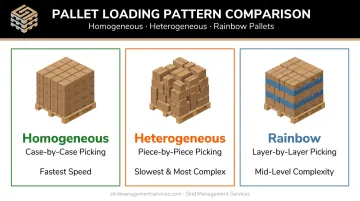
Homogeneous vs. Heterogeneous vs. Rainbow Pallets
Heterogeneous pallets carry multiple box or package types, often loaded in no particular pattern, and picked one piece at a time. A distributor consolidating a mixed store order onto one pallet is building a heterogeneous load.
Rainbow pallets sit in between. GS1's own code-list documentation describes a "case rainbow pallet" as multiple SKUs stacked in distinct layers, with at least two layers on the load. Each layer is homogeneous on its own, but the pallet as a whole mixes SKUs by layer, and it gets picked layer by layer rather than case by case.
This distinction affects daily operations in several ways:
- Homogeneous pallets support the fastest, most predictable picking since location and dimensions are known in advance
- Heterogeneous pallets require piece-level verification, which slows manual picking and complicates automated handling
- Rainbow pallets need layer-picking equipment or software logic that tracks which layer contains which SKU
Warehouses standardizing on homogeneous loads wherever possible reduce the number of decision points a picker or robot has to process per pallet.
Why Homogeneous Pallets Matter in Warehousing
Picking speed and inventory accuracy both improve when box dimensions and locations are known ahead of time. A picker who doesn't have to verify SKU on every single case moves faster and makes fewer mistakes. That's the qualitative case for homogeneity, and it holds up across warehouse operations regardless of industry.
Homogeneous loads also make a difference because automated systems are engineered around consistent geometry. AS/RS platforms and robotic palletizers check pallets on entry for dimensions, weight, and load distribution. Swisslog notes that AS/RS induction profiles identify dimensions, weight, load distribution, and precise positioning before a pallet is accepted into automated storage. Even small deviations can trigger misalignment or downtime.
A few data points illustrate what's achievable when layer and load consistency is high:
- Layer-picking installations have reported throughput as high as 180 to 400 layers per hour in vendor case studies
- One installation automated 90% of dispatched volume using consistent layer geometry
- Industry benchmarks (WERC) cite medians around 20 pallets picked and shipped per person-hour, though these figures span mixed load types and aren't a direct homogeneous-versus-mixed comparison
To be clear, no controlled study proves homogeneous pallets are, say, exactly 30% faster than mixed loads. What's well-documented is the mechanism: removing SKU and geometry variability removes decision points, and fewer decision points mean fewer errors and faster cycles.
Some advanced vision-guided robots, like ABB's depalletizer, can handle changing SKUs and shapes on the fly. Most warehouses don't have that level of automation sophistication yet, though, which makes homogeneous loads the more practical standard for now.
Types of Homogeneous Pallets
Homogeneous pallets aren't one-size-fits-all. The single-SKU load sitting on top might be identical across programs, but the pallet base underneath varies by material, and that choice affects durability, hygiene, weight, and total cost.
Choosing the right base material shapes how well the load performs in storage, in transport, and inside automated handling systems. Here's how the three main options stack up.
Wood Homogeneous Pallets
A wood homogeneous pallet is a single-SKU load built on a standard wood base, typically stringer or block construction. Wood's rigidity, combined with standardized footprints like 48x40, supports consistent single-SKU stacking patterns that most warehouse racking is already designed around.
Why wood remains the default choice:
- Lower cost than plastic or metal alternatives
- Easier to repair and recycle at end of life
- Broad compatibility with existing racking and handling equipment
- Available in stringer, block, wing, and double-wing configurations depending on load and entry requirements
Wood pallets crossing international borders need ISPM-15 heat treatment, which requires a minimum wood-core temperature of 56°C sustained for at least 30 minutes, plus an official IPPC stamp.
Skid Management Services runs a dedicated ISPM-15 verification and re-stamping program, including corridor support for Port of Baltimore exporters. This keeps pallets from getting rejected at the port over a smudged or missing mark.
Best suited for:
High-volume domestic warehousing, food and beverage manufacturing, and general manufacturing where cost efficiency and repairability matter most.
For food-grade programs specifically, new kiln-dried heat-treated (KD HT) pallets are typically recommended. They carry no chemical treatment history and no prior-load contamination risk, which matters under FSMA's Preventive Controls rule and GFSI standards like SQF and BRCGS.
Sourcing treated wood pallets from a national supplier network, such as Skid Management Services, keeps large-scale homogeneous pallet programs supplied without gaps.
SMS backs this with owned inventory plus an expansive supplier network, serving anchor clients like Campbell Snacks, Knouse Foods, and Hain Celestial Group across sizes including GMA 48x40, 48x48, 42x42, and 44x44.
Limitations: Wood is susceptible to moisture damage, splintering, and dimensional inconsistency if not sourced from a quality-controlled supplier. Grading systems (Grade A, Grade B, Utility) help manage this risk when buying recycled stock.
Plastic Homogeneous Pallets
A plastic homogeneous pallet is a single-SKU load built on a molded plastic base. Uniform molding delivers precise, repeatable dimensions that suit both automated handling and hygienic environments.
What sets plastic apart:
- No nails, no splinters, no risk of loose fasteners entering product zones
- Resists moisture absorption far better than untreated wood
- Longer service lifecycle than a standard wood pallet under normal cycling
- Falls outside ISPM-15 scope entirely, since it isn't raw wood packaging material
Best suited for: Pharmaceutical, cold storage, and export applications where hygiene and dimensional precision outweigh upfront cost. Nonporous plastic surfaces can be hot-washed, steamed, or chemically sanitized, which matters for cleanroom and controlled-environment programs.
Trade-offs: Higher upfront cost than wood, risk of deformation under excessive static loads, and no practical repair option once damaged. A cracked plastic pallet typically gets replaced, not fixed.
Metal Homogeneous Pallets
A metal homogeneous pallet uses a steel or aluminum base to support very heavy, uniform loads without deformation. The rigid frame handles conditions that would crush or warp wood or plastic over time.
Where metal earns its cost:
- Higher load capacity and impact resistance than wood or plastic
- Long service life under repeated heavy-duty cycling
- Easy to sanitize, which suits food-adjacent industrial applications
Skid Management Services distributes steel sheet metal storage pallets for exactly these scenarios, supplying industrial shipping, manufacturing, and heavy-duty storage operations across its Greater Philadelphia, Lehigh Valley, and South Jersey service markets, with national reach through its supplier network.
Best suited for: Heavy manufacturing, automotive, and metal industry warehousing where loads are dense and uniform. Published capacities vary widely by manufacturer and support condition. Some steel pallets rate as low as 2,500 lb on unsupported racking, while heavier-duty aluminum designs rate into the tens of thousands of pounds statically.
Trade-offs: Metal is the heaviest option, which raises freight costs, and it carries the highest upfront investment of the three materials.
Homogeneous Pallet Sizes: Full, Half & Quarter Loads
Material isn't the only variable. Footprint size matters just as much for automation compatibility and SKU volume matching.
- Full-size pallets — the North American standard is 48x40 inches, while the EPAL Euro pallet standard runs 1,200 x 800 mm with a safe working load of 1,500 kg
- Half pallets — roughly half the footprint of a full pallet, used for smaller SKU quantities or tighter aisle and automation space; EPAL's half-pallet products run 800 x 600 mm
- Quarter pallets — sized for very low-volume SKUs or retail-ready display picking, commonly around 600 x 400 mm
Skid Management Services stocks a 24x40 half wood pallet and a 20x24 quarter wood pallet for exactly these lower-volume, retail-ready use cases, plus a 24x24 custom small-footprint option for non-standard load configurations. Any of these can be engineered to a specific dimension when a standard size doesn't fit the product.
How to Choose & Finalize the Right Homogeneous Pallet
The right type, material, and size depend on load weight, automation needs, and budget, not on whichever option sounds most advanced. A metal pallet isn't automatically "better" than wood if your load never exceeds a few hundred pounds.
Factors to Consider
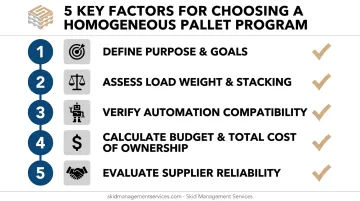
Work through these before committing to a program:
- Define purpose and goals — domestic distribution, export compliance, or fully automated storage all point toward different specs
- Assess load weight and stacking requirements — know your static and dynamic load capacity needs per SKU before picking a material
- Verify automation compatibility — check dimensional tolerance requirements for any robotic palletizer or AS/RS system in your chain
- Calculate budget and total cost of ownership — weigh purchase price against repair, replacement, and freight costs over the pallet's life
- Evaluate supplier reliability — a national supplier with a broad network, such as Skid Management Services, helps ensure consistent quality and uninterrupted supply for ongoing pallet programs
What to Check Before Finalizing
A few final checks prevent expensive surprises down the line:
- Don't over-spec. Skip metal if a well-built wood pallet already meets your load requirement.
- Confirm ISPM-15 compliance for any wood pallet headed for export. A missing or unauthorized stamp can get a shipment rejected, fumigated, or destroyed at the buyer's expense.
- Verify dimensional consistency. Automation systems can jam or misread pallets over minor size deviations, so uniform deck-board and stringer tolerances are worth the premium for first-time automated builds.
- Confirm supply volume and lead times. A supplier who can't maintain consistent stock will disrupt your warehouse operations faster than any pallet defect will.
Conclusion
Homogeneous pallets standardize single-SKU loads, and that standardization is what makes efficient, automation-ready warehousing possible. Get the load geometry consistent, and picking speed, inventory accuracy, and automation compatibility all improve together.
Material choice (wood, plastic, or metal) and footprint size (full, half, or quarter) create genuinely different tools suited to different jobs. There's no universal "best" option — only the one that matches your load weight, automation setup, and budget.
Understanding these differences, and sourcing from a partner like Skid Management Services, which maintains consistent quality and supply across new, used, and custom-built pallets, leads to smoother operations and real cost savings over time.
Frequently Asked Questions
What is a homogeneous pallet?
A homogeneous pallet is loaded with a single SKU or box type of known, consistent dimensions. It's commonly used for efficient picking, storage, and automated handling in warehouses.
What is a half pallet called?
It's commonly called a "half pallet," typically measuring 24 x 40 inches in the U.S. — roughly half the footprint of a standard 48 x 40 pallet. The Euro equivalent, sized 800 x 600 mm, follows the same half-size logic.
What is the difference between a homogeneous and a heterogeneous pallet?
A homogeneous pallet carries one SKU with known dimensions, picked one identical case at a time. A heterogeneous pallet mixes multiple SKUs, typically picked piece by piece with more handling complexity.
What is a rainbow pallet?
A rainbow pallet is a mixed-SKU load built from homogeneous layers, meaning each layer holds one SKU but different layers hold different products. It's picked layer by layer rather than case by case.
Are homogeneous pallets better for automated warehouses?
Generally, yes. Consistent dimensions and known SKU locations make homogeneous pallets easier for robotic palletizers and AS/RS systems to handle without misreads or jams.
How do I decide between a homogeneous or mixed pallet for my shipment?
It depends on SKU variety, order volume per product, and whether the receiving warehouse runs automation. High-volume single-SKU orders favor homogeneous loads, while smaller mixed orders often require heterogeneous or rainbow configurations.