
Getting this wrong costs money. Getting it right means smoother receiving, fewer damaged claims, and predictable freight costs. This guide breaks down the standard dimensions, weight ranges, grades, and construction types you need to know before your next purchase order.
TL;DR
- Standard GMA pallet measures 48" x 40" (1219 x 1016 mm), roughly 5.5–6" tall
- Grade A, B, and Utility classifications drive price, durability, and repair history
- Block and stringer construction set forklift entry and automation compatibility
- Specialty sizes (36" x 36", 42" x 42", 44" x 44", 48" x 48") serve beverage, chemical, and industrial loads
- Matching grade and construction to your operation prevents rack failures and shipment rejections
What GMA Pallet Dimensions Represent
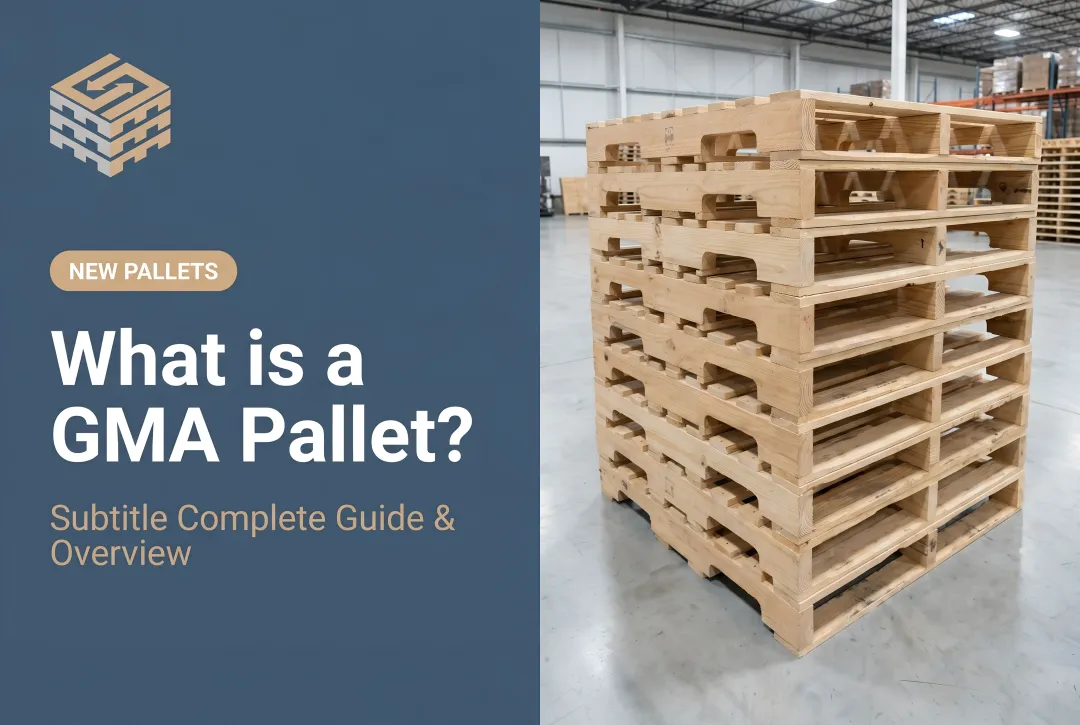
GMA stands for the Grocery Manufacturers Association, the trade group that established the 48" x 40" pallet footprint decades ago for the grocery supply chain. The organization has since rebranded as the Consumer Brands Association, but the "GMA pallet" name stuck in the industry.
The National Wooden Pallet and Container Association's 2025 Uniform Standard still references the original 1992 GMA document when defining the 48x40 stringer pallet, confirming it as the foundation for the size the industry still orders by default.
Here's the key distinction:
- Dimension is a fixed design parameter. 48" x 40" doesn't change.
- Weight and load capacity are derived operating characteristics. They shift based on lumber species, board thickness, grade, and condition.
Confusing these two categories is where a lot of buyers get into trouble.
Factors That Influence Actual Pallet Specs in the Field
Catalog sheets rarely match exactly what shows up on your dock. A few reasons why:
- Manufacturer variation in board thickness and stringer configuration, even among pallets marketed as "standard GMA"
- New vs. reconditioned condition — recycled pallets carry repair history that affects strength and sometimes actual measurements
- Wood species and moisture content, which swing empty weight noticeably
- Wear over the pallet's lifecycle, as repeated repairs change structural integrity even if the footprint stays 48x40
If you're sourcing at volume, that variance is why consistent grading beats the lowest per-unit price — the approach Skid Management Services takes across new, used, and reconditioned GMA supply.
Standard GMA Pallet Dimensions and Specifications
The 48x40 GMA pallet is governed by longstanding industry guidelines, and its construction details matter as much as the headline dimension.
Core Footprint and Construction
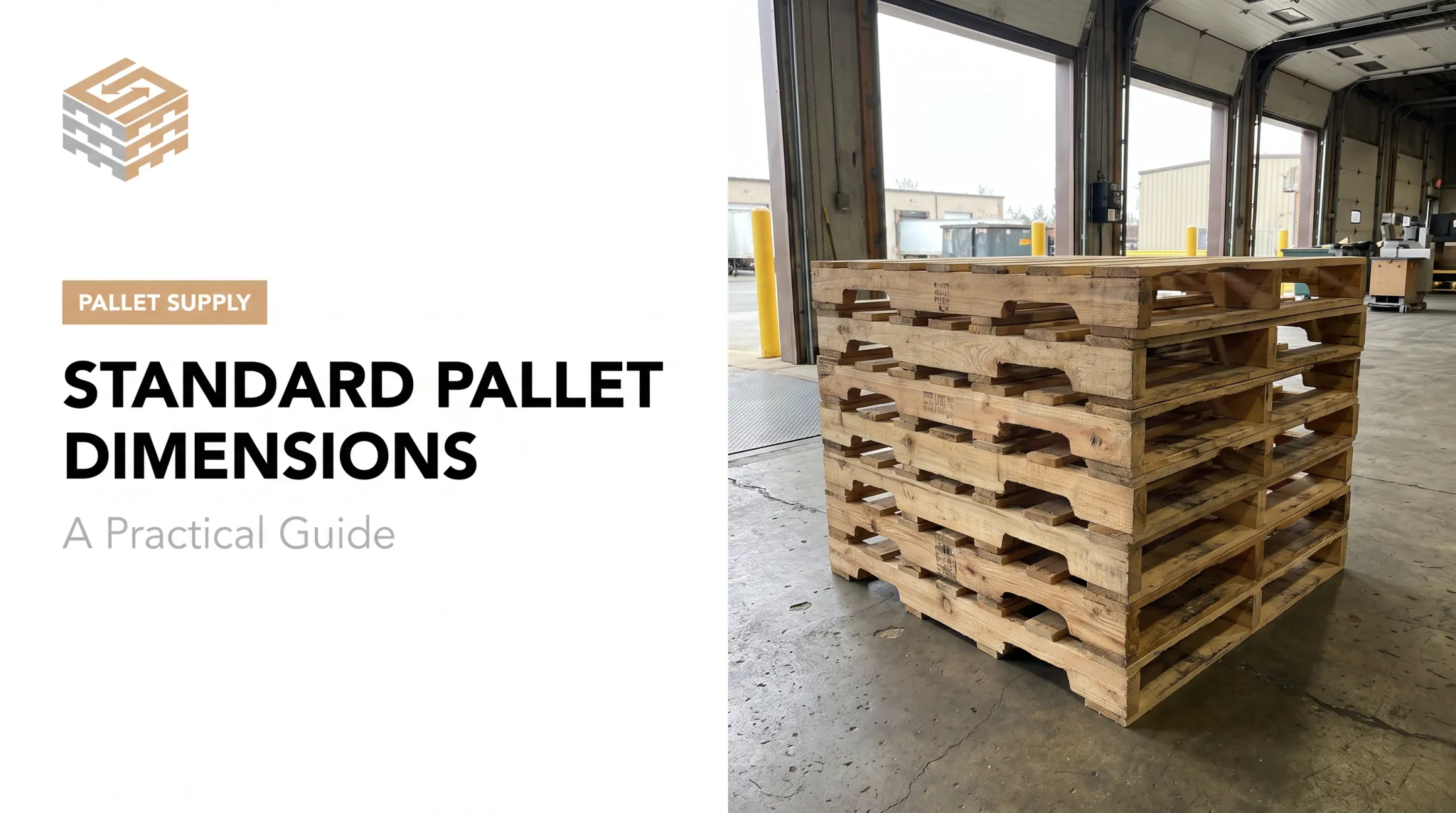
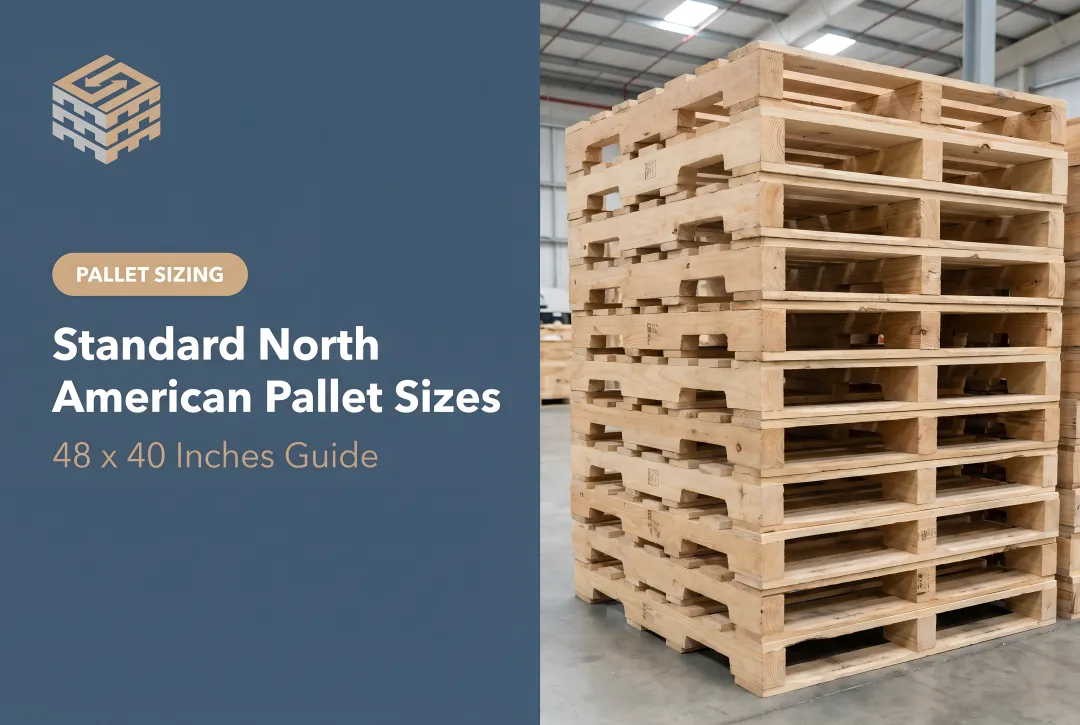
- Length x width: 48" x 40" (1219 x 1016mm), giving a usable area of roughly 13.3 sq ft
- Height: Typically 5.5-6 inches
- Entry: Four-way forklift entry via two notches per side, on the classic notched stringer design
- Board configuration: End boards run around 5.5" wide, center boards closer to 3.5"

The NWPCA's 2025 standard specifically catalogs this as the "48x40 Notched Three Stringer Pallet," and federal spec A-A-52586 aligns with this same size.
Weight and Load Capacity
Empty weight for a GMA pallet varies by lumber species, moisture content, and board thickness. There's no single fixed number, so two "identical" 48x40 pallets from different mills can feel different when you pick one up.
Load capacity is where a lot of confusion happens. Three separate figures matter:
| Load type | What it measures |
|---|---|
| Static load | Capacity while at rest, uniformly loaded |
| Dynamic load | Capacity while being moved by forklift or conveyor |
| Rack/racking load | Capacity when edge-racked, typically the lowest figure |

A Pallet Enterprise technical breakdown confirms these are genuinely different engineering tests, not interchangeable numbers. A pallet rated for a strong static load can still fail if you rack-store it beyond its racking capacity. Always ask your supplier which figure they're quoting.
Alternative GMA-Adjacent Sizes
Not every load fits 48x40. Common alternatives include:
- 48x48: chemical and drum industry standard, sized to fit four 55-gallon drums without overhang
- 42x42: telecom equipment, paint, and coatings
- 44x44: built around 275- and 330-gallon IBC totes
- 36x36: common in beer and craft-brewery distribution
- 40x40: dairy applications, sized for stacked milk crates

Skid Management Services stocks these alternative sizes alongside standard GMA pallets, including new, recycled, and custom-engineered builds for chemical, beverage, and industrial accounts.
GMA Pallet Grades and Construction Types
Grade and build type drive price, durability, and how well a pallet fits your application. Get this wrong and you're either overpaying or risking a failure.
Grading System: A, B, and Utility
- Grade A: All seven deck boards present, no broken stringers, minimal repair history. Functionally equivalent to new for most applications.
- Grade B: May carry one or two minor board repairs but retains full structural integrity, solid for general warehouse and distribution use.
- Utility Grade: The lowest-cost option, best reserved for internal flow rather than customer-facing shipments.
Research from the USDA Forest Service found that heavily repaired pallets retain about one-third the stiffness and half the racking strength of a comparable new pallet. Those figures are why heavily repaired stock should never carry critical or heavy rack loads.
Block vs. Stringer Construction
- Stringer pallets use solid wood runners. Notched versions allow partial four-way entry; unnotched versions are two-way only.
- Block pallets use corner blocks instead of solid stringers, giving true four-way entry from any side.
Block pallets cost more but suit automated systems and robotic handling better. Stringer pallets are cheaper and cover most general warehouse needs, but they're less flexible if your facility runs conveyor or AS/RS equipment that demands consistent four-way access.

How GMA Specs Are Documented, Measured, and Verified
Verify spec compliance at the receiving dock, not only against the purchase order.
Specification and Documentation
Reference points include NWPCA/CBA published guidelines and supplier data sheets. For export shipments, ISPM-15 heat-treatment stamps are the documentation that matters most, since customs will hold or reject non-compliant loads.
Measurement and Verification Methods
At minimum, verify on receipt:
- Length and width against your PO specification
- Board thickness, especially on recycled stock where repair history varies
- Entry type, confirming two-way vs. four-way matches your equipment
Field variance is more common with recycled and reconditioned pallets than with new stock, because repair history isn't standardized across suppliers.
Skid Management Services sources GMA pallets to exact grade, dimension, and volume needs through its own inventory and national supplier network, so multi-location orders stay on consistent specs.
Implications of Using Incorrect or Substandard GMA Pallets
Mismatched specs create real downstream problems for operations, safety, and cost.
- Rack instability and automation jams — undersized boards or the wrong grade can throw off conveyor and AS/RS systems designed around tight tolerances
- Accelerated failure — Grade C or heavily damaged pallets used under heavy or racked loads fail faster and pose safety risks
- Rejected shipments — retail and fulfillment centers (including Amazon FBA programs) can refuse non-compliant pallets, triggering freight costs and chargebacks
- Export violations — non-compliant wood packaging can be refused at entry, returned at the exporter’s expense, or destroyed under USDA APHIS ISPM-15 enforcement
For exporters moving freight through the Port of Baltimore corridor, stamp verification and re-stamping support prevent costly holds, returns, and destroyed loads.
Common Misconceptions About GMA Pallet Specs
A few myths worth clearing up:
- "All 48x40 pallets are structurally identical." Not true. Manufacturer, lumber species, and repair history all affect real-world performance, even at the same nominal footprint.
- "Static, dynamic, and rack load are the same figure." They're separate engineering measurements. A pallet strong under one condition can still underperform under another.
- "All GMA pallets are automatically heat-treated for export." Heat treatment isn't a default feature. ISPM-15 compliance requires a specific process and mark, and it must be verified before international shipment.
Conclusion
GMA dimensions and grades set the governing specs, not just a nominal size on a purchase order. Matching grade, construction, and load capacity to your actual operation—floor storage, rack systems, or automated handling—prevents costly failures down the line.
Working with an experienced national supplier like Skid Management Services keeps your supply consistent, whether you need standard 48x40 stock or a specialty size for chemical, beverage, or export programs.
Frequently Asked Questions
What are the dimensions of a GMA pallet?
Standard GMA pallets measure 48" x 40" (1219 x 1016mm), with a usable area of about 13.3 sq ft. Height typically runs 5.5-6 inches.
What does GMA mean for pallets?
GMA stands for the Grocery Manufacturers Association, the trade group (now the Consumer Brands Association) that created the standardized 48x40 pallet spec decades ago.
How much does a GMA pallet cost?
Cost varies by grade, material, and order volume, and it shifts with the current lumber market. Request a quote from your supplier for accurate current pricing.
How much weight can a GMA pallet hold?
Capacity depends on grade, construction, and condition, with static, dynamic, and rack-load figures all measuring different things. Rack-stored loads generally carry a lower safe capacity than floor-stacked static loads.
What's the difference between Grade A and Grade B GMA pallets?
Grade A pallets have all seven deck boards intact with no broken stringers and minimal repair history. Grade B pallets may carry one or two minor board repairs while still holding full structural integrity.
Are GMA pallets required to be heat-treated?
Heat treatment isn't required for domestic use. It's mandatory for international export under ISPM-15, which requires a 56°C core temperature for at least 30 minutes plus a compliant stamp.