According to the National Wooden Pallet and Container Association, more than 1.8 billion pallets are in service in the United States, and 93% are made from wood. That scale means species selection isn't a minor detail — it directly affects weight capacity, longevity, shipping costs, and regulatory compliance.
This guide covers the hardwood vs. softwood distinction, the most common wood species used in U.S. pallet production, how to choose the right wood for your operation, and what treatment requirements apply when shipping internationally.
Key Takeaways
- Southern Yellow Pine (SYP) and oak are the two most widely used pallet wood species in the U.S.
- Hardwoods offer greater density, load capacity, and longevity; softwoods are lighter, cheaper, and easier to kiln-dry
- The right species depends on load weight, industry application, reuse frequency, and budget
- Wood pallets crossing international borders must comply with ISPM-15 heat treatment standards
- Mixed hardwood pallets deliver durability across multiple species at a lower cost than single-species oak
Hardwood vs. Softwood: Understanding the Basics
The hardwood/softwood distinction is botanical, not a hardness rating. According to the USDA Forest Products Laboratory Wood Handbook, hardwoods are angiosperms (broad-leaved, typically deciduous trees) and softwoods are gymnosperms (conifers/evergreens). The names can mislead: longleaf pine, a softwood, registers 5,200 N side hardness — harder than yellow-poplar, a hardwood, at 2,400 N.
What actually drives pallet performance is wood density, measured by specific gravity — and the species breakdown below shows why that matters more than the hardwood/softwood label.
How Density Affects Pallet Performance
Denser wood holds nails more securely and holds up longer under repeated loading. Here's how common pallet species compare using USDA FPL data:
| Species | Specific Gravity | Side Hardness |
|---|---|---|
| White oak | 0.68 | 6,000 N |
| Red oak | 0.63 | 5,400 N |
| Longleaf pine | 0.59 | 5,200 N |
| Slash pine | 0.59 | 5,200 N |
| Loblolly pine | 0.51 | 4,200 N |
| Douglas-fir | 0.48 | 3,100 N |
| Sitka spruce | 0.40 | 2,200 N |
| Yellow-poplar | 0.45 | 2,400 N |
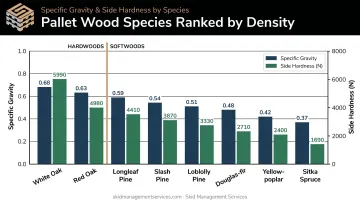
Note: Values are for clear, straight-grained specimens — not pallet-grade lumber, which will vary.
Hardwood vs. Softwood Trade-Offs
Hardwoods tend to win on durability:
- Higher load-bearing capacity from greater density
- Superior nail-holding strength
- Longer service life under repeated use
- Better suited for multi-trip and pooled pallet programs
Softwoods offer practical cost and logistics advantages:
- Lighter weight reduces per-unit freight costs
- Lower purchase price at equivalent dimensions
- Faster growth cycle supports more sustainable sourcing
- Kiln-dries more easily, reducing moisture and mold risk
The Most Common Pallet Wood Species Used in U.S. Manufacturing
Research from Virginia Tech's Center for Packaging and Unit Load Design, along with a USDA Forest Service study (Bush & Araman, 2009) tracking U.S. pallet production trends, identifies Southern Yellow Pine and oak as the dominant species in American pallet manufacturing by volume.
Southern Yellow Pine (SYP)
SYP is not a single species. It's a commercial classification covering four related pines: loblolly (Pinus taeda), longleaf (Pinus palustris), shortleaf (Pinus echinata), and slash pine (Pinus elliottii). Density profiles are similar across the group, though loblolly pine grades toward the higher end.
SYP dominates U.S. pallet production for practical reasons:
- Grows throughout the southeastern U.S. with deep mill infrastructure supporting consistent supply
- Performs well with high-speed automated nailing equipment used in modern pallet shops
- Kiln-dries efficiently, making it the go-to choice for moisture-sensitive industries
- Costs less per unit than hardwood at comparable dimensions
Kiln-dried SYP pallets are standard in food manufacturing, pharmaceutical supply chains, and cold storage programs where moisture control matters. Skid Management Services supplies kiln-dried softwood pallets (pine, spruce, and fir) for food-grade and FDA-regulated applications, including programs for Campbell Snacks, Knouse Foods, and Nissin Foods operating under FSMA and GFSI standards.
Oak
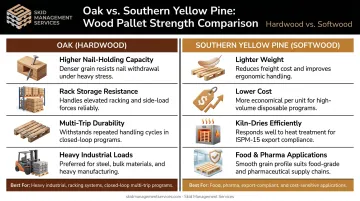
Where SYP offers cost and supply advantages, oak trades those for raw density and durability. Oak pallets sit at the heavier end of the hardwood spectrum. White oak registers 0.68 specific gravity and 6,000 N hardness; red oak comes in at 0.63 / 5,400 N — both figures are well above loblolly pine's 0.51 / 4,200 N.
That density translates directly into pallet performance:
- Higher nail-holding capacity reduces board separation under heavy loads
- Greater resistance to racking and deflection in rack storage
- Longer service life in multi-trip programs where pallets cycle hundreds of times
Oak pallets are the standard choice for heavy industrial applications: steel and metal components, machinery, bulk chemicals, automotive parts. USDA research identifies reusable pallets as one of oak's major industrial product markets. Both red and white oak are used in pallet production; most pallet shops do not sort by variety, so a single pallet may contain boards from both.
Other Wood Species Found in Pallet Production
Hardwood Alternatives: Mixed Hardwood Pallets
Beyond oak, a range of hardwood species regularly appear in pallet lumber: poplar, maple, ash, beech, birch, and sweetgum. These are most often blended together as mixed hardwood pallets — combining offcuts and surplus lumber from multiple species.
Mixed hardwood pallets offer a practical middle ground:
- More durable than softwood for heavier applications
- Less expensive than single-species oak
- Regional availability drives the blend — a pallet from the Mid-Atlantic may contain different species than one from the Midwest
Skid Management Services stocks oak, maple, and mixed hardwood pallets across the full standard size range — useful when load weight or cycle frequency rules out softwood.
Softwood Alternatives by Region
SYP dominates the eastern U.S., but availability shifts heading west:
- Douglas-fir — the primary pallet softwood on the U.S. West Coast, with a specific gravity of 0.48 and 3,100 N hardness; stronger than spruce, though below SYP's upper range
- Spruce (Sitka at 0.40 / 2,200 N, Engelmann at 0.35 / 1,800 N) — less dense than SYP, requiring careful design to compensate for lower strength ratings
- Hemlock and true firs — common in Pacific Northwest production where SYP supply is limited
Globally, species vary by what's locally abundant and cost-effective. Rubberwood, for instance, is common in Southeast Asian pallet production — each region uses what's close, cheap, and structurally sufficient for local load requirements.
How to Choose the Right Pallet Wood for Your Needs
No single species is universally correct. Four variables determine the right choice.
Load Weight and Application
- Heavy loads (steel, machinery, bulk chemicals, loads over roughly 2,000 lbs): oak or mixed hardwood for density and nail-holding strength
- Lighter consumer goods, food products, retail: SYP pallets deliver adequate performance at lower cost
- Food, pharmaceutical, cold storage: kiln-dried softwood — moisture control and a clean contamination profile outweigh the weight difference
Single-Use vs. Multi-Trip
This is where the economics shift most sharply:
- Single-use / one-way pallets — shipped to a destination and not returned. Softwood reduces per-unit cost since the pallet only needs to make one trip.
- Multi-trip / pooled pallets — cycling through a supply chain repeatedly. Hardwood's greater durability justifies the higher upfront cost.
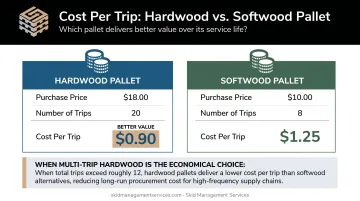
The right framing is cost per trip, not purchase price. A hardwood pallet at $18 that survives 20 trips costs $0.90 per trip. A softwood pallet at $10 that handles 8 trips costs $1.25 per trip. The math favors hardwood in closed-loop programs.
Skid Management Services supplies both softwood single-use pallets and hardwood multi-trip builds. For operations running 500+ pallets per month, their closed-loop pallet management programs — covering supply, pickup, and recycling under one vendor — typically offset 15–40% of new pallet spend through trade-in credits.
Supplier Consistency
Selecting the right wood species only delivers value when supply stays consistent. Disruptions in grade or species mid-program create quality variance that undermines the original decision.
Skid Management Services combines its own inventory with an expansive supplier network, so customers maintain a consistent species and grade specification across locations — without managing multiple vendor relationships.
Wood Treatment Requirements: What Pallet Buyers Need to Know
ISPM-15: The International Standard
Any solid wood pallet or packaging material crossing international borders must comply with ISPM-15 (International Standards for Phytosanitary Measures No. 15), administered by the IPPC. The standard eliminates the risk of transporting invasive insects and pathogens via wood packaging.
The official ISPM-15 heat treatment requirement: wood must reach a minimum core temperature of 56°C for 30 continuous minutes throughout the wood profile, including the core.
Reading the IPPC Stamp
Every compliant pallet carries a mark with four required elements:
- IPPC two-leaf symbol: the internationally recognized phytosanitary logo
- ISO country code: "US" for U.S.-treated wood
- Unique treatment provider ID: issued by USDA APHIS to the licensed treatment facility
- Treatment code: "HT" for heat treatment; "MB" for methyl bromide fumigation
A missing, smudged, or post-treatment unauthorized stamp is grounds for shipment rejection at the destination port. Buyers can also request a certificate of compliance from their supplier.
Skid Management Services sources ISPM-15 heat-treated pallets through USDA APHIS-recognized treatment providers and supports export compliance audits with full documentation on request.
Domestic vs. Export Requirements
An important distinction:
| Shipment Type | ISPM-15 Required? |
|---|---|
| International (imports & exports) | Yes — mandatory |
| Domestic U.S. only | No |
Many domestic buyers in food manufacturing, pharmaceutical production, and cold storage specify kiln-dried (KD) lumber regardless of export status. Reduced moisture content improves structural stability, inhibits mold, and supports food safety compliance under FDA FSMA and GFSI frameworks.
KD and HT are not automatically interchangeable. Kiln drying satisfies ISPM-15 only when the process reaches the required heat treatment parameters and the wood is certified and stamped by a recognized provider.
Frequently Asked Questions
How do you tell if a pallet is oak or pine?
Oak is noticeably heavier, has a tighter grain pattern that can appear slightly "fuzzy" on cut edges as it ages, and resists saw blades more than pine. Pine is lighter, often shows resin pockets at knotholes, and gives off a distinctive pine scent when freshly cut or sanded.
Are pallets made of real wood?
Yes — the vast majority of pallets in the U.S. are made from real, solid wood. The NWPCA reports that 93% of the 1.8 billion pallets in U.S. service are wood, primarily Southern Yellow Pine and oak. Plastic and composite pallets exist but remain a small share of the market.
What is the most common wood used in pallet manufacturing?
Southern Yellow Pine and oak are the two most widely used species in U.S. pallet production, according to a USDA/Virginia Tech study (Bush and Araman, 2009) on U.S. production trends. SYP leads in volume, particularly across the eastern U.S.
Is hardwood or softwood better for pallets?
Neither is universally better. Hardwood is stronger and more durable for heavy loads and multi-trip programs; softwood is lighter, less expensive, and better suited for single-use or weight-sensitive applications. The right answer depends on load requirements and how many times the pallet will be used.
Do wood pallets need to be heat treated?
Heat treatment is required only for pallets used in international shipping under ISPM-15. Domestic pallets have no treatment requirement, though kiln-dried lumber is often specified for food, pharmaceutical, and cold storage applications where moisture control matters.
Why is Southern Yellow Pine so widely used for pallets?
SYP is abundant across the southeastern U.S., priced below hardwood alternatives, compatible with automated pallet manufacturing equipment, and kiln-dries efficiently. For eastern U.S. pallet manufacturers running high-volume programs, no softwood checks more boxes at once.