Lumber grade and wood species work together to determine a pallet's strength, cost, compliance status, and how many trips it survives before needing repair. Get either one wrong, and you're either overpaying for capacity you don't use or under-building for the load you're shipping.
This guide breaks down the grading systems that matter, compares hardwood and softwood species, and walks through how to match lumber grade to your actual shipping requirements, not just the lowest quote on the table.
Key Takeaways
- Knots, wane, splits, and warp are the defects that set pallet lumber grade and price
- Softwood Grade #3 and Hardwood #3 Common/Industrial handle most standard pallet production
- Southern Yellow Pine now outproduces hardwood in U.S. pallets, though hardwood still wins for heavy loads
- Grade selection should hinge on load weight, reuse cycle, and budget, not sticker price alone
What Is Pallet Grade Lumber?
Pallet grade lumber is wood graded for structural performance, not appearance. Furniture makers care about grain pattern and color-matching. Pallet manufacturers care about whether a board holds a 2,000-pound load without splitting at the stringer notch.
Grading agencies inspect visible defects to sort lumber into tiers:
- Knots: size and location relative to load-bearing points
- Wane: missing wood or bark along the board's edge
- Splits and checks: cracks running with or across the grain
- Bow, crook, and twist: warping that affects stacking and nailing
- Decay: fungal damage that weakens fiber strength
The National Hardwood Lumber Association (NHLA) sets grading rules for hardwood species. The American Lumber Standard Committee (ALSC) accredits the agencies that grade softwood under the PS 20 standard.
The National Wooden Pallet & Container Association (NWPCA) publishes its own five-tier classification built specifically for pallet components:
- Select
- Premium
- Standard
- Utility
- Economy
Here's the part that trips up a lot of buyers: "pallet grade" almost always means the lower-to-mid tiers of these systems. Top hardwood grades like FAS and Select get pulled for cabinetry, flooring, and millwork, where clear, unblemished faces command a premium.
What's left after those cuttings, boards with more knots and less cosmetic appeal, is exactly what pallet manufacturers want. It's structurally sound, it's cheaper, and nobody's shipping a pallet to a furniture showroom.
Types of Lumber Grades Used in Pallets
Softwood and hardwood use entirely separate grading scales, developed by different agencies for different purposes. Both systems push pallet-grade material toward the lower end, not because it's inferior wood, but because cosmetic defects don't matter when the board's job is holding a shrink-wrapped skid of canned goods.
Softwood Grades for Pallets
Softwood dimensional lumber runs on a numbered scale, with each step down allowing more visible defects:
- Grade #2: Moderate knots and wane, used mainly for general framing; occasionally blended into pallet stock when priced competitively against #3.
- Grade #3: The pallet industry's workhorse grade, allowing more knots and wane than #2 while retaining enough strength for crates, pallets, and concrete forming; most standard warehouse pallets use it.
- Grade #4 (Economy): Multiple visible defects but still kiln-dried and standard-sized, common for dunnage, bracing, and single-use pallets.
Exact defect allowances vary by grading agency and species group, so "Grade #3" from one mill isn't automatically identical to another's.
Hardwood Grades for Pallets
Hardwood grading works on a cutting-yield system rather than a simple numbered scale. FAS, Select, and No. 1/No. 2 Common grades are reserved for furniture and millwork. They require a minimum percentage of clear, defect-free cuttings from each board's face.
No. 3 Common, often called Industrial grade, is where pallet lumber lives. It requires far less clear-face yield than the grades above it, meaning more knots and more visible-but-sound defects at a lower price per board foot.
None of that matters for a stringer buried under a load. What matters is whether the wood holds its shape and takes a nail without splitting.
The #3 vs #4 Decision for Pallet Buyers
Choosing between #3 and economy #4 lumber comes down to how many times the pallet needs to survive a forklift, a truck ride, and a warehouse stack.
| Factor | Grade #3 | Grade #4 / Economy |
|---|---|---|
| Defect tolerance | Lower | Higher |
| Strength | Higher | Lower |
| Best for | Reusable/returnable pallets, heavy or fragile loads | One-way shipments, dunnage, bracing |
| Cost | Higher per board foot | Lower per board foot |
No universally verified price gap exists between #3 and #4, since costs shift by mill, region, and season. But a USDA Forest Service study on softwood grades found that starting grade meaningfully affects usable output: southern pine No. 2 stock yielded 62% Grade 2-or-better pallet parts, compared to just 36% from No. 3 stock.
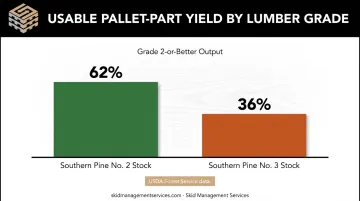
The lesson applies just as well to the #3-versus-#4 decision. A cheaper grade that generates more cutting waste and rework can erase its price advantage fast.
If your pallets run through a closed-loop or returnable program, the extra strength in #3 pays for itself over multiple trips. If it's a one-way export shipment broken down at the destination dock, #4 economy grade often makes more sense.
Hardwood vs. Softwood: Choosing Wood Species for Pallets
Here's a common mix-up: hardwood and softwood classifications describe the type of tree (deciduous versus coniferous), not how hard or dense the wood actually is. Balsa is technically a hardwood despite being softer than pine. For pallets, species selection matters more than the label itself.
Common Hardwood Species Used in Pallets
Oak, maple, hickory, birch, and poplar make up the bulk of hardwood pallet stock. Their density gives them a real edge for demanding applications:
- Higher load capacity for heavy machinery, automotive parts, and industrial equipment
- Better fastener retention, meaning nails and staples hold tighter through repeated handling
- Longer service life in returnable or pooled pallet systems that see dozens of trips
Hardwood forests are concentrated in the northeastern and north-central United States, which shapes where mills operate and how far lumber travels before reaching a pallet manufacturer. That regional concentration is one reason hardwood pallets often cost more the farther you are from those source forests.
Industry experience also shows mixed hardwood components typically outperforming mixed softwood on strength and stiffness, a notable benefit for anyone shipping heavy or fragile loads through a returnable program.
Common Softwood Species Used in Pallets
Southern Yellow Pine, spruce, fir, and general pine species dominate softwood pallet production. They grow faster than hardwood species, cost less per board foot, and weigh less, a real advantage when freight is priced by weight.
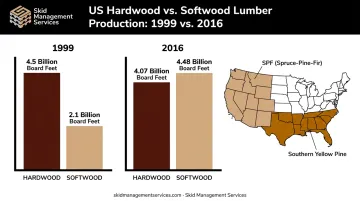
That combination has reshaped the U.S. pallet industry. In 1999, new pallet production used 4.5 billion board feet of hardwood versus just 2.1 billion board feet of softwood.
By 2016, the mix had flipped: 4.07 billion board feet of hardwood versus 4.48 billion board feet of softwood, according to a Virginia Tech and USDA Forest Service study on U.S. pallet material use. Softwood now makes up the majority of new pallet lumber nationwide.
Regional sourcing still matters. Southern Yellow Pine dominates production across the South, while SPF (Spruce-Pine-Fir) species dominate sourcing out West, a split that affects pricing and lead times depending on where pallets are manufactured and shipped from.
Common Uses and Benefits of Pallet Grade Lumber
Matching Grade to Application
The right grade depends entirely on what's riding on the pallet and how many times it needs to make the trip.
- Grade #3 softwood or #3 Common hardwood: standard warehouse pallets, reusable and returnable programs, general distribution
- Grade #4/economy: single-use shipments, export loads discarded at destination, lightweight consumer goods
- Hardwood: heavy machinery, automotive parts, high-value goods where product damage costs far more than the pallet
- Softwood: lighter, high-volume consumer goods where weight and unit cost matter more than repeated reuse
A food manufacturer shipping canned goods on a closed-loop program has very different needs than an exporter sending a one-way container overseas. Matching grade to that specific use case is where cost savings actually show up.
Key Benefits of Using Graded Lumber
Buying the correct grade, not the most expensive and not the cheapest, delivers three concrete advantages.
Cost-efficiency. Overpaying for premium clear lumber on a one-way shipment is money that never comes back. Matching grade to actual load requirements means you're not funding strength or appearance nobody needed.
Sustainability. Lower pallet grades put lumber to work that would otherwise go to waste. Boards that don't meet furniture-grade cutting yields, too many knots for a cabinet door, still have plenty of structural life left.
The pallet industry remains one of the largest domestic consumers of lower-yield hardwood and softwood output, keeping usable fiber out of the burn pile.
Compliance and safety. Properly graded lumber that's also kiln-dried and heat-treated meets both domestic GMA/NWPCA pallet standards and international ISPM-15 requirements for export shipments.
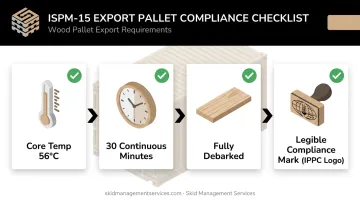
Under ISPM 15, wood packaging crossing international borders must reach a core temperature of 56°C for at least 30 continuous minutes, be debarked, and carry a legible compliance stamp, according to the IPPC's ISPM 15 regulation.
Skip any of those elements, and customs can reject the shipment at the port, sometimes at the exporter's expense. Exporters shipping through corridors like the Port of Baltimore rely on suppliers such as Skid Management Services to verify stamps and coordinate re-stamping before containers ever reach the dock.
How to Choose the Right Pallet Lumber for Your Business
Before requesting quotes, walk through three questions:
- How heavy and fragile is the load? Heavier or more fragile goods justify hardwood or a higher softwood grade, even at extra upfront cost.
- Is this a one-way or returnable pallet? A pallet making 20 trips through a closed-loop program needs more durability than one broken down after a single delivery.
- What's the real budget target? Look at the total cost per shipping cycle, including damage, replacement, and downtime, rather than the sticker price per pallet.
Load-rated custom builds can range from standard capacity up to 10,000+ pounds dynamic for heavy-equipment applications, so specifying grade without specifying load rating leaves half the equation unanswered.
Cost is the next variable, and skipping straight to the cheapest option often backfires. A pallet that collapses mid-transit costs far more in damaged product and delayed shipments than the few dollars saved on lumber grade.
This is where working with an established supplier pays off. Skid Management Services maintains its own pallet inventory alongside an expansive network of pallet and packaging suppliers, so grade or species availability doesn't become your problem when the market tightens. That dual-sourcing model covers different needs:
- Softwood #3 for standard distribution loads
- Oak or maple for heavy machinery shipments
- Kiln-dried heat-treated lumber for ISPM-15 export programs
Pricing stays competitive and supply stays uninterrupted, regardless of what's happening at any single mill.
Even with that flexibility, don't take a switch in grade or species on faith. Request samples or schedule a site visit to see how the pallet performs under your actual conditions. Match it to your real forklift, stack height, and trip count, not a generic lab test.
Frequently Asked Questions
What type of lumber is used for pallets?
Southern Yellow Pine and oak are the two most common species in U.S. pallet production. Softwood now makes up the majority of new pallet lumber nationwide, thanks to lower cost and faster growth cycles.
What grade is pallet wood?
Most pallets use softwood Grade #3 or #4, or hardwood #3 Common (Industrial) grade. These grades prioritize structural strength over cosmetic appearance, exactly what a pallet needs.
What is the difference between #3 and #4 pallet lumber?
Grade #3 has fewer defects and more strength, making it better for reusable or heavy-load pallets. Grade #4/economy allows more knots and wane and suits single-use, one-way shipments.
Is hardwood or softwood better for shipping pallets?
Hardwood offers greater density and durability for heavy or repeated-use loads. Softwood is lighter and more cost-effective for high-volume, lighter shipments. Neither is universally better.
Can pallet grade lumber be recycled or reused?
Yes. Graded pallet lumber, especially hardwood, is commonly repaired, remanufactured into recycled pallets, or processed into mulch, biomass fuel, or other wood by-products once beyond repair.
How much does lumber grade affect pallet cost?
Choosing an appropriately lower grade instead of defaulting to premium lumber can lower per-unit pallet cost. Ask Skid Management Services for a grade-by-grade cost comparison based on your specific load requirements.