NFPA data shows an average of 1,544 warehouse structure fires per year between 2020 and 2024, causing roughly $314 million in direct property damage annually. Processed wood or paper was the material first ignited in 41% of these fires, and storage areas accounted for 69% of the total property loss.
That doesn't mean pallets caused those fires. It means combustible storage, including pallet piles, is a major factor in how fast a warehouse fire spreads and how much damage it does. A single unplanned inspection finding can shut down a loading dock, trigger insurance scrutiny, or land your facility an OSHA citation.
Wood pallets aren't inherently dangerous. Stack too many of them too high, too close together, or too near an ignition source, and you've built a fire load your sprinkler system was never designed to handle.
Key Takeaways
- Storage volume, height, and spacing, not the pallets themselves, determine your fire code obligations.
- Indoor idle-pallet piles under 6 feet, in four stacks or fewer, may skip automatic sprinkler triggers under NFPA 13.
- Outdoor stacks face separate height, area, and setback rules under NFPA 1 and the International Fire Code (IFC).
- Adopted code editions vary by state, so your local fire official has the final word.
Fire Protection Requirements for Wood Pallet Storage
Three variables drive every fire code decision for pallets: where they're stored, how they're piled, and how many are on-site at once.
Indoor and outdoor storage fall under different code frameworks entirely. A pile that's perfectly compliant in your yard might violate every rule inside your warehouse, and vice versa.
Fire codes also draw a hard line between two categories:
| Category | Definition | Governing Rules |
|---|---|---|
| Idle pallets | Empty stock waiting for the next shipment | NFPA 13's specific idle-pallet provisions |
| In-use pallets | Pallets actively supporting product | Standard commodity storage and sprinkler design rules |
Here's the part that trips up a lot of operations teams: compliance is jurisdiction-specific. Some states still enforce older NFPA or ICC code editions, with different height and spacing limits than the newest published versions.
A facility in one county might operate under a completely different rulebook than a sister facility 50 miles away.
Fire protection compliance is an ongoing responsibility, not a one-time checkbox on a permit application. It shifts as pallet volumes grow, storage layouts change, or your state adopts a new code cycle.
Building that review into your regular facility maintenance calendar beats finding out the hard way during an inspection.
General Fire Safety Precautions for Pallet Storage
Before addressing the specific height and spacing numbers, get the baseline housekeeping right. Most fire code violations trace back to skipped basics, not misunderstood formulas.
Every facility storing pallets in volume should maintain:
- A current site plan showing pallet storage zones, access roads, and building setbacks
- Fire prevention plan covering inspection frequency, ignition source controls, and staff responsibilities
- Security management plan addressing unauthorized access to storage areas
Current NFPA and ICC amendments increasingly require these three documents, which are usually the first thing a fire marshal asks to see.
Access matters just as much as paperwork. Evacuation routes and fire extinguishing equipment near pallet storage zones need unobstructed access at all times, and a pallet pile that's crept a few feet into a fire lane over several months is one of the most common findings in state fire marshal inspection reports.
Inspect on a Schedule, Not by Accident
Routine inspections should check for:
- Damaged or splintered pallets that increase fire load
- Debris buildup around pile bases
- Pile expansion beyond approved dimensions
- Proximity to flammable substances, ignition sources, or electrical equipment
None of this is optional, indoors or outdoors. A pallet stack next to an electrical panel or forklift charging station is a violation regardless of how well it meets height and spacing rules everywhere else.
Indoor Wood Pallet Storage Requirements
Indoor idle-pallet storage gets a narrow allowance under NFPA 13, but it's easy to misread as a blanket exemption. It isn't one.
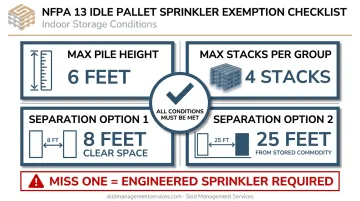
NFPA 13's idle pallet provisions permit a limited arrangement under Ordinary Hazard Group 2 criteria, but only when every condition below is met at the same time:
| Requirement | Limit |
|---|---|
| Maximum pile height | 6 feet |
| Maximum stacks per pile group | 4 stacks |
| Separation option 1 | 8 feet of clear space |
| Separation option 2 | 25 feet of stored commodity |
Miss any one of those thresholds, height, stack count, or separation, and your storage arrangement no longer qualifies for the allowance. At that point, you need an engineered sprinkler system sized for your actual storage configuration: density/area design, in-rack sprinklers, or another approach matched to your ceiling height and commodity class.
When to Call a Sprinkler Contractor
If your indoor pallet volumes are creeping toward these limits, don't wait for a violation notice. A qualified fire sprinkler contractor can assess whether your current system covers your real storage footprint, or whether you need a redesign before volumes grow further. Bring your pile height counts, stack totals, and current sprinkler specs to that conversation to speed up the evaluation.
Plastic Pallets Aren't Automatically Different
Before finalizing any redesign, clarify one more variable that affects your sprinkler calculations: pallet material. Plastic pallets listed and labeled under FM 4996 or UL 2335 are treated identically to wood pallets for sprinkler determination purposes.
Unlisted plastic or composite pallets don't get that treatment; they're generally considered a higher fire hazard until proven otherwise through listing. If your facility mixes wood and plastic loads, confirm listing status pallet-by-pallet rather than assuming uniform treatment.
Outdoor Wood Pallet Storage Requirements
Outdoor storage runs on a different set of rules entirely, governed by performance-based provisions in NFPA 1 and the International Fire Code. Both require a current site plan, fire prevention plan, and security plan before you even get to stacking dimensions.
Here's where it gets genuinely confusing for facility managers: the numbers differ depending on which code your state has adopted and what kind of site you're running.
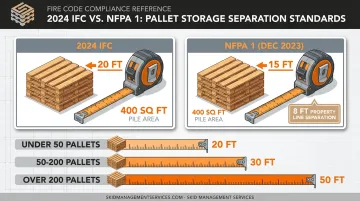
- General outdoor pallet storage under the 2024 IFC allows piles up to 20 feet high, with individual pile area capped at 400 square feet.
- NFPA 1 guidance issued in December 2023 references a 15-foot height limit, pile area under 400 square feet, and 8-foot minimum separation between stacks and property lines. These figures remain enforced in many jurisdictions that haven't adopted the newer edition.
- Pallet manufacturing or recycling sites fall under a separate IFC chapter that uses a different formula altogether: clearance equal to 0.75 times stack height (or 8 feet, whichever is greater) from property lines and important buildings.
Adjacent-storage separation adds another layer. NFPA guidance sets distances based on quantity:
- 20 feet for fewer than 50 pallets
- 30 feet for 50 to 200 pallets
- 50 feet for more than 200 pallets
Some jurisdictions apply additional pile dimension limits, sometimes referenced as 60 or 100 feet in one direction, but these figures vary by local amendment rather than a single national standard. Don't assume a number you saw at another facility applies to yours.
Before you stack a single pallet outdoors, confirm three things with your local fire code official:
- Which code body (NFPA 1 or IFC) governs your jurisdiction
- Which edition year is currently adopted
- Whether your site qualifies as general storage or falls under manufacturing/recycling provisions
Skipping that verification step is how compliant-looking piles end up flagged during inspection.
Material and Environmental Considerations for Pallet Fire Risk
Fire risk isn't only about geometry. What condition your pallets are in, and where you keep them, matters just as much.
Outdoor pallets need to stay dry and clear of standing water. Wood pallets are naturally hygroscopic, meaning they absorb ambient moisture, and repeated wet-dry cycling accelerates rot. Rotted wood weakens structurally and burns differently and unpredictably compared to sound lumber.
Beyond moisture, other factors compound fire risk:
- Heat source proximity: even indirect exposure raises ignition risk over time
- Dust accumulation: fine wood dust ignites more readily than solid stock
- Moisture exposure: degrades structural integrity and increases splintering
Damaged or splintered pallets create a double problem. They add fire load individually, and they're harder to stack safely within the pile-count and height limits covered above. A pile of uneven, partially broken pallets rarely holds its shape, which pushes stacks past approved dimensions without anyone noticing.
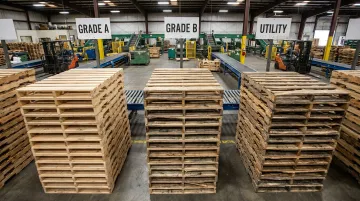
Pallet sourcing plays a direct role in this risk. Skid Management Services grades recycled pallets across three tiers, Grade A, Grade B, and Utility, based on structural criteria like intact deck boards and stringer condition.
Consistently graded, well-maintained pallets stack more predictably than a mixed pile of unknown-condition stock. That predictability makes it easier to stay within code-defined height and spacing limits, instead of guessing where a pile's true dimensions end.
Some environments demand extra protection. For cold storage or frozen food operations, kiln-dried heat-treated pallets resist the freeze-thaw moisture cycling that causes standard pallets to warp and degrade faster than in ambient conditions.
Common Compliance Mistakes to Avoid
Most fire code violations aren't dramatic. They're small oversights that compound over months.
- Letting idle pallets accumulate silently. Returned or unused pallets pile up faster than most teams track them, quietly pushing past the 6-foot/four-stack indoor threshold without anyone recalculating sprinkler needs.
- Assuming your old code edition still applies. A facility that passed inspection years ago under an older NFPA or IFC edition isn't automatically compliant today, since states update editions on their own timelines.
- Ignoring early warning signs. Unauthorized pile growth, a blocked fire lane, or a separation distance that's shrunk over time are all flags worth acting on before an inspector finds them first.
- Neglecting documentation updates. Site plans, fire prevention plans, and security plans need updating as your storage layout or volumes change, not just at initial approval.
The accumulation problem deserves particular attention, since it's the mistake that creeps up fastest. Warehouses generate used and idle pallets faster than most teams can process them, and a pile that's compliant in January can quietly exceed exemption thresholds by summer.
Structured pickup programs, whether on a fixed weekly cadence or on-demand, keep idle stock from building past the volumes your fire protection plan was designed around.
Conclusion
Fire-safe pallet storage comes down to matching three variables—pile height, spacing, and quantity—to whichever code framework governs your indoor or outdoor storage. There's no universal number that works everywhere, and guessing based on what another facility does is how violations happen.
Treat compliance as a routine part of facility management. Schedule periodic reviews with your local fire official, keep site documentation current, and source pallets that support consistent, code-compliant stacking rather than working against it.
Frequently Asked Questions
Are pallets a fire hazard?
Wood pallets are combustible and become a significant fire hazard once stored in large quantities without following height, spacing, and pile-size limits. Isolated, well-maintained pallets pose minimal risk; large, uncontrolled piles do not.
What is ISPM 15 for wooden pallets?
ISPM 15 is an international phytosanitary standard requiring heat treatment or fumigation of wood packaging used in international shipping to prevent pest spread. It has nothing to do with fire code compliance.
Do I need a sprinkler system to store wood pallets indoors?
Not necessarily, if stacks stay under 6 feet, pile groups don't exceed four stacks, and you maintain proper clear spacing. Exceed any of those limits and you'll need an engineered sprinkler system.
How high can I stack wood pallets outdoors?
Current codes allow up to 20 feet in many jurisdictions. Legacy 15-foot limits still apply elsewhere, depending on which NFPA or IFC edition your state has adopted.
What is the required spacing between outdoor pallet stacks?
A minimum 8-foot separation between individual stacks is common. Additional setback rules apply from buildings and property lines, depending on which code and facility type applies to your site.
Are plastic pallets safer than wood pallets for fire risk?
Not automatically. Plastic pallets are generally considered a higher fire hazard unless they're listed and labeled under FM 4996 or UL 2335. Once certified, they're treated the same as wood pallets for sprinkler purposes.