Introduction
Most shipping damage claims trace back to one overlooked detail: how the load was secured to the pallet. Pallet strapping doesn't get much attention until a shipment arrives with crushed cartons or a leaning load that got rejected at the dock.
Choosing the right strapping material affects more than load stability. It determines cost per pallet, compliance with carrier requirements, and whether your product survives a multi-stop delivery route intact.
This article breaks down the three primary pallet strapping materials, how they differ in strength and behavior, and how to match the right one to your specific load.
Key Takeaways
- Three materials dominate pallet strapping: PP, PET, and steel, each suited to different load weights
- Break strength varies by product, not just material type, so always check the specs
- PET retains tension longer than PP, ideal for loads that settle or ship long distances
- Steel offers the highest strength ceiling but needs careful handling and corrosion protection
- Choosing the wrong strapping wastes money on overkill or risks failure from underspec
What Is Pallet Strapping Material and Why It Matters
Pallet strapping is a flat banding material tensioned around a unit load to hold products together during transport and storage. It's applied by hand with tensioning tools and buckles, or through semi-automatic and fully automatic strapping machines for higher-volume operations.
Strapping does the job stretch wrap can't do alone: compressing a load tight enough to resist shifting, bulging, or collapsing under handling stress. Without it, loads settle unevenly, cartons crush, and pallets arrive out of vertical alignment.
The damage data backs this up. According to a 2019 Packaging Digest report, case damage shows up on as much as 11% of arriving unit loads, averaging around 2% across shipments. The report also flags leaning or out-of-vertical loads as especially vulnerable to impact damage during transit.
That 2%-11% figure covers all observed case damage, not damage caused solely by weak strapping. But load stability is a direct contributor, and it's one variable you can control before the truck ever leaves the dock.
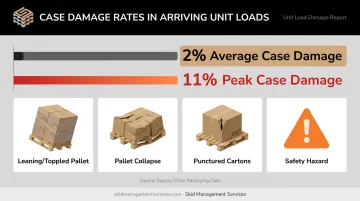
What goes wrong without proper strapping:
- Load shifting during transit, leading to leaning or toppled pallets
- Pallet collapse under compression, especially with heavier or stacked loads
- Crushed or punctured cartons from uneven weight distribution
- Workplace safety hazards when unsecured materials fall during unloading
Getting strapping right prevents damage claims and keeps product moving through your supply chain without rework, reshipment, or safety incidents at the dock.
Types of Pallet Strapping Material
Strapping isn't one-size-fits-all. The right material depends on load weight, rigidity, how far the pallet is traveling, and whether you're strapping by hand or feeding a machine.
Three materials cover the vast majority of pallet strapping applications across industries: polypropylene, polyester, and steel. Each has a distinct strength profile, cost point, and ideal use case.
Polypropylene (PP) Strapping
PP strapping is an economical plastic strap, often embossed for grip, that stretches under tension and recovers as loads settle. It's the entry point for plastic strapping and the most widely used option for general-purpose palletizing.
Best suited for:
- Lightweight to medium loads such as printed materials and cartons
- Food distribution and general product bundling
- Appliances and retail goods that don't require extreme tension retention
- General carton and pallet reinforcement
Key strengths:
- Lowest cost among plastic strapping options
- Good elasticity, which helps as loads settle during handling
- Easy to apply by hand tools or automatic machines
Limitations:
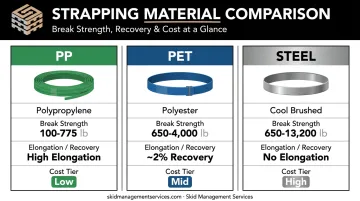
- Lower tensile strength than PET or steel: manufacturer ranges for machine-grade PP typically run from around 100 lb up to roughly 775 lb break strength depending on width and product
- Sensitive to UV exposure without special formulation; standard PP has a UV life estimated at 30 to 90 days depending on sunlight exposure and color
- Recycled or black strap tends to be less consistent than virgin/white strap for automatic machine feeding, increasing the risk of snapping or jamming
Polyester (PET) Strapping
PET strapping is a stronger, stiffer plastic strap, often manufactured from recycled bottle material, with tensile properties that can rival steel and far less elongation than PP.
Best suited for:
- Heavier, rigid, or non-compressible loads such as metals, lumber, and bricks
- Tile and construction materials that need consistent tension over time
- Bottled or canned goods requiring long-term grip as loads cool or shift
- Long-haul or multi-stop shipments where tension retention matters most
Key strengths:
- Higher tensile strength than standard steel in some grades: cited manufacturer ranges run from 650 lb up to 4,000 lb break strength depending on width and grade
- Retains tension longer than PP as loads settle, shrink, or cool; PET typically shows only about 2% elastic recovery, meaning it holds its grip rather than loosening
- Safer edges than steel, reducing handling risk
Limitations:
- Higher price point than standard PP strapping
- Can degrade with prolonged, unmitigated UV exposure over long storage periods
- Offers less elongation than corded alternatives for irregular or expanding loads
Steel Strapping
Steel strapping is a rigid, high-tensile metal strap available in regular-duty and high-tensile grades. It's historically been the go-to for extreme loads that plastic strapping can't handle.
Best suited for:
- Extreme-weight pallets and dense, non-compressible products
- Sharp-edged loads like steel coils, machinery, and heavy construction materials
- Railroad shipments where AAR (Association of American Railroads) rules apply, though requirements vary by commodity and loading figure rather than mandating steel universally
Key strengths:
- Highest published break strength ceiling of the three materials — regular-duty steel strap ranges roughly from 650 lb to 1,990 lb, while high-tensile grades run from 1,900 lb up to 13,200 lb, according to Signode's published product ranges
- Resistant to cutting through on sharp edges
- Does not stretch once tensioned, holding rigid loads firmly in place
Limitations:
- No elongation or recovery, so it can't adjust as a load settles
- Prone to rust over time without corrosion-resistant coatings
- Loses strength when bent at sharp angles
- More hazardous to handle and generally costlier to apply than plastic alternatives
How to Choose the Right Pallet Strapping Material
The "right" strapping isn't whichever material is most common in your industry. It depends on the load itself and how it's traveling.
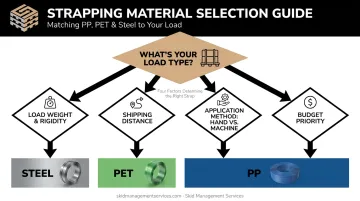
Load weight and rigidity. Heavier or non-compressible loads (metal, lumber, machinery) need PET or steel. Lighter, settling loads like cartons or appliances are well served by PP.
Shipping distance and settling behavior. Longer hauls or products prone to shifting benefit from materials with strong tension retention. PET's minimal elongation makes it a better fit than PP for multi-stop routes.
Application method and volume. A few things to consider:
- Low-volume, manual operations can use hand tools with any of the three materials without major tradeoffs.
- High-volume operations benefit from machine-grade, virgin-resin strapping, which feeds more consistently and reduces jamming or downtime.
- Mixed environments — some hand-applied, some machine-fed — may need to stock two strap grades to match each workflow.
Budget versus long-term cost. Cheaper strapping upfront can cost more later if it under-secures a load, leading to reshipment, damage claims, or equipment wear from inconsistent feed quality. Weigh material cost against those downstream risks before defaulting to the lowest price per roll.
Sourcing matters here too. Skid Management Services stocks polypropylene, polyester, and steel strapping in both hand and machine grades as part of a broader B2B packaging materials line, alongside pallets, stretch film, and corner boards.
Pulling pallets and strapping from a single supplier network keeps pricing steady and shipments moving, without settling for inconsistent strap quality just to save a purchase order.
Common Mistakes to Avoid When Selecting Strapping Material
A few recurring errors show up across pallet strapping programs, regardless of industry:
- Over-strapping. Choosing steel or PET when PP would secure the load just as well wastes material cost and adds unnecessary weight to shipments.
- Ignoring elongation and recovery trade-offs. Picking a high-elongation material like PP for a load that needs steady long-term tension can leave straps loose by the time the pallet reaches its destination.
- Using inconsistent-grade strap in automatic machinery. Recycled or non-uniform strap can cause camber issues, jamming, and added wear on tensioning equipment, especially in high-volume automated lines.
The fix is straightforward: match strap grade to application method from the start, rather than defaulting to whatever's on hand.
Conclusion
Pallet strapping material directly affects load security, shipping costs, and damage rates from the moment a pallet leaves the dock. PP, PET, and steel each handle different weight capacities and rigidity needs, making them suited to distinct shipping conditions. No single material works for every load.
Matching material to load gets easier with a supplier who stocks all three types and can advise on your specific load specs. Skid Management Services supplies food and beverage manufacturers and other high-volume shippers across Pennsylvania, New Jersey, Delaware, and Maryland. The company keeps pallets and packaging materials, including strapping, moving together without supply gaps.
Frequently Asked Questions
What is the difference between wrapping and strapping?
Stretch wrap contains and stabilizes multiple items into one load by cocooning them in stretch film. Strapping uses tensioned bands to bind and compress items tightly together. Many shippers use both for maximum load security.
What material is used for pallet straps?
The three primary materials are polypropylene (PP), polyester (PET), and steel. Woven or corded strapping is used in some specialized applications involving irregular or expanding loads.
What is the strongest pallet strapping material?
High-tensile steel offers the highest published break strength, reaching into the thousands of pounds in heavy-duty grades. That said, heavy PET formulations can rival or exceed the strength of regular-duty steel in certain specs.
What is the difference between PP and PET strapping?
PP is more economical with higher elongation and recovery, making it well suited to settling loads. PET is stronger, retains tension longer, and fits heavier or rigid loads better.
Is pallet strapping recyclable?
PP and PET strapping are both recyclable, PP as plastic #5 and PET as plastic #1. Most residential recycling programs don't accept them, so commercial recycling channels are typically needed.
How do I know what width or tensile strength of strapping I need?
Strap sizing depends on pallet weight, the number of straps used, and how stable the load needs to be. Consulting a packaging supplier like Skid Management Services with your exact load specifications is the most reliable way to get sizing right.