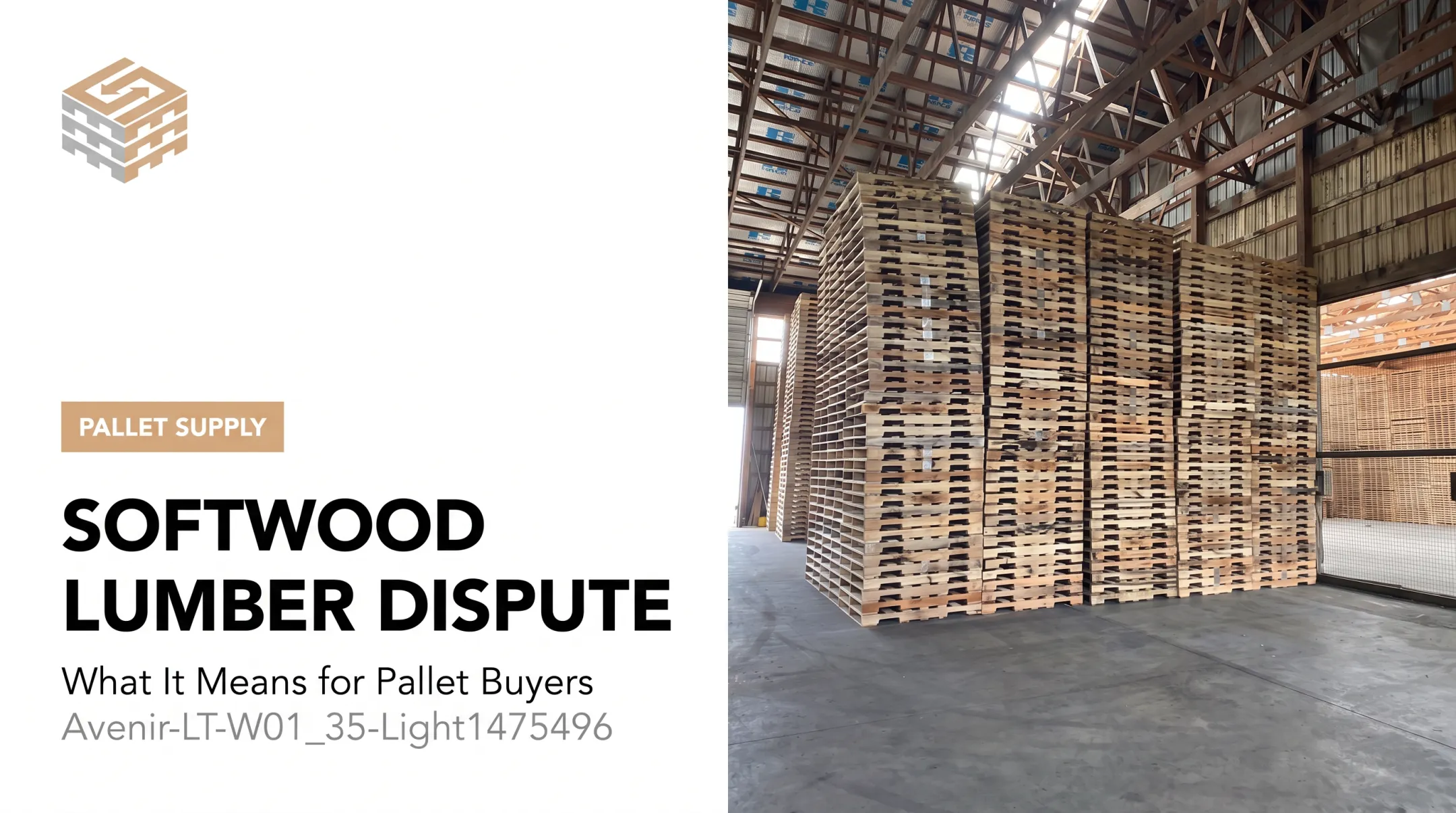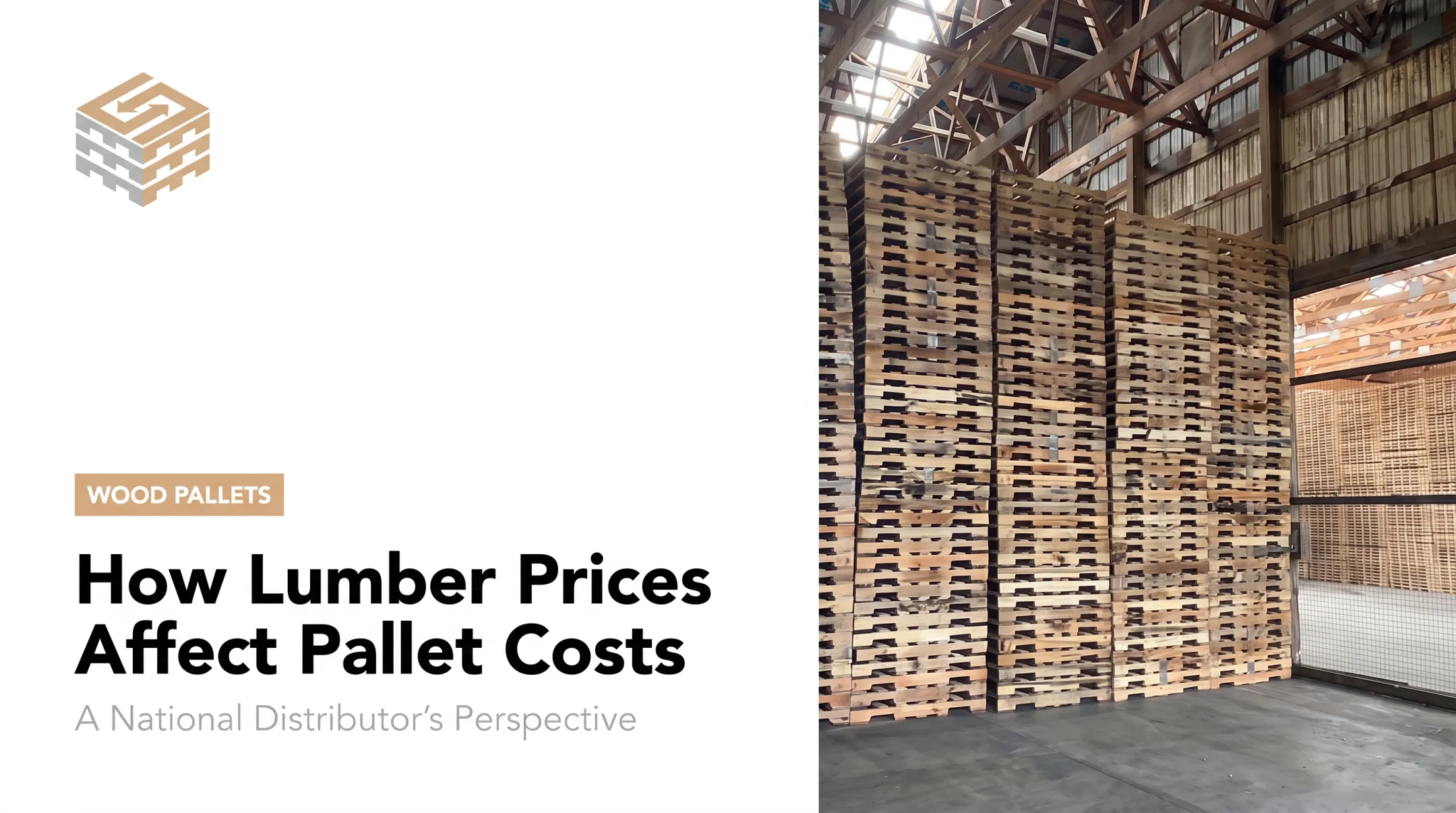

Tariffs raise the cost of a key input—lumber—that flows into every wood pallet. But the price you actually pay reflects freight, labor, hardware, pallet specifications, and how much supply is available in your region at the moment you order. A 10% or 20% duty rarely shows up as a 10% or 20% jump on your invoice.
This article traces how tariff costs move through the lumber and pallet supply chain, explains why prices and lead times shift the way they do, and outlines procurement steps you can take now. One note before we dive in: tariff rates, trade measures, exemptions, and effective dates change frequently. Always confirm current figures against U.S. government sources before making a purchasing decision based on a specific percentage.
Key Takeaways
- Canadian lumber duties raise delivered lumber costs and intensify competition for substitute lumber
- Tariff rates don't pass through one-to-one into pallet prices—lumber is only one cost component
- Weather, housing demand, mill capacity, and freight rates can amplify or offset tariff pressure
- Forecasting, supplier diversification, and recycled or remanufactured pallet programs cut tariff-driven cost exposure
How Canadian Lumber Tariffs Reach Pallet Prices
Duties don't hit your pallet invoice directly. They travel through several intermediate steps first.
The Cost Pass-Through Chain
When Canadian softwood lumber enters the U.S., customs assesses applicable duties at the border. That raises the importer's or mill's landed cost. From there:

- Higher import costs push some buyers toward domestic lumber, which tightens that supply too.
- Domestic mill pricing can rise as demand shifts away from Canadian sources.
- Pallet manufacturers absorb some cost increases and pass along the rest.
- Freight and labor get layered on top of the adjusted lumber cost.
- The final quote reflects all of the above, not just the tariff percentage.
Types of Trade Measures at Play
U.S. pallet buyers may encounter several distinct duty categories, and they don't all work the same way:
- Antidumping (AD) duties: company-specific rates applied when Canadian producers are found to be selling below fair value
- Countervailing duties (CVD): offset foreign government subsidies to lumber producers
- Section 232 measures: national-security tariffs that can apply to specified softwood timber and lumber from any country, not only Canada
- Other applicable tariffs: remedies can stack; USMCA preference does not automatically waive AD, CVD, or Section 232 duties
According to U.S. Customs and Border Protection's October 2025 implementation guidance, an additional 10% ad valorem duty applies to specified softwood timber and lumber headings under a dedicated tariff classification.
That guidance matters for lumber importers. Finished wood pallets fall under a different Harmonized Tariff Schedule classification than raw sawn lumber. A pallet built from lumber already purchased domestically is not itself subject to that import duty. The effect flows through indirectly, via lumber cost and availability.
Rates vary by producer, exporter, and product classification, and Commerce periodically amends its determinations. Always verify current rates through the Department of Commerce, CBP, or the Office of the U.S. Trade Representative before quoting a specific percentage to a customer or leadership team.
A Hypothetical Illustration
Here's a hypothetical example, not a market statistic, showing why a tariff rate and a pallet price increase rarely match.
Say lumber makes up 45% of a pallet's manufacturing cost. If duties raise that lumber cost by 20%, the pallet's total cost might rise by roughly 9%, assuming labor, hardware, freight, and overhead stay flat.
In practice, those other costs rarely stay flat, and grade, region, and supplier contract terms all shift the math. Treat this as illustrative only, not a benchmark for any specific supplier or pallet grade.
Why Canadian Lumber Matters—and What Else Moves the Market
Canada is a major supplier of softwood lumber to U.S. buyers, so cross-border trade measures quickly show up in pallet-grade supply and price.
Canada's Role in the Supply Chain
The Congressional Research Service reports that Canada supplied approximately 75% by value of U.S. 2024 imports of the softwood timber and lumber products later covered by the 2025 Section 232 measure: roughly $5.2 billion of $7 billion total.

That figure is import value for covered products, not Canada's share of total U.S. lumber consumption. It should not be read as the full domestic supply picture.
When cross-border economics deteriorate, Canadian producers respond in a few ways:
- Redirecting exports to other markets
- Reducing output at existing mills
- Delaying capital investments
- Closing mills that are no longer economically viable
Canfor's July 2026 announcement that it would permanently close its Fox Creek, Alberta sawmill cited weak markets, persistent U.S. duties and tariffs, and regional fiber constraints from wildfires and a concluded beetle-management strategy. Several pressures stacked at once; tariffs were one factor, not the only one.
Beyond Tariffs: Other Forces at Play
Tariffs are one variable among several. Others that move pallet-grade lumber pricing include:
- Housing and construction demand competing for the same softwood
- Seasonal shipping surges ahead of peak retail and produce seasons
- Wildfire or storm damage that cuts timber availability
- Logging and mill labor shortages
- Trucking rates and fuel costs
- Gaps between where lumber is milled and where pallets are built
Mills often prioritize higher-value construction-grade lumber, especially when capacity is tight. That leaves pallet buyers competing for a smaller pool of pallet-grade material—a dynamic that can matter more than the tariff rate itself in any given month.
What to Monitor
Short-term spikes and longer-term structural shifts are different problems. Watch:
- New tariff announcements or amended duty rates
- Lumber benchmark reports (such as weekly softwood pricing indexes)
- Mill capacity changes and closures
- Housing start data
- Freight and fuel conditions
- Your own suppliers' quoted lead times
What Rising Pallet Prices Mean for U.S. Businesses
Higher pallet costs rarely stay contained to the purchasing line item. They ripple into warehouse handling, outbound freight, inventory carrying costs, and sometimes customer pricing decisions.
Beyond the Purchase Price
Those secondary costs climb faster when supply tightens. When pallet-grade lumber gets scarce, buyers often see:
- Longer lead times on standard orders
- Fewer available grades or dimensions
- Reduced flexibility for custom specifications
- Greater risk for companies relying on spot purchases instead of planned supply
Fastmarkets reported that its low-grade lumber index rose 27% since early January 2026 as of late March 2026, outpacing framing lumber's 14% increase over the same window. Low-grade lumber is exactly what most pallets are built from, which is why pallet-grade pricing can move differently than construction lumber benchmarks.

New vs. Recycled vs. Repaired vs. Pooled
No single pallet type is right for every load. Weigh the trade-offs:
| Pallet Type | Upfront Cost | Condition Consistency | Best Fit |
|---|---|---|---|
| New | Highest | Most consistent | Export, heavy loads, automation, food-grade |
| Recycled/Remanufactured | 40-60% lower than new | Varies by grade | General warehousing, non-critical shipments |
| Repaired | Moderate | Depends on repair quality | Internal reuse, closed-loop programs |
| Pooled | Rental-based | Provider-dependent | High-turnover retail distribution |
That price gap matters more when lumber costs climb. Sanitation requirements, export compliance, and load consistency still decide whether recycled stock fits a specific shipment.
Quote Checklist
Before comparing supplier quotes on unit price alone, check:
- Pallet design, grade, and lumber species
- New, used, or repaired condition
- Quantity and delivery terms
- Lead time and minimum order requirements
- Tariff or fuel surcharges
- Price adjustment clauses
Unit price is only part of the math. Delaying replacement of visibly damaged pallets to save money often backfires. Broken boards and protruding nails create safety hazards and product damage that cost more than the pallet itself.
How U.S. Buyers Can Reduce Tariff Exposure and Supply Risk
None of this is fully within a buyer's control, but a few procurement habits still reduce exposure.
Build a Forecast and Diversify Suppliers
Start with a rolling demand forecast that accounts for production schedules, seasonal peaks, new customers, and expected pallet loss or repair rates. Then look at where your supply comes from:
- Avoid dependence on a single mill, region, or border route
- Evaluate new suppliers on quality, delivery reliability, and total landed cost, not price alone
- Keep at least one qualified backup source active, even if you rarely use it
Choose the Right Buying Structure
Spot buying offers flexibility but exposes you fully to price swings. Longer-term agreements can offer more stability, with trade-offs:
- Fixed pricing protects against increases but can leave you overpaying if the market softens
- Index-linked pricing tracks the market but requires trust in the benchmark
- Volume commitments often earn better rates but reduce flexibility
- Tariff-adjustment clauses distribute risk more fairly between buyer and supplier
Rethink Your Pallet Mix
Evaluate new, recycled, repaired, and redesigned pallets against actual load, racking, and durability needs rather than defaulting to whatever's cheapest that week.
Custom-engineered pallets, for instance, can carry dynamic load ratings from 4,000 pounds up to 10,000-plus pounds. That cuts extra blocking or dunnage that adds cost elsewhere.
Closed-loop programs (where used pallets get picked up and new or recycled ones delivered on the same trip) tend to make the most economic sense once volume reaches roughly 500 pallets per month moving in both directions. Trade-in credits on returned pallets typically offset 15-40% of new-pallet spend, depending on grade mix.
This is where a supplier with both owned inventory and a broad network matters. Skid Management Services combines its own pallet stock with an expansive supplier network to help buyers pursue competitive pricing and consistent supply, even when regional lumber markets tighten. That doesn't guarantee a specific price or availability, but it does widen your options when one source runs short.
If you're reassessing your pallet program, contact Skid Management Services at 717-202-0304 or Info@SkidManagementServices.com to discuss your specifications, volume, and timeline.
Conclusion
Canadian lumber tariffs are a real cost driver, but they're one input among many. Lumber availability, domestic demand, freight rates, labor, and your own pallet specifications all shape the final number on a quote.
The practical path forward:
- Verify your actual tariff exposure against current government sources
- Build a demand forecast
- Compare total delivered cost rather than sticker price
- Keep qualified backup suppliers in place before a shortage becomes urgent
- Review reuse and repair opportunities now, rather than after prices spike
Working with a supplier that can flex between new, recycled, and custom pallets—without overpromising on price or availability—gives you more room to adjust as trade policy and lumber markets continue shifting.
Frequently Asked Questions
What is the cost of one pallet?
Pallet price depends on size, grade, new vs. recycled condition, lumber species, quantity, and freight distance. A standard GMA 48x40 can differ sharply from a custom or heat-treated export build, so quote to your exact specs.
What is the price of softwood lumber?
Softwood prices move with species, grade, region, and market timing. Pallet-grade lumber often prices differently from construction-grade benchmarks, so use a current weekly lumber report—not a stale average.
What are the current tariffs on lumber imports from Canada?
Duty rates depend on product classification, the specific trade measure, and the effective date, and they shift through U.S. Department of Commerce reviews. Confirm live figures on official U.S. government sources instead of a single fixed percentage.
How do tariffs affect lumber prices?
Tariffs raise the delivered cost of imported Canadian lumber and can tighten supply, which pushes domestic prices higher as well. Final market prices rarely rise by exactly the tariff percentage.
Are pallet prices going up?
Often yes—when lumber, freight, labor, or demand costs climb, and Canadian lumber tariffs have been one clear driver of that pressure. How much you pay still varies by pallet type, region, and supplier, so compare current quotes.
Why is there a pallet shortage?
Shortages usually trace to tight lumber supply, mill disruptions, seasonal demand spikes, transport limits, or labor gaps. How severe it feels still depends on pallet size, grade, and your regional market.