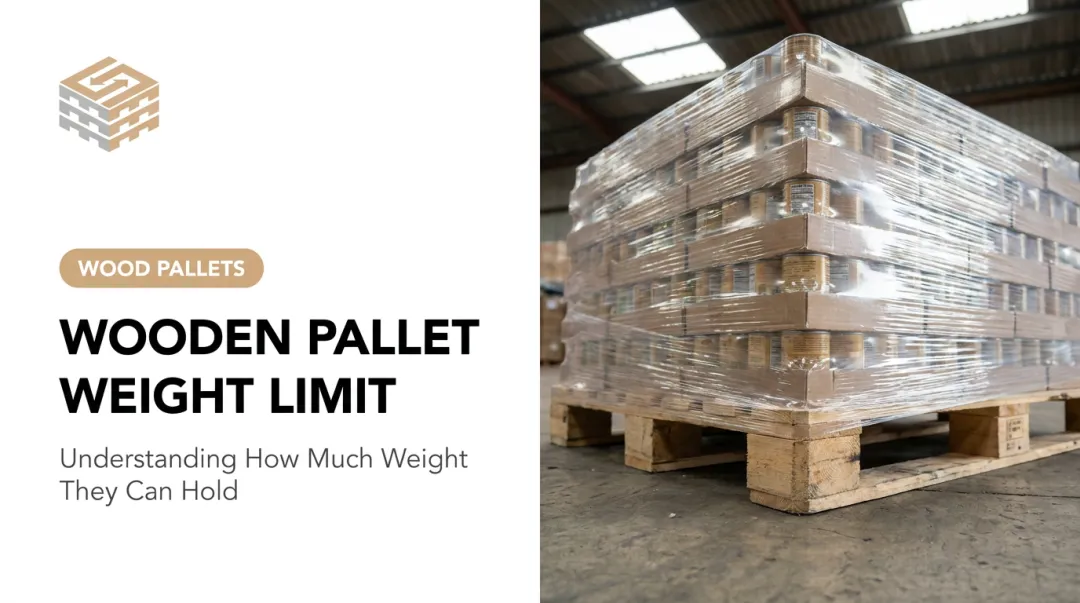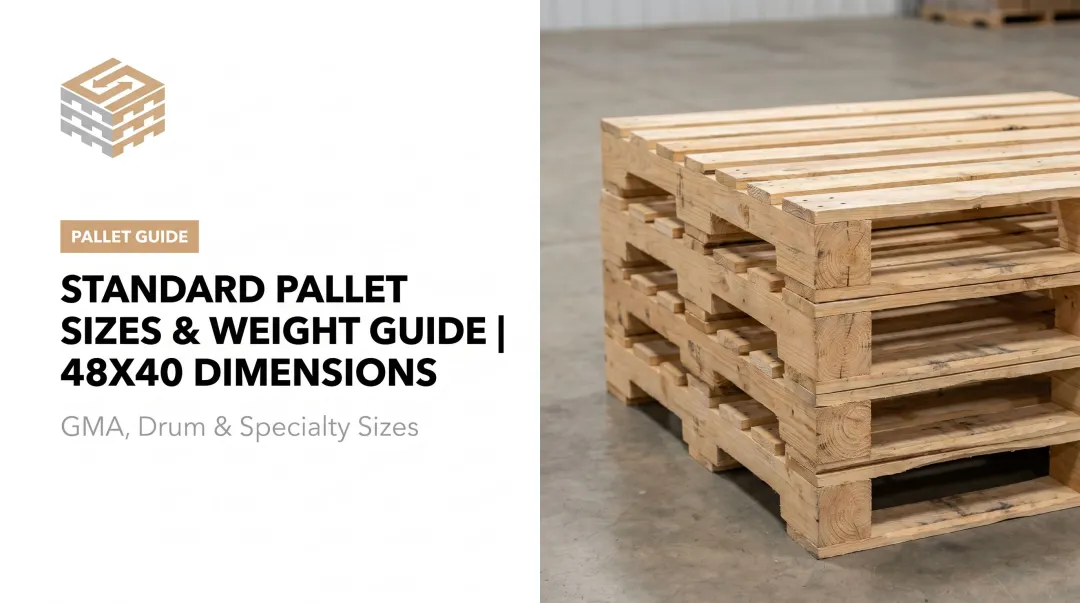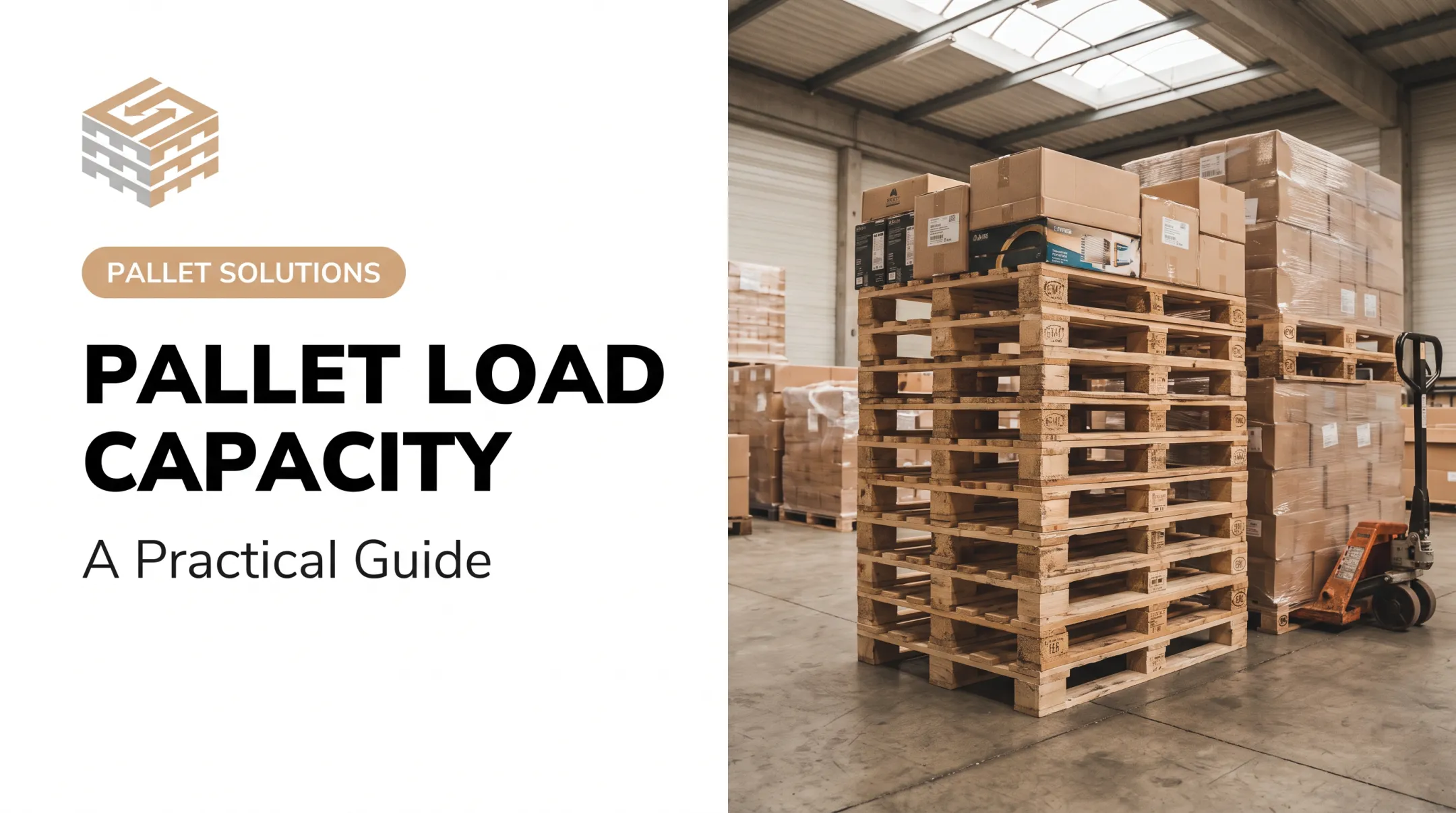

A pallet's weight capacity depends on whether it's sitting still, being moved, or spanning open rack beams. Each condition carries a different rating, and mixing them up is where accidents start.
This guide breaks down capacity ranges by pallet type, the factors that quietly erode published ratings, and how to choose the right pallet before you load it.
TL;DR
- A standard 48"x40" GMA wood pallet holds roughly 4,600 lbs static, 2,500 lbs dynamic, and 2,000-2,500 lbs racked
- Capacity varies widely by build: heavy-duty wood block and steel pallets can carry substantially higher loads
- Static, dynamic, and racking loads are different ratings — never use them interchangeably
- Board thickness, wood species, pallet age, and moisture content all affect real-world capacity
- Sourcing correctly rated pallets protects product, workers, and equipment
What Pallet Weight Capacity Actually Means
Pallet weight capacity is the maximum load a pallet can safely support under a specific condition. That limit changes with how the pallet is supported and loaded.
Virginia Tech's Center for Packaging and Unit Load Design defines capacity testing around support conditions like rack, floor, fork-tine, and conveyor support, paired with loading conditions such as uniform loads, point loads, or actual product. Treating capacity as one universal number is exactly how pallets get overloaded.
Static, Dynamic, and Racking Load Explained
- Static load — weight supported while the pallet sits motionless on a flat floor. Typically the highest-rated capacity.
- Dynamic load — weight supported while being moved by forklift or pallet jack. Always lower than static because motion adds stress.
- Racking load — weight supported when the pallet spans open beams with only the ends supported. The most demanding scenario, since there's no floor underneath to help.

A pallet rated for static loads isn't automatically safe in racking—the most demanding of the three conditions above.
Virginia Tech's rack test uses two parallel beams and limits post-creep deflection to 1.9% of support distance under ASTM D1185, or 2% under ISO 8611. For a 48x40 pallet on beams spaced 36 inches apart, that is about 0.68–0.72 inches of allowable sag before the pallet fails the test.
Pallet Weight Capacity by Type and Material
Here's how the major pallet types compare on published capacity:
| Pallet Type | Static Load | Dynamic Load | Racking Load |
|---|---|---|---|
| GMA 48x40 wood stringer | ~4,600 lbs | ~2,500 lbs | 2,000-2,500 lbs |
| CHEP/PECO wood block, 48x40 | — | ~2,800 lbs | Varies by span |
| Lightweight export plastic | ~3,500 lbs | ~2,200 lbs | Not rated |
| Rackable reinforced plastic | Up to 15,000 lbs | 2,800-4,000 lbs | Up to 3,000 lbs |
| Steel pallet | ~4,000 lbs | ~3,500 lbs | ~2,500 lbs |

Wood Pallets
GMA 48x40 stringer pallets are the U.S. workhorse. Kamps Pallets lists a predicted maximum safe load around 4,600 lbs static when fork tines run parallel to pallet length, with dynamic capacity dropping to roughly 2,500 lbs.
Heavy-duty wood block pallets, the kind used in pooled programs like CHEP and PECO, generally handle higher static loads thanks to four-way block construction. Industry data puts CHEP's pooled wood block pallet around 2,800 lbs under normal operating conditions.
Not every application needs a pooled program, though. Skid Management Services works with food and beverage manufacturers exiting CHEP/PECO pools, sourcing GMA and block pallets rated for the exact load profile — whether that's a beverage pallet built for 3,000+ lbs dynamic or a standard warehouse pallet. Our national supplier network keeps pricing competitive and supply uninterrupted, even when standard inventory can't match a specialty spec.
Plastic and Metal Pallets
Lightweight export plastic pallets trade capacity for freight savings. Models like the Cabka Nest i1 support around 1,000-1,500 lbs, but shave weight off every outbound shipment.
Rackable plastic pallets flip that trade-off. Reinforced internal ribs let some models, like ORBIS's XP Grocery pallet, hit 15,000 lbs static. That's not typical — it reflects the top end of reinforced design.
Steel pallets offer the highest overall durability and are reserved mostly for heavy manufacturing, where repeated abuse would destroy wood or plastic over time.
Pallet Size and Capacity
Bigger footprint doesn't automatically mean bigger capacity. Kamps' size chart lists safe maximum loads of 3,544 lbs for 40x40, 4,592 lbs for 48x40, and 4,673 lbs for 48x48 — but those numbers change because deck-board and stringer configurations change too, not because of dimensions alone.

Pallet engineering research from Virginia Tech supports this: capacity depends on span, beam spacing, construction, and load type together, not footprint in isolation. A 48x48 pallet spanning a shorter rack beam will outperform the same pallet spanning a longer one, regardless of surface area.
Factors That Affect Real-World Pallet Capacity
Published capacity ratings assume ideal lab conditions. Warehouse floors rarely match that.
- Wood species and board thickness: Kamps' controlled 48x40 GMA tests show warehouse-safe average loads jumping from 3,135 lbs (5/8" softwood) to 5,651 lbs (3/4" hardwood).
- Pallet age and condition: Repeated stress, drying, and loosened fasteners reduce capacity over a pallet's service life. There's no universal degradation curve, but visible wear is a reliable signal.
- Moisture content: Virginia Tech notes wood stabilizes around 8-14% moisture indoors and 12-18% outdoors. Wetter lumber is weaker lumber.
- Load distribution: Uneven or overhanging product concentrates stress. A 2023 packaging study found box overhang can reduce compression strength by up to 40%, independent of the pallet's own rating.
Species and grade matter for sourcing decisions too. Skid Management Services supplies softwood (pine, spruce, fir), hardwood (oak, maple, mixed), and heat-treated kiln-dried lumber for ISPM-15 export compliance. Graded recycled inventory (Grade A, Grade B, Utility/#2) is also available, and Grade A performs equivalent to new for most applications.
How Pallet Capacity Is Specified and Verified
A published capacity rating only holds if the pallet is sound. Verify condition before every heavy load.
Manufacturers publish ratings based on standardized testing, commonly ISO 8611, ASTM D1185, or the NWPCA Pallet Design System. ASTM D1185 recommends testing at least three sample pallets, then dividing the ultimate failure load by a safety factor to land on a safe working capacity.
Before loading, warehouse teams should check:
- Deck boards for cracks or bowing
- Stringers for splits
- Fasteners for looseness or protrusion
- Overall squareness (a leaning pallet is a warning sign, not a quirk)
For custom or high-volume programs, an established supplier can lock in the right rating before production starts. Skid Management Services' design consultation specifies dimensions, construction, lumber grade, and required load rating upfront.
That process supports custom builds rated from 4,000 lbs to over 10,000 lbs dynamic for heavy machinery applications.

Risks and Warning Signs of Overloading a Pallet
Exceeding a pallet's rated capacity sets off a predictable chain reaction: boards crack, stringers split, and the stack collapses, sometimes with little warning.
Watch for these field signs:
- Bowing or sagging deck boards under load
- Stacks leaning instead of sitting square
- Forklift operators struggling to lift a load evenly
- Audible cracking during pickup or placement
OSHA's 1910.176 standard requires stored materials to be stacked and blocked so they can't slide or collapse — overloaded pallets violate that baseline directly.
Downstream costs add up fast: damaged product, injury liability, and loads rejected before they leave your dock.
Conclusion
Pallet weight capacity isn't a single number. It's a range shaped by material, design, and whether the load is sitting still, moving, or spanning open rack.
Matching the right pallet type to the job protects your product, your people, and your equipment. Guessing at capacity, or assuming a static rating applies during transit, is how avoidable accidents happen.
Skid Management Services combines in-house inventory with a national supplier network to keep correctly rated pallets available whenever a load demands them, from standard GMA stringers to custom heavy-duty builds.
Frequently Asked Questions
How much weight can a standard pallet support?
A standard 48x40 GMA wood pallet supports about 4,600 lbs static, 2,500 lbs dynamic, and roughly 2,000-2,500 lbs when racked. Actual figures vary by grade and condition.
What is the difference between static and dynamic pallet load?
Static load is the rating while the pallet sits motionless on the ground. Dynamic load applies while it's being moved, and it's always lower due to added stress.
Can a pallet hold more weight if it's plastic instead of wood?
Often yes. Reinforced plastic pallets can support comparable or higher static loads than wood, though ratings vary widely by design and construction.
How do I know if I'm overloading a pallet?
Look for bowed deck boards, cracked stringers, or a stack shifting and leaning during handling. Any of these signal reduced capacity.
Does pallet age affect how much weight it can hold?
Yes. Wear, drying, and repeated stress reduce load-bearing capacity over a pallet's typical service life, even without visible damage.
What pallet type should I use for heavy manufacturing loads?
Heavy-duty wood block or custom-built pallets rated for your specific load work best. Work with a supplier that offers consistent quality control and design consultation, such as Skid Management Services (717-202-0304 or Info@SkidManagementServices.com).