The average per-pallet monthly storage rate climbed from $13.02 in 2017 to $20.17 in 2025, a jump of nearly 55%, according to warehousing industry pricing data tracked across 600+ warehouses. Rates have since stabilized, but the higher baseline is here to stay.
Pricing swings widely depending on storage type, billing model, region, and how much inventory you actually move. This guide breaks down real pricing ranges, the billing models that shape your invoice, hidden cost drivers, and how to budget without getting blindsided.
Key Takeaways
- Dry pallet storage runs $14–$22.50 per pallet/month; cold storage adds a 33-57% premium
- Billing model (per pallet, cubic foot, or bin) can shift your total bill by 20-30% at the same quoted rate
- Long-term storage surcharges and monthly minimums are becoming standard, not exceptions
- Dense, uniform, high-volume pallets earn the best rates; mixed SKUs and low volume cost more
- Pallet quality and consistency directly affect how much rack space your inventory actually uses
How Much Does 3PL Pallet Storage Cost? (Pricing Overview)
There's no single "going rate" for pallet storage. Pricing depends on storage type, location, contract volume, and which billing method your provider uses.
Common budgeting mistakes:
- Locking in a budget based on one quoted rate, then getting hit with add-on fees
- Ignoring long-term storage surcharges until inventory sits past 90 or 180 days
- Not clarifying upfront what's bundled into storage versus billed separately
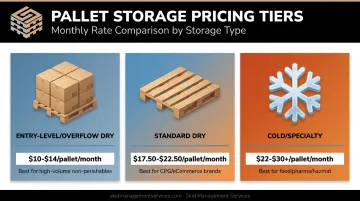
| Tier | Typical Range (per pallet/month) | Best For |
|---|---|---|
| Entry-level/overflow dry | $10-$14 | High-volume accounts, non-perishables |
| Standard dry | $17.50-$22.50 | Most CPG and eCommerce brands |
| Cold/specialty | $22-$30+ | Food, pharma, hazmat, bonded goods |
Price Range 1: Ambient/Dry Storage
Standard dry storage usually includes a rack position and basic inventory tracking. It typically excludes handling, labor, and long-term fees.
- Best for: non-perishable goods, standard SKU dimensions
- Rates at higher volume (500+ pallets) can drop toward $14/pallet/month; smaller accounts (50 pallets) often see $22.50
- Add-on charges for pallet exchange, inbound/outbound handling, and shrink-wrap replenishment typically bill separately from the base rate
Price Range 2: Temperature-Controlled/Cold Storage
Cold storage costs more because refrigeration, energy, and compliance monitoring add fixed costs to every square foot of space.
- Refrigerated warehouse operating expenses rose 6.09% year over year in Q3 2024, driven mostly by labor (40% of cost weight) and rent (39%), per the Global Cold Chain Alliance's Cold Chain Index
- Energy surcharges and compliance monitoring fees often bill separately from the quoted base rate
- Best for: food, pharma, perishables requiring continuous temperature control
Price Range 3: Specialty Storage (Bonded, Hazmat, High-Security)
Bonded, hazmat, and high-security storage carry custom pricing rather than a published percentage premium.
- Bonded goods typically incur charges in addition to standard rates, plus minimum handling fees per lot
- Hazmat storage requires fire-rated segregation, spill containment, and specialized suppression systems
- Best for: regulated goods, high-value inventory, import/export compliance needs
Key Factors That Affect 3PL Pallet Storage Pricing
Pricing isn't arbitrary. It reflects location, product characteristics, contract terms, and how your inventory actually behaves inside the warehouse.
Location & Regional Market
Coastal and urban markets command a real premium. In one provider comparison, a 500-pallet account in California priced at roughly $25/pallet versus $18.50/pallet in the Midwest, a 35% gap for the same volume tier.
Storage Type (Dry vs. Cold vs. Specialized)
Ambient storage is the cheapest baseline. Cold and compliance-heavy storage stack on refrigeration, monitoring, and certification costs that dry storage never touches. Cold storage commands a substantial premium over the dry-storage baseline, and compliance certifications such as SQF or BRCGS add ongoing audit fees on top.
Pallet Type, Size & Quality
Oversized, damaged, or inconsistent pallets waste rack space. A pallet that's an inch too tall or warped from moisture exposure can throw off an entire rack bay's tolerance, reducing how many positions a warehouse can actually use.
This is where pallet sourcing matters more than most brands realize:
- Uniform deck-board and stringer tolerances matter most for automated or first-time rack builds
- 4-way entry (block or notched stringer construction) reduces forklift repositioning in tight rack aisles
- Kiln-dried, heat-treated lumber resists moisture-related warping in cold storage racks
Providers like Skid Management Services supply custom-engineered pallets built to match specific rack bay dimensions and load ratings, avoiding this waste from the start.
Inventory Volume & Contract Length
Volume tiers unlock lower per-pallet rates. In one example, dry storage rates fell nearly 38% between a 50-pallet account and a 500-pallet account. Shorter-than-12-month terms can carry a 10-20% premium, while 24-month commitments often support 10-15% discounts.
Handling & Ancillary Services
Receiving, pallet in/out fees, and labor sit outside the base storage rate. Expect these charged separately, not bundled. These per-transaction charges add up fast for high-volume accounts, so factor them into your total cost comparison rather than the base rate alone.
Inventory Age / Turnover
Slow-moving pallets trigger long-term storage surcharges once they cross a set threshold, usually six months. The surcharge structure itself has shifted: it now applies as 30-50% of the standard fee, down from 50-100% in the prior year. Even so, more warehouses are charging it than ever before.
Storage Billing Models: Per Pallet vs. Cubic Foot vs. Other Methods
How your 3PL measures your storage matters just as much as the rate itself. Two providers quoting the same "$18/pallet" can produce very different invoices depending on the billing model.
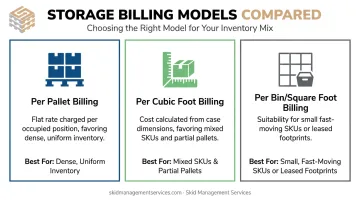
The three most common billing models include:
- Per Pallet Billing: A flat rate per occupied position, regardless of how full it is. Favors dense, uniform, fully-stacked inventory.
- Per Cubic Foot Billing: Calculated from case dimensions (length x width x height, divided by 1,728), then multiplied by units on hand. Favors mixed SKUs and partial pallets since you only pay for space used.
- Per Bin / Per Square Foot Billing: Bin billing suits small, fast-moving SKUs; square-foot billing suits dedicated or leased footprints. Some providers charge per bin, shelf, and pallet separately.
Here's how the same inventory prices out differently:
| Scenario | Per Pallet Billing | Cubic Foot Billing |
|---|---|---|
| Full pallet (fully stacked) | $18 flat | ~$18 (full volume charged) |
| Half-empty pallet | $18 flat (same rate) | ~$9 (only occupied volume charged) |
If your SKU mix runs lean or seasonal, cubic foot billing can save real money. If you ship dense, uniform pallets, per-pallet billing is usually simpler and cheaper.
Before signing anything: ask your prospective 3PL which model they use, whether they calculate it as a daily snapshot or monthly count, and request a sample invoice. The billing frequency alone can change your effective rate.
Full 3PL Cost Breakdown: Beyond the Storage Rate
Storage is just one line on the invoice. The full cost of working with a 3PL extends well beyond the monthly pallet fee.
Receiving/inbound fees (one-time, per shipment):
- Per pallet: roughly $10-$50
- Per carton: roughly $2-$3
- Per labor hour: roughly $35-$50
This covers unloading, counting, and labeling inbound freight.
Pick, pack & returns processing (recurring, per order):
- First item per B2C order: roughly $1.80-$4.00
- Additional items: around $0.25-$1.00
- Returns: roughly $2-$5 per return, and most warehouses now charge a return fee by default
Long-term storage surcharges & monthly minimums (periodic/recurring):
These fees apply once inventory sits past a defined threshold, and they've become far more common. According to The Fulfillment Advisor's 2025 warehousing market report, the share of warehouses charging long-term storage fees jumped from 23.3% in 2024 to 48.6% in 2025, more than doubling in a single year.
Monthly minimum charges rose too, averaging roughly $517 in 2025 versus $338 the year before.
How to Estimate Your Budget and Avoid Common Storage Cost Mistakes
The right storage setup balances cost, reliability, and your actual product profile. Chasing the lowest quoted rate almost always backfires.
Factors to model before you budget:
- Average pallet count on hand across peak and off-peak months
- Inventory turnover rate (how fast pallets actually move)
- Seasonal peak volume, not just your annual average
- Any SKUs requiring cold storage or specialty handling
Mistakes that blow up budgets:
- Comparing only the headline per-pallet rate across quotes
- Ignoring handling, receiving, and long-term storage fees entirely
- Overlooking monthly minimums that apply even at low volume
Cost-saving strategies that actually move the needle:
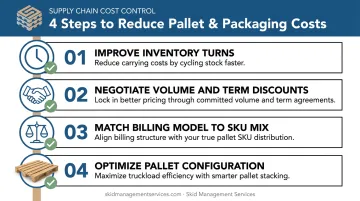
- Improve inventory turns to stay ahead of long-term storage surcharge thresholds
- Negotiate volume and term discounts, since 24-month commitments often unlock 10-15% savings
- Match your billing model to your SKU mix, cubic foot billing for partial pallets, per-pallet for dense uniform loads
- Optimize pallet configuration with consistent, well-built pallets. Uniform dimensions and 4-way entry reduce wasted rack space. Providers like Skid Management Services build custom-spec pallets around specific rack bay dimensions instead of forcing a standard footprint to fit
3PL pallet storage cost varies enormously depending on the factors covered here, from storage type to billing model to how your pallets are built. Model your real pallet counts and SKU mix before signing a contract, then revisit the numbers whenever volume or turnover shifts.
Frequently Asked Questions
What is the going rate for pallet storage?
Standard dry pallet storage typically runs $14 to $22.50 per pallet/month, depending on volume. Cold storage adds a 33-57% premium, and coastal markets run higher than the Midwest.
How to calculate pallet storage cost?
Multiply your pallet count by the contracted monthly rate for pallet-based billing. For cubic-foot billing, calculate occupied cubic feet per case, then multiply by units on hand and the per-cubic-foot rate.
What is the difference between pallet and cubic foot storage billing?
Pallet billing charges a flat rate per position regardless of how full it is. Cubic foot billing charges only for the actual volume your inventory occupies, which favors partial pallets and mixed SKUs.
How much does cold storage cost per pallet compared to dry storage?
Cold storage typically commands a 33-57% premium over dry storage, depending on volume tier. Refrigeration, energy, and compliance monitoring drive the added cost.
Do 3PLs charge minimum monthly storage fees?
Yes. Roughly 47% of warehouses enforce a monthly minimum regardless of pallet count, and the average minimum has risen to about $517, up from $338 the previous year.
How can I reduce my 3PL pallet storage costs?
Improve inventory turnover, negotiate volume or term discounts, and match your billing model to your SKU mix. Using consistent, well-built pallets also reduces wasted rack space and lowers per-unit storage cost.