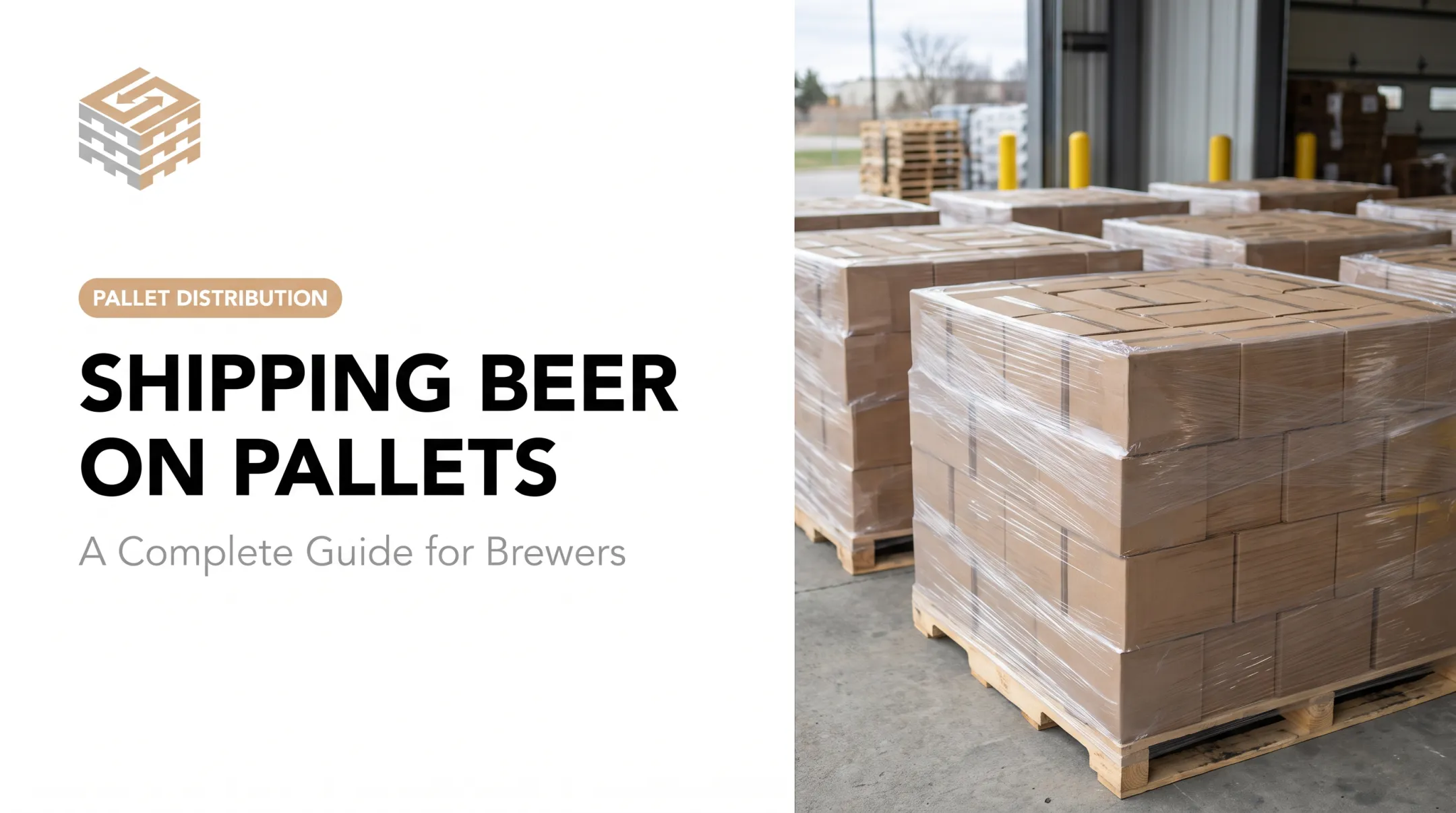

Wooden pallets remain the backbone of wine logistics for good reason. They're durable, stackable, and cost-effective at scale. More than 1.8 billion pallets are in service across the US daily, and roughly 90% of shipped products move on pallets, with wood making up about 93% of the US pallet market.
This guide covers pallet types, sizing, loading best practices, and how to find a supplier who won't leave you scrambling during peak season.
Key Takeaways
- Wood pallets deliver the load capacity glass cases demand, at a cost per shipment that plastic often can't match
- Layer patterns, case orientation, and containment (not just wrap) determine whether bottles arrive intact
- Standard 48x40 GMA sizing works for most wine cases; boutique wineries may need custom builds
- International shipments require ISPM-15 heat treatment — domestic shipments generally don't
- A single supplier with real inventory depth beats juggling regional vendors during surge months
Why Wineries Rely on Wooden Pallets
Glass bottles are unforgiving cargo. They're heavy, they concentrate weight unevenly, and they don't flex when a case shifts mid-transit. Cardboard alone can't provide the rigid base a stacked wine load needs. You need a platform engineered to hold that weight without buckling.
There's no reliable industry-wide figure for wine breakage rates during transit (any blog claiming otherwise is guessing). Breakage risk comes down to the packaging system, not a single material choice.
Support condition, load distribution, and stiffness all factor into whether a pallet holds up, according to Virginia Tech's Center for Packaging and Unit Load Design.
That said, wood has practical advantages over the alternatives:
- Higher rigidity: holds concentrated, heavy loads better than most plastic pallets
- Repairable: swap a damaged deck board instead of replacing the whole unit
- Universally accepted: works across US warehouses, carriers, and retail DCs without compatibility issues
Wood vs. Plastic vs. Pallet Collars for Wine
| Option | Cost | Reusability | Best for |
|---|---|---|---|
| Wood pallet | Low-moderate | High (repairable) | Heavy, repeated wine shipments |
| Plastic pallet | High upfront | High (non-repairable) | Wash-down/sanitation-critical loads |
| Pallet collars | Moderate | High | Reducing wrap use, adding stack containment |

For most wineries, wood wins on total cost of ownership. Plastic only makes sense when sanitation requirements (like FDA wash-down zones) demand it.
Choosing the Right Pallet Size and Type for Wine Cases
The 48x40 inch GMA pallet is the North American default, and most wine case footprints fit that layout cleanly. It's also the format many receivers specify outright. Some distributor co-ops require 48x40, four-way entry pallets with less than a quarter-inch of overhang per side.
Standard doesn't mean universal. Skid Management Services also supplies 32x30-inch pallets for specialty beverage and wine applications, plus 36x36 formats common in craft beverage distribution. Those sizes help when your case dimensions don't play nicely with GMA sizing.
New, Remanufactured, or Recycled: What Fits Your Budget
- New pallets — most uniform, easiest to load-rate accurately, best for high-value or export shipments
- Remanufactured — built from sorted, graded components; more consistent than recycled, cheaper than new
- Recycled/Grade A — cost-effective, functionally equivalent to new for most applications, typically 40-60% less expensive than new
Block vs. Stringer Construction
Two constructions dominate wine logistics:
- Stringer — three supports with a top deck; two-way or four-way entry depending on notching; the everyday workhorse
- Block — true four-way access, including Euro-style configurations; generally better for tighter warehouse turns
Neither wins by default on tall wine stacks. Engineered load rating does. Beverage-rated pallets are commonly built to 3,000+ lb dynamic capacity, with reinforced double-wing stringer designs rated up to 4,000+ lb for heavier configurations.

Export Shipments Need ISPM-15
Any wine crossing an international border needs heat-treated, ISPM-15-certified pallets. That means:
- Core temperature of 132.8°F (56°C) for at least 30 minutes
- A visible stamp showing the IPPC logo, country code, provider ID, and "HT" treatment code
- Legible marks — smudged or missing stamps can mean rejection, return shipping costs, or destruction at the port
Domestic US shipments don't require this. Don't pay for heat treatment you don't need.
Treatment stamps aren't the only spec that matters—case geometry still drives fit. Boutique wineries with odd case dimensions aren't stuck with ill-fitting standard pallets. Custom-engineered builds can match any case footprint, with tailored deck spacing, load rating, and construction type.
Best Practices for Loading and Securing Wine on Pallets
Getting the pallet right is half the job. How you load it determines whether bottles survive the trip.
Case orientation matters as much as pallet choice. Keep every layer in the same configuration. Mixing patterns creates weak points where cases can shift.
A common beverage industry setup runs 14 cases per layer across four layers (56 cases total), though some receivers allow 11 or 14 depending on case pack. Always confirm the pattern with your receiving customer; carton dimensions and bottle shape change the math.
To secure the load without over-relying on plastic wrap:
- Add corner boards or edge protectors to guard exposed corners from crushing and forklift hits
- Apply PP, PET, or steel strapping to lock layers against shift in transit
- Tension stretch film enough to contain the load without crushing bottom-layer cases
A loaded pallet generally shouldn't exceed about 5.5 feet (1.7 m) in height, though maximum payload varies by carrier and regional transport rules. Bottom-layer cases carry the most weight, so:
- Square the load with zero overhang
- Use the approved layer pattern consistently
- Protect exposed corners before wrapping
- Test the wrap tension on a trial shipment before scaling up

Don’t guess at wrap settings or stack height. Case strength and bottle weight both set the safe threshold, so confirm them on a real shipment before you scale up.
Sustainability and Cost Considerations for Wineries
Wood pallets are renewable, repairable, and (at end of life) recyclable into mulch, biomass fuel, or board products. That lifecycle differs from plastic, which typically gets replaced wholesale rather than repaired.
Recycling numbers vary by source and definition, so treat any single statistic with caution. The National Wooden Pallet and Container Association reported 95% of wooden pallets recycled as of 2016, while EPA data shows a lower material-recycling rate when measured differently. Both can be true; they're measuring different flows.
For cost control, three levers matter most for wineries:
- Recycled/Grade A pallets run 40-60% cheaper than new, with full structural integrity for most beverage loads
- Pallet pooling and closed-loop programs (scheduled delivery paired with pickup of used pallets) typically offset 15-40% of new-pallet spend through trade-in credit
- Pool-exit strategies (moving off CHEP/PECO) can eliminate recurring per-turn pool fees entirely

Sourcing Reliable Wooden Pallets for Your Winery
Seasonal surges are the reality of wine shipping: harvest bottling, holiday orders, spring releases. Juggling one regional vendor for GMA pallets and another for custom sizing isn't built for that rhythm.
Skid Management Services operates on a dual-source model: own inventory backed by a broad supplier network. That combination keeps supply uninterrupted when volume spikes, so wineries aren't stuck reordering from three vendors during their busiest month.
For wineries specifically, that means:
- Standard and specialty sizing: GMA 48x40 alongside 32x30 and 36x36 formats built for beverage applications
- Grade flexibility: new, remanufactured, and recycled (Grade A/B/Utility) options to match budget and load requirements
- ISPM-15 export support: heat-treated, properly stamped pallets with stamp verification for exporters, including Port of Baltimore corridor delivery
- Closed-loop programs: for operations moving roughly 500+ pallets a month two-way, with scheduled delivery and pickup on the same trip
Working with one supplier who covers pallets, packaging materials, and reverse logistics cuts the coordination headache to one call instead of four.
Frequently Asked Questions
What type of pallet is best for shipping wine?
Standard 48x40 GMA wood pallets work for most domestic wine shipments. For export, heat-treated ISPM-15 pallets are required, and heavier stacked loads often benefit from reinforced block or double-wing stringer construction.
How many wine cases fit on a standard pallet?
A common configuration is 14 cases per layer across four layers, totaling 56 cases. Counts vary by case dimensions, bottle format, and receiver requirements.
Do wine pallets need to be heat-treated?
Only for international shipments. ISPM-15 heat treatment and stamping are required when wine crosses a border, but domestic US shipments generally don't require heat treatment.
Are wooden pallets better than plastic for wine transport?
Wood typically wins on cost and load capacity for heavy, repeated-use shipments. Plastic can make sense for sanitation-critical applications, but wood's repairability keeps total cost of ownership lower for most wineries.
How can I reduce bottle breakage during pallet shipping?
Use consistent case orientation across every layer, add corner boards for edge protection, and apply properly tensioned stretch film or strapping. Test your containment setup with a trial shipment before scaling.
Can I get recycled pallets for winery shipping to save costs?
Yes — Grade A recycled pallets offer full structural integrity at 40-60% below new pallet cost. Just confirm they've been inspected and graded before they enter your supply chain.