
Tighter lumber supply shows up fast on the warehouse floor. Rush orders replace planned purchases. Freight gets booked at premium rates. Production lines wait on pallets that should have arrived days earlier. Margins absorb costs that never appear on the original quote.
Here's the part many buyers miss: pallet cost isn't fixed. It moves with lumber conditions, specifications, order timing, freight, reuse practices, and how well a supplier plans ahead. This article breaks down where those costs actually originate and what you can control.
Key Takeaways
- Hidden costs (rush freight, repairs, disposal, stockouts) often outweigh the sticker price
- Right-sizing specs, recycled pallets where fit, and demand forecasting cut costs fastest
- Supplier diversification and longer lead-time visibility lower shortage risk and rush spend
- Track cost per usable pallet, not just the quoted unit price
How Costs Around Pallets Typically Build Up
Pallet spending rarely arrives as one clean invoice. It accumulates across procurement, transportation, handling, storage, repairs, replacement, disposal, and product damage claims. By the time a business adds it all up, the "$12 pallet" often costs considerably more.
Lumber shortages make this worse by triggering episodic cost spikes. Short lead times force spot-market purchases. Allocation limits what suppliers can deliver on schedule. Buyers get pushed into expedited freight or substitute pallet grades that weren't originally specified.
Those spikes are easy to feel and hard to fully account for, because only part of pallet spend shows up on the purchase order.
What's visible upfront:
- The unit quote per pallet
- Freight charges listed on the purchase order
- Minimum order quantity requirements
What stays hidden until disruption exposes it:
- Pallets lost in transit or never returned
- Failed loads and product damage from substandard pallets
- Rejected shipments at distribution center docks
- Warehouse debris and disposal fees
- Production downtime waiting on inventory
A Pallet Enterprise industry editor has cautioned that shaving material out of a pallet to lower its purchase price can leave buyers exposed to product damage and operational disruption that costs far more than the initial savings (Pallet Enterprise, 2024). The figures in that piece are illustrative, not a measured industry benchmark—but the cost-shift risk is real.
Illustrative total-cost example (hypothetical figures for a mid-size shipper moving 1,000 pallets/month):
| Cost component | Estimated monthly impact |
|---|---|
| Unit price (new GMA, 48x40) | $12,000 |
| Freight (standard schedule) | $1,200 |
| Repair/replacement (5% loss rate) | $600 |
| Storage/handling | $400 |
| Shortage-related rush premium | $900 |
| Total | $15,100 |

That's roughly 26% above the base unit-price total. The example is hypothetical, yet the pattern is consistent: the lowest unit price is rarely the lowest total cost once freight, loss, handling, and shortage premiums are included.
Key Cost Drivers for Pallets
Lumber Supply and Regional Conditions
Wood pallet pricing tracks closely with lumber availability, species, grade, mill capacity, labor, transportation, and fuel costs. Regional supply-demand imbalances matter too.
Fastmarkets reported new western-softwood GMA A-grade pallets selling for $11 to $17 in Seattle and $10.50 to $16.50 in San Francisco as of late November 2024. Used GMA pallets in good-to-average condition ran $5 to $7 in most markets (Fastmarkets, 2024).
Those are market-specific transactions, not a national average—which is why local supplier quotes matter more than headline figures.
Skilled-worker shortages also pressure pallet pricing. Industry commentary treats labor gaps as an ongoing challenge for manufacturers, though that view reflects sentiment rather than a measured national vacancy rate.
Design Choices That Drive Cost
Specification decisions made before purchase often determine lifecycle spend more than the sticker price does:
- Dimensions and footprint (standard GMA 48x40 versus custom sizes)
- Stringer versus block construction, and 2-way versus 4-way entry
- Deck-board count and configuration
- Static and dynamic load ratings
- Moisture resistance for cold storage or hygiene-sensitive loads
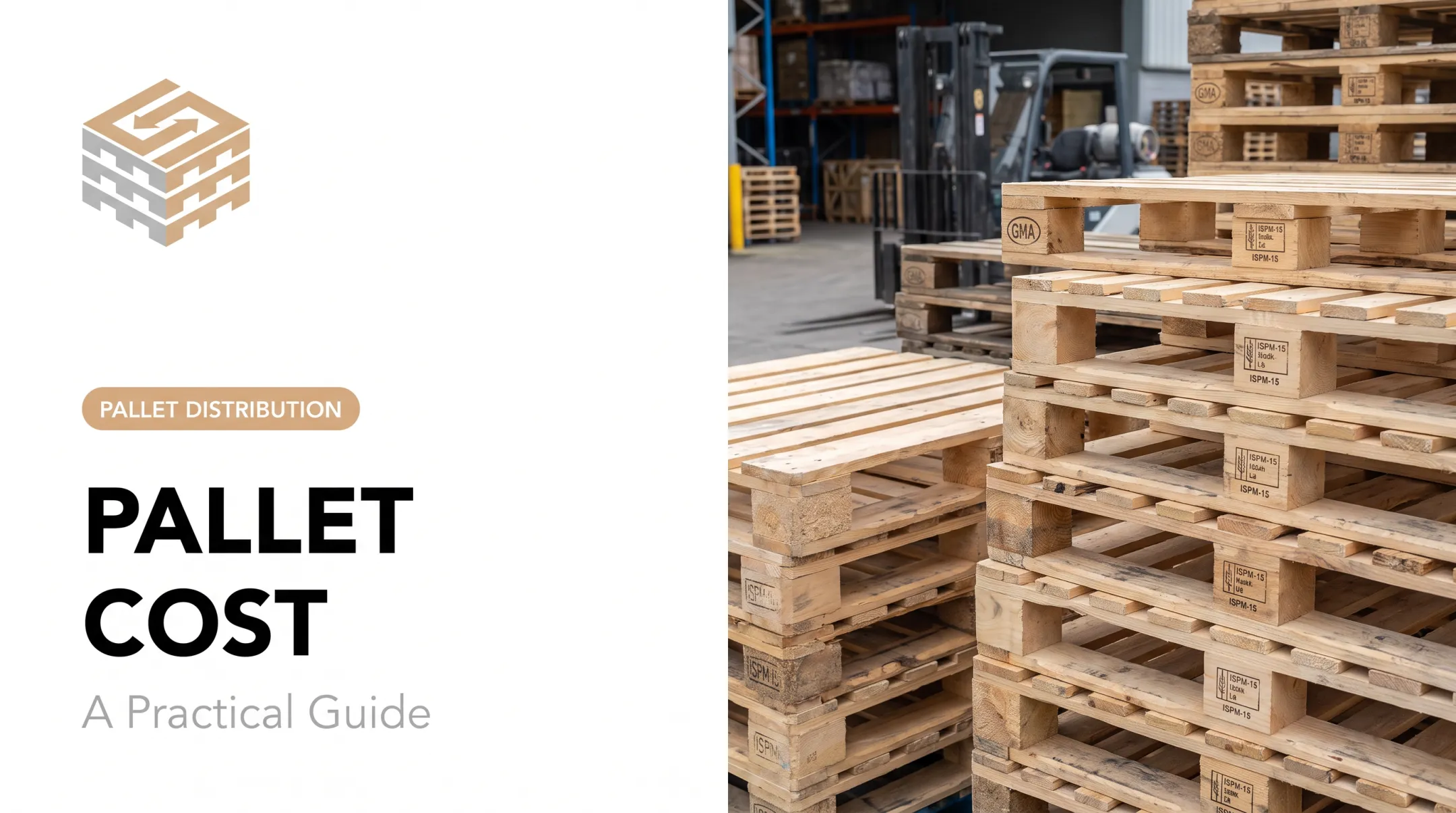
- Heat treatment for ISPM-15 export compliance
Over-specifying a pallet for an internal, low-stress application wastes money. Choosing an unsuitable low-cost pallet for a demanding load invites damage, rejected shipments, and repeat purchases. Neither extreme protects the bottom line.
Volume, Lead Time, and Trade Policy
Order volume, truckload utilization, delivery distance, storage capacity, and forecast accuracy all affect landed cost. Supplier concentration adds shortage exposure: if one mill or one distributor controls your supply, a regional disruption becomes your problem.
Trade policy adds another variable. Commerce's 2025 administrative reviews set Canadian softwood lumber antidumping and countervailing duty rates that vary by exporter, with non-selected companies facing 20.56% antidumping and 14.63% countervailing rates (U.S. Department of Commerce, 2025).

These duties apply to covered lumber products, not assembled finished pallets, which the underlying 2018 order specifically excludes. Don't assume a lumber tariff automatically translates into an equivalent pallet-price increase. Verify current U.S. policy before locking in long-term contracts, since rates and scope can shift.
High-volume shippers should prioritize contract pricing and truckload efficiency. Smaller operations typically get more value from flexible minimum orders and reliable availability over aggressive per-unit discounts.
Cost-Reduction Strategies for Pallets
The right strategy depends on how your pallets are specified, purchased, used, recovered, repaired, and supplied. Weigh every savings idea against product protection and supply continuity, not unit price alone.
Strategies That Reduce Costs by Changing Decisions
Reassess your specifications first. Many businesses pay for load capacity, board count, or heat treatment they don't actually need. Review dimensions, load ratings, and handling requirements against actual use, not legacy habit.
Consider recycled or remanufactured pallets where they fit. Grade A recycled pallets (all seven deck boards present, no broken stringers) work well for most internal warehouse handling and outbound shipments without rigid receiver specs. Grade B and utility-grade options cost less but demand realistic acceptance criteria:
- Define which loads tolerate minor repairs versus which require new pallets
- Compare expected service life, not just unit price
- Reserve new pallets for food-grade, export, and automated rack applications
Recycled and remanufactured pallets typically deliver 40 to 60% cost savings versus new pallets while remaining adequate for internal flow and receivers with flexible quality requirements.
Forecast demand before you need pallets, not after. Use shipment schedules, seasonal peaks, and historical usage to place orders early. Rush orders during a shortage cost more and come with fewer choices.
Compare total landed cost, not quoted price. Factor in delivery, minimum order quantities, fuel surcharges, quality consistency, and lead-time reliability. A slightly higher quote from a supplier with dependable delivery often beats a cheaper quote that arrives late.
Strategies That Reduce Costs by Changing How Pallets Are Managed
Inventory discipline prevents most emergency purchases. Track on-hand quantities, consumption rates, open orders, and safety-stock thresholds so you're never caught reordering under pressure.
Build a clear repair-versus-replace process:
- Inspect for split boards, broken stringers or blocks, and loose fasteners
- Flag contamination or moisture damage that affects structural integrity
- Document every inspection so unsafe pallets never re-enter circulation
- Route repairable units to refurbishment, not the dumpster
Recover pallets arriving with inbound freight instead of treating them as waste. Assign someone to collect, sort, and redeploy usable units before ordering replacements you didn't need to buy.
Handling practices matter more than most teams realize. Field research comparing used stringer pallets against laboratory simulations found frequent damage concentrated at stringer notches and bottom lead deckboards (BioResources, 2023).
Train forklift operators and dock staff on proper stacking and entry angles to protect those failure points and extend pallet life.
Review performance quarterly using cost per usable pallet, repair rate, loss rate, and stockout frequency. These numbers reveal problems long before they show up as an emergency purchase.

Strategies That Reduce Costs by Changing the Context Around Pallets
Diversify your supplier base. Depending on a single source during a shortage means their regional disruption becomes your disruption. A broader network improves access to different grades, quantities, and delivery windows when one channel tightens.
This is where an expansive supplier network earns its keep. Skid Management Services combines its own pallet inventory with a wide network of pallet and packaging suppliers across the country, which helps maintain competitive pricing and uninterrupted supply even when regional mills or recyclers face tighter conditions.
That owned-inventory-plus-network model is especially useful when you need custom specs, recycled-grade options, or closed-loop recovery without scrambling during a spike.
Evaluate pooling versus ownership. If retrieval, repair, and storage costs for a private fleet exceed the value of holding it, a managed recovery or buy-back program may cost less overall. Compare program fees against your current total cost before switching either direction.
Reconsider alternative materials only where they fit. Plastic, composite, or metal pallets may justify their cost for specific durability, hygiene, or automation needs. They are not automatically cheaper once lifecycle economics are factored in, so evaluate case by case rather than assuming a material swap solves a cost problem.
Tighten the surrounding system. Reducing empty miles, unnecessary handling steps, and storage congestion extends pallet life and cuts freight and labor costs at the same time.
Schedule a strategy review whenever lumber prices, tariffs, freight conditions, or supplier lead times shift meaningfully, rather than waiting for the next shortage to force the conversation.
Conclusion
Cutting pallet costs during a lumber shortage isn't about chasing the lowest unit price. Savings come from finding where total cost actually originates: specification, purchasing timing, inventory discipline, repair practices, and supplier resilience.
A balanced approach works best:
- Right-size your specs
- Plan demand instead of reacting to it
- Reuse and repair pallets that qualify
- Control inventory closely
- Compare landed cost, not quoted price
- Keep more than one qualified supplier on hand
Review your pallet data and supplier resilience now, before the next shortage-driven price spike catches your operation flat-footed. To review specifications, check availability, or request a quote on wood pallets and packaging supply, contact Skid Management Services at 717-202-0304 or Info@SkidManagementServices.com.
Frequently Asked Questions
What is the average price per pallet?
Price varies by size, new-versus-recycled condition, grade, wood market, order quantity, freight, and treatment requirements. Rather than relying on a national average, request a current quote from your supplier based on your specific specs and region.
How do I calculate cost per pallet position?
Add storage, handling, equipment, labor, purchase or rental, damage, and occupied warehouse space, then divide by the number of pallet positions. That figure differs from shipped-pallet cost, which only tracks expense when a pallet moves through your supply chain.
Are pallet prices going up?
Prices can rise when lumber, labor, freight, demand, or tariffs increase. Conditions still vary by region and grade, so check current supplier quotes and market data before assuming a broad national trend applies to you.
Are tariffs affecting wood prices?
Tariffs and trade policy can affect imported lumber costs, but the impact depends on product origin, policy scope, and exemptions. Finished pallets are frequently excluded from lumber-specific duties, so verify current U.S. policy before assuming a direct pass-through cost.
Why is there a pallet shortage?
Shortages stem from timber and lumber availability, manufacturing capacity, labor constraints, freight conditions, and demand peaks. Pallet loss and repair delays add pressure, and these issues are often regional or temporary rather than one uniform nationwide condition.