
Understanding entry configuration, dimensions, load limits, and construction type is essential before you order pallets for racking, automation, or shipping. Get the spec wrong and you'll deal with damaged loads, automation downtime, or forklift bottlenecks.
This guide breaks down the specifications, dimensions, load capacities, and construction differences you need to choose the right four-way pallet for your operation.
TL;DR
- Four-way entry lets forklifts and pallet jacks approach from any side; two-way stringer pallets allow end access only
- Most U.S. four-way pallets are block-style in 48"x40" GMA dimensions
- Load capacity hinges on construction, lumber grade, and support condition—not entry type alone
- Pick four-way vs. two-way based on handling frequency, racking layout, and automation needs
- Skid Management Services supplies new, recycled, and custom four-way and two-way pallets nationwide
What a Four-Way Entry Pallet Is
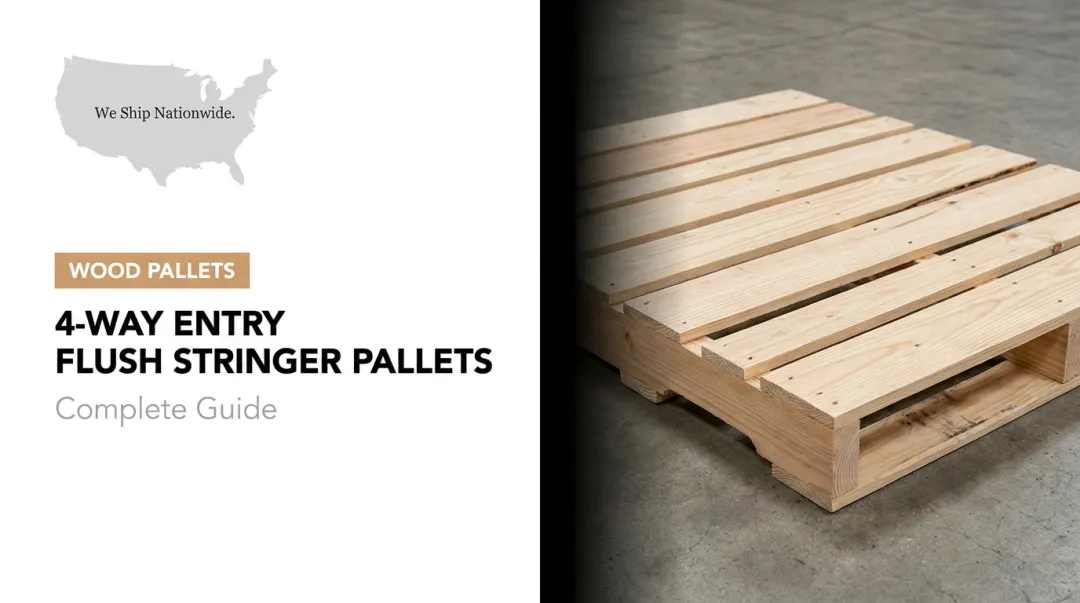
A four-way entry pallet is built so forklift tines or pallet jacks can enter from any side, not just two. That access speeds how your team picks up and moves a load from any approach angle.
Entry configuration is a structural design feature. It doesn't automatically tell you how much weight the pallet can carry; that's a separate spec tied to construction and testing.
According to the National Wooden Pallet and Container Association's Uniform Standard for Wood Pallets, there are two routes to four-way access:
- True block construction — full access from every side, no limitations
- Partial four-way (notched stringer) — forklift access from all sides, but pallet jack access limited to two
Block vs. Notched Stringer Construction
Block pallets use blocks at the corners and center, supporting both the top and bottom decks. Any forklift or pallet jack can enter from any direction without restriction.
Notched stringer pallets keep the solid stringer design but cut notches into them. This allows forklift entry from all four sides, but a standard pallet jack still can't get through the stringer sides.
Skid Management Services supplies both types. Its block pallets deliver true four-way entry. Its double-wing stringer pallets use notched construction for partial four-way access and suit heavy-duty applications up to 4,000+ lb dynamic capacity.
True block pallets generally offer higher load ratings and better durability than notched stringer designs, though they cost more to build.

Standard Dimensions and Specifications
Four-way entry is available across most standard pallet footprints, and the 48"x40" GMA size still dominates the U.S. market. A 2025 BioResources industry study found 48x40 pallets represented 29% of new pallets produced in 2021. Footprint alone, though, is only the starting spec.
Common Four-Way Pallet Sizes
| Size | Typical Use | Notes |
|---|---|---|
| 48"x40" | General warehousing, retail DC | Most common; NWPCA example shows 7 top / 5 bottom deckboards |
| 48"x48" | Drums, chemical | Fits four 55-gallon drums in 2x2 layout; ~2,500-3,000 lb dynamic |
| 42"x42" | Telecom, paint, chemical | Lighter than 48x48, heavier than GMA 48x40 |
| 40"x48" | Industry-specific | Varies by supplier program |
| 48"x36" | Industry-specific | Varies by supplier program |
A "48x40" label only names the footprint. It does not guarantee height, weight, or deck-board count. The NWPCA standard treats size and design details as separate from the nominal footprint, so two 48x40 pallets from different suppliers are often built differently.

Load Capacity and Weight Considerations
Load capacity is three separate ratings:
- Static load capacity — how much weight the pallet supports sitting on the floor
- Dynamic load capacity — how much it supports while being moved (fork-supported)
- Racking load capacity — how much it supports when spanning open space on a rack
According to Virginia Tech's Center for Packaging and Unit Load Design, strength and stiffness testing each produce a preliminary safe load figure, and the lower of the two becomes the rated capacity for that support condition.

Grade affects real-world performance as much as footprint. Skid Management Services supplies new, Grade A, and Grade B recycled pallets:
- Grade A recycled — treated as equivalent to new for most applications
- Grade B — structurally intact; best for general warehouse use, not heavy-duty programs
No universal industry percentage separates grades, so skip generic claims like "Grade B is 20% weaker." Use the tested rating for your unit load and support condition.
Key Technical Properties That Define Performance
Four-way pallets stand apart on three fronts: handling flexibility, structural strength, and weight/shipping impact.
Property 1: Handling Flexibility and Access
Multi-directional entry removes the orientation problem. Forklift drivers don't need to reposition a pallet to get tines under it. They can approach from whichever side is closest. In high-throughput operations, this cuts down on wasted movement. The trade-off? Block construction adds material and labor, which raises the unit cost compared to a basic two-way stringer pallet.
Property 2: Structural Strength and Durability
Block construction generally holds up better under heavier, repeated loads than notched stringer designs. The blocks distribute weight more evenly across the deck. This matters most for:
- High-cycle operations (pallets reused dozens of times)
- Heavy unit loads near the pallet's rated capacity
- Automated systems where pallet failure causes line stoppages A 2020 Virginia Tech case study found that stringer-class recycled pallets were the leading cause of pallet-related downtime in surveyed semi- and fully automated facilities. If you're running automation, condition and construction consistency matter more than the marketing label.
Property 3: Weight and Trailer Efficiency
Four-way block pallets typically weigh more than two-way stringer pallets, simply because they carry more structural material. That added tare weight eats into your trailer's payload capacity on every shipment. There's no fixed weight differential across the industry. It depends on lumber species, board thickness, and design. If shipping economics matter for your program, request the actual tare weight for your specific build rather than relying on a general estimate.

How Four-Way Pallets Are Specified and Verified
Specification covers design and receiving alike. Treat it as a quality-control checkpoint once pallets arrive at your dock.
Specification and Documentation
Your purchase order or engineering drawing should define:
- Nominal size (length x width)
- Entry type (full four-way, partial four-way, or two-way)
- Construction (block or stringer)
- Deck board count, top and bottom
- Lumber grade and treatment
- Rated capacity and the support condition it was tested under
Rated capacity is not the same as field-tested capacity. A pallet rated for 3,000 lb under controlled lab conditions may perform differently once it's handling real warehouse traffic, forklift impacts, and repeated stacking.
Measurement and Inspection Methods
At receiving, check for:
- Block or stringer placement matching the spec
- Notch depth consistent across the batch (for notched stringer designs)
- Deck board count matching the order
- Missing, cracked, or split components
- Protruding fasteners
Skid Management Services confirms four-way entry on every pallet for its Amazon FBA program, but a documented notch-depth tolerance check isn't standard across every order type. If your program requires tight tolerance control, ask your supplier directly what their inspection process covers.
This is where a supplier network matters. Skid Management Services combines its own inventory with an expansive supplier network to help maintain consistent specs across large, multi-location orders, which reduces the risk of mismatched pallets arriving at different facilities.
Choosing Between Four-Way and Two-Way Pallets
Don't default to one type across your whole operation. Match the entry configuration to how the pallet will actually be used.
Consider these factors:
- Racking and forklift fleet compatibility: Does your equipment need side access, or does it always approach from the same direction?
- Automation and conveyor requirements: Automated systems often need consistent geometry, which favors new pallets with uniform tolerances over mixed-condition recycled stock.
- Handling frequency: High-turnover operations benefit most from four-way access because it cuts repositioning time.
- Upfront cost vs. long-term efficiency: Block pallets cost more per unit but may reduce labor time over hundreds of cycles.
There's no industry-standard dollar premium for four-way over two-way. Pricing depends on lumber grade, volume, and delivery lane.
Skid Management Services' national supplier network helps businesses source the right four-way or two-way spec at competitive pricing with consistent supply—whether a standard GMA pallet or a custom build for chemical, cold storage, or retail-DC programs.
Frequently Asked Questions
What are the specifications of a standard four-way entry pallet?
A standard 48"x40" GMA four-way pallet uses block or notched-stringer construction. Exact top/bottom deck board counts, height, and weight vary by supplier and must be confirmed on your specific quote.
How does a two-way pallet differ from a four-way entry pallet?
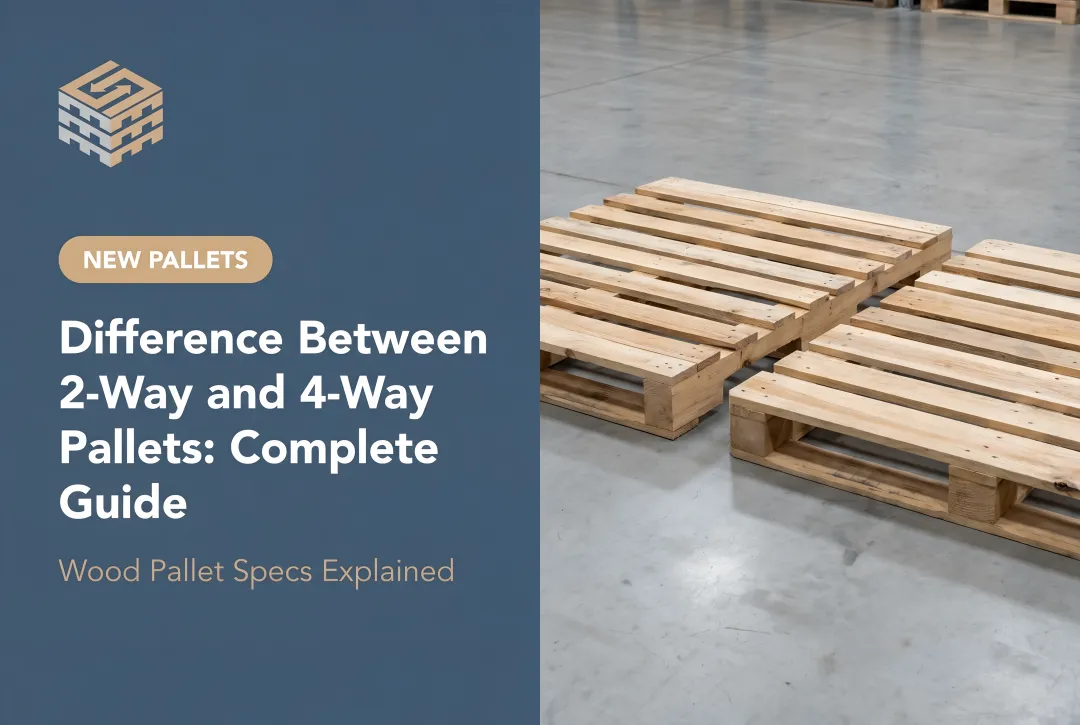
Two-way pallets only allow forklift entry from the stringer ends. Four-way pallets permit entry from all four sides, either through block construction or notched stringers.
Is a four-way pallet the same as a block pallet?
Not always. Most true four-way pallets use block construction, but notched stringer pallets also achieve four-way forklift access without being classified as block pallets.
How much does a standard four-way pallet weigh?
There's no universal weight standard. Block construction typically weighs more than two-way stringer pallets due to added material, but you should request the actual tare weight for your specific design.
What industries require four-way entry pallets?
High-volume retail, grocery distribution, and automated warehousing commonly use four-way pallets. Chemical, telecom, and food and beverage manufacturers also rely on them for specific size and load requirements.
Are four-way pallets more expensive than two-way pallets?
Block construction generally adds material and labor cost. Whether that premium pays off depends on your handling frequency, since faster loading can offset the higher unit price over time.