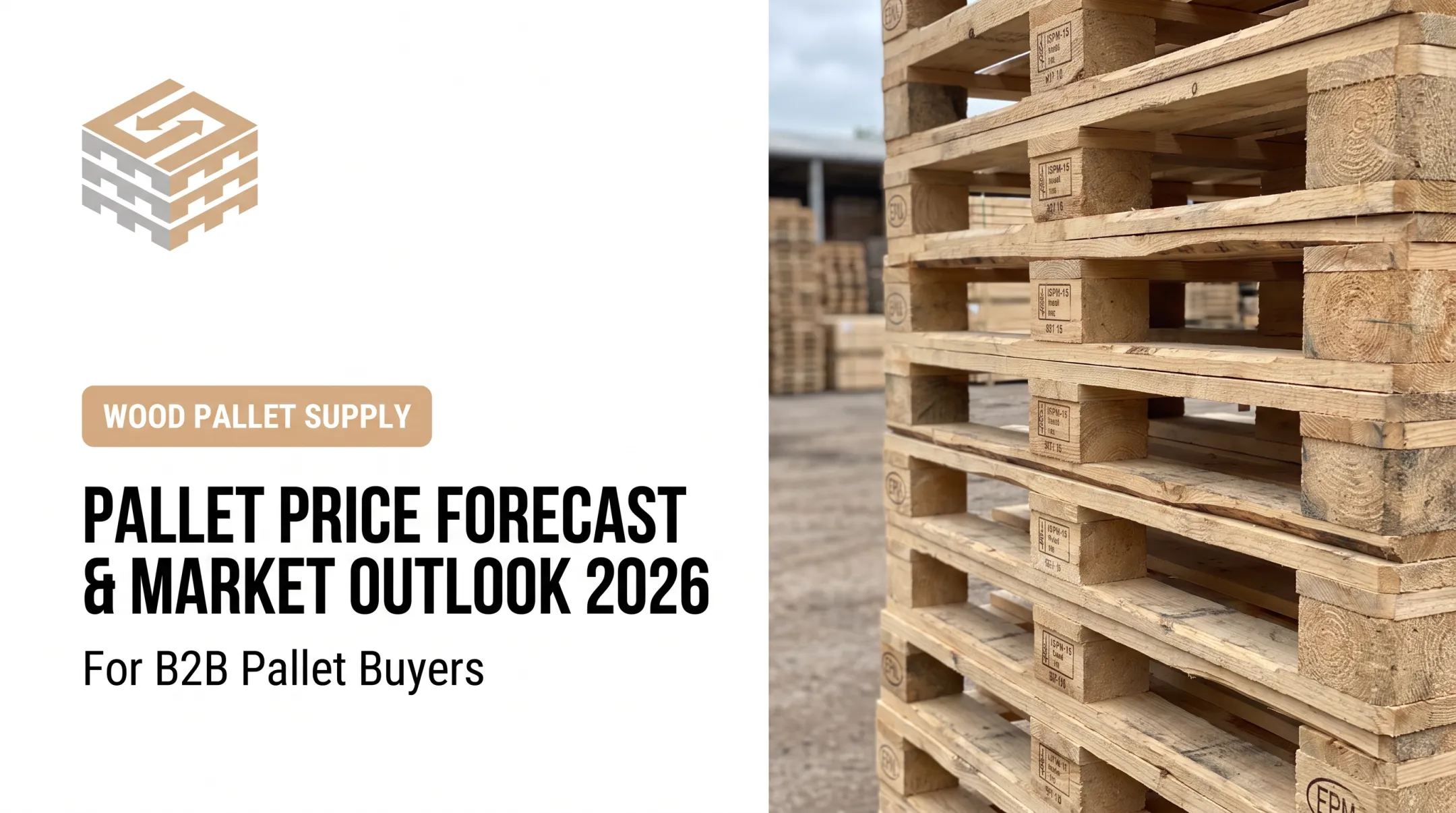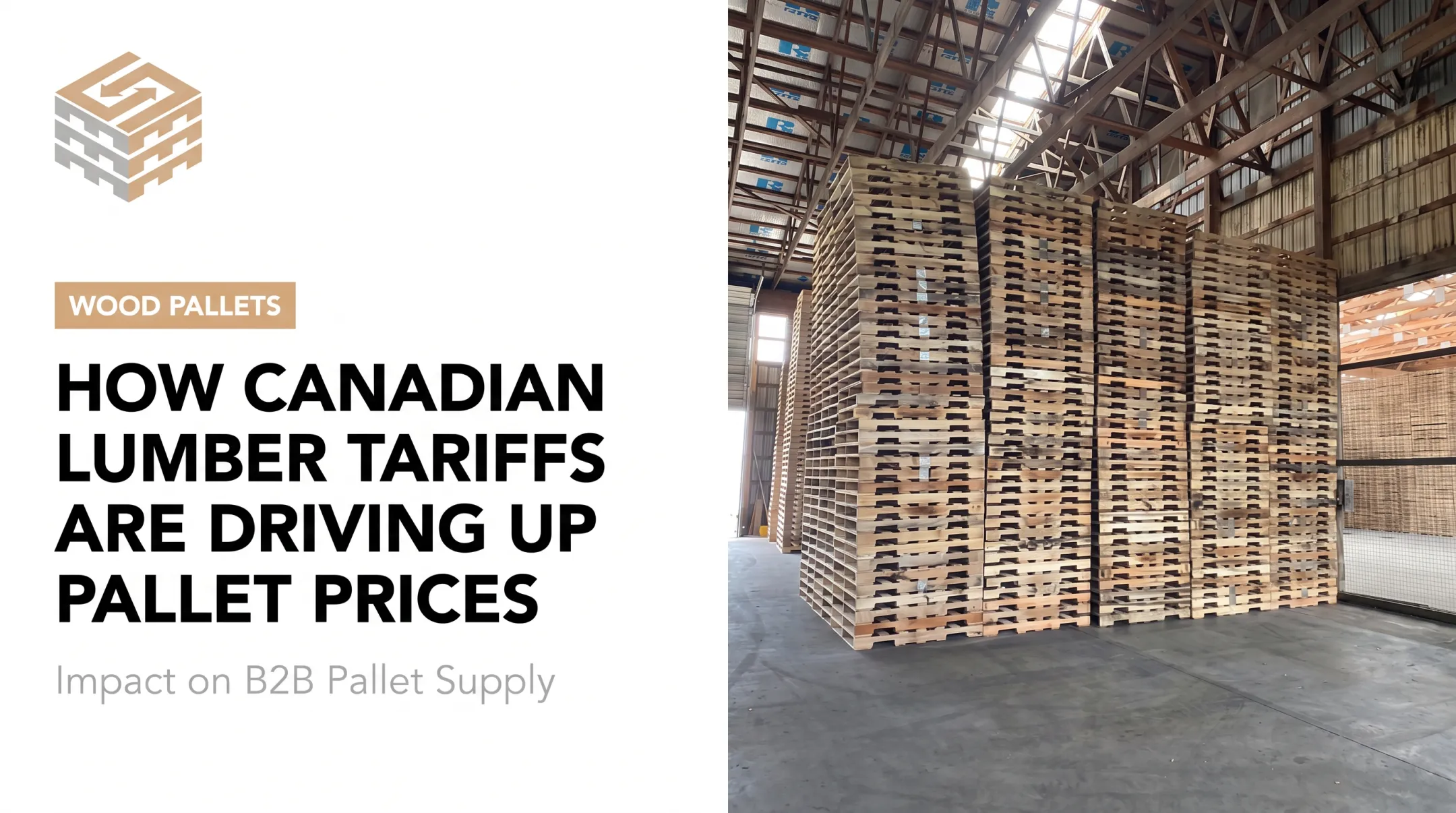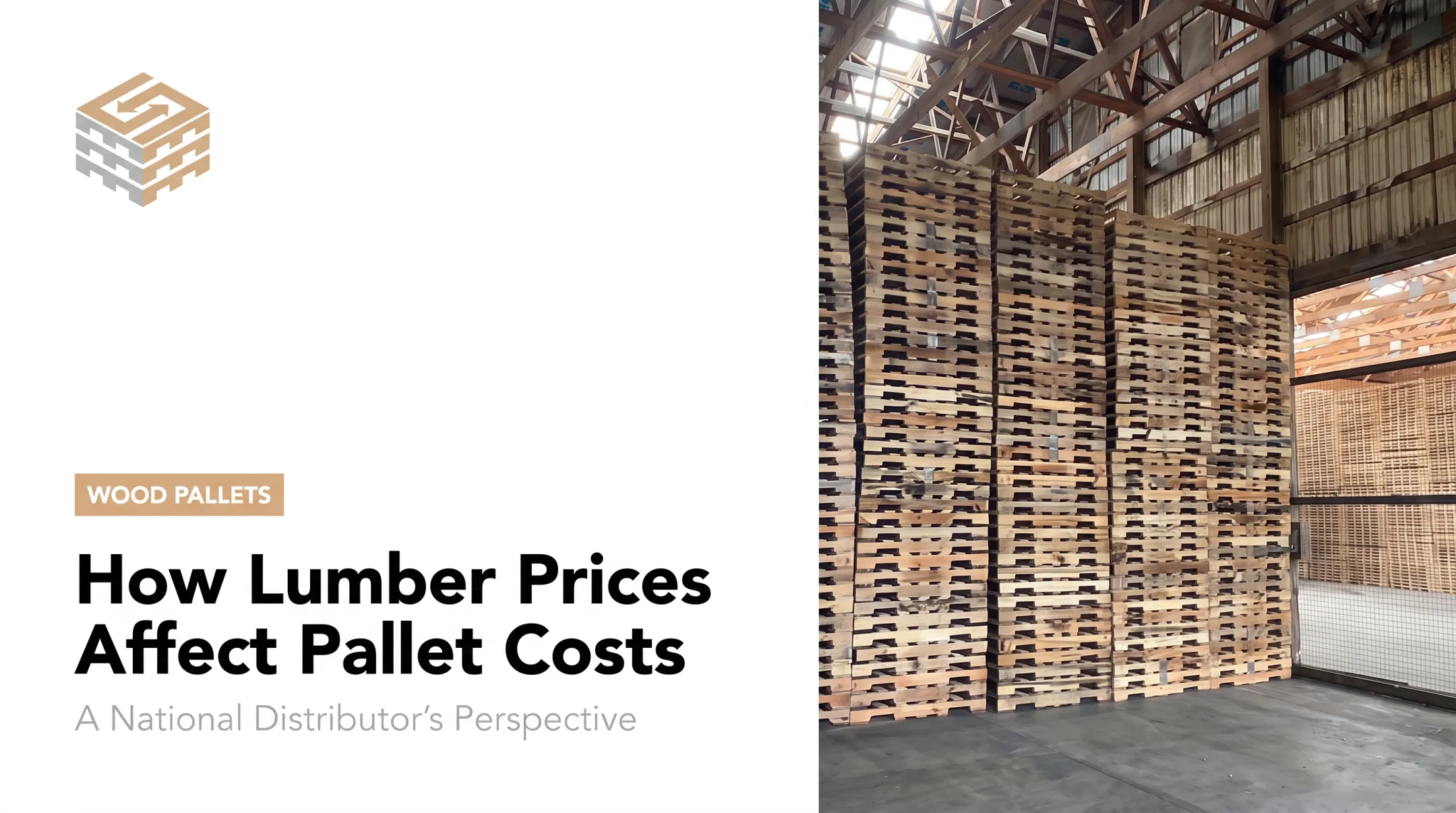

If your latest quote came in higher than last year's, you're not imagining things. But the increase isn't uniform. Pallet dimensions, condition, wood type, order volume, freight distance, and treatment requirements all move the needle differently depending on your supplier and region.
This article breaks down what current pricing data actually shows, what's driving the movement, how it's hitting operations, and what to watch heading into 2027.
Key Takeaways
- Grade A prices swing with size, region, volume, and new vs. recycled or remanufactured stock
- Lumber, cores, freight, and labor drive delivered cost—and those inputs do not move in lockstep
- Compare total cost per usable trip, not just the invoice line
- Diversify suppliers and enforce grading standards instead of defaulting to Grade B
Grade A Pallet Price Trends in 2026
Grade A Pallet Pricing Direction
One marketplace report tracking wholesale listings puts the national average price for used 48x40 Grade A pallets at $9.04 in January-February 2026. That compares with reported averages of $8.33 in 2025 and $6.16 in 2024, according to UsedPalletRecycling's 2026 pricing report.
That's a real directional signal, but it's a listing average across 396 suppliers, not an audited index of completed transactions.
Buy-back rates and procurement prices aren't the same thing. A Florida buyer reported paying $6 to $9 per used Grade A pallet for qualifying loads in July 2026. That's what a supplier pays you to collect pallets, not what you'd pay to buy them. Keep those two numbers in separate columns when you're budgeting.
Typical Grade A Pallet Specifications and Price Variables
"Grade A" isn't a federally regulated term. Most suppliers apply it to pallets with:
- All (or nearly all) deck boards present and intact
- Sound stringers, no cracks or breaks
- Consistent dimensions matching the stated spec
- Limited, clean repair history (some suppliers allow minor board repairs or mending plates)
Standard 48x40 GMA pallets price differently than custom sizes. Entry type (2-way vs. 4-way), board configuration, and load rating all factor into the quote. A retail-DC-spec pallet with tight rack tolerances will cost more than a general-use unit of the same nominal size.
Regional and Delivered-Price Differences
Lumber availability and local pallet-core supply create real regional spreads. The same 2026 marketplace report broke down Grade A listing averages by region:
| Region | Average Listed Price (48x40 Grade A) |
|---|---|
| West | $10.72 |
| Northeast | $10.36 |
| Southeast | $8.48 |
| Midwest | $8.40 |
| Southwest | $5.79 |

These are listing averages, not matched delivered quotes for identical order sizes. The regional spread still matters for budgeting.
Buyers near active core-collection markets and pallet-recycling hubs often see tighter pricing than buyers in supply-constrained regions. One example is the Pennsylvania, New York, West Virginia, and New Jersey mill corridor within 150 miles of Greater Philadelphia.
Base price and delivered price are different numbers. Freight, fuel surcharges, accessorial fees, and taxes sit on top of the per-pallet cost. Always ask suppliers to separate these line items before comparing quotes.
Grade A Versus Grade B Purchasing Decisions
Grade B pallets typically carry 1-2 minor board repairs but retain full structural integrity. They work fine for general warehouse handling and internal transfers.
Grade A earns its premium when:
- Automated conveyor or rack systems need consistent dimensions
- Retailers enforce strict receiving specs (Amazon FBA rejects pallets with damaged stringers or missing deck boards)
- Products need repeat-trip durability without failure risk
- Appearance matters for customer-facing shipments
If your operation doesn't hit those thresholds, Grade B can shave real cost off packaging spend without hurting performance.
New, Recycled, and Remanufactured Grade A Options
Recycled and remanufactured pallets typically deliver 40-60% cost savings versus new builds, based on Skid Management Services' pricing data. New pallets offer the cleanest, most consistent option for food-grade and FDA-regulated applications where contamination history matters. Remanufactured pallets, built from recovered lumber components, work well for nonstandard sizes when used standard-size stock isn't available.
Before you sign off on any "Grade A" quote, confirm:
- Does it include heat treatment for ISPM-15 export compliance?
- Is sanitation documentation available if you're in food or pharma?
- Are exact dimensions guaranteed, or is there tolerance variance?
- What's the stated dynamic load capacity?
- Does the supplier's grading match your definition of Grade A?
What's Driving the Grade A Pallet Price Increase?
Grade A pricing reflects several linked cost inputs, not one national market rate. Here's what the current data actually supports.
Lumber and Pallet-Grade Wood Availability
The Hardwood Market Report's July 3, 2026 assessment quotes Northern, green, random-width pallet lumber (4/4 thickness) at $320 per thousand board feet, with a reported range of $280 to $425, according to the Hardwood Market Report.
That figure is a pallet-grade input quote, not a finished-pallet price, and it doesn't by itself prove a year-over-year increase. General construction-lumber indexes miss this market; pallet-grade material tracks low-grade log availability and sawmill byproduct output instead.
Recovered Pallet Cores and Repair Economics
Recycled Grade A inventory depends on the volume and condition of returned pallet cores flowing back into the system. One industry outlook expects core availability to stabilize relative to the prior two years, rather than confirming a nationwide shortage.
Don't assume core scarcity explains every quote increase you're seeing. Repair labor, fastener costs, and sorting capacity all play a role, but no verifiable 2026 figure isolates their individual contribution.
Freight, Fuel, Labor, and Operating Costs
Even when the pallet's base material price holds steady, delivered cost can climb from transportation alone. DAT reported August 2026 national van spot linehaul at $2.19 per mile, according to DAT's freight data.
Here's an illustrative example using that figure:
- 500-mile haul × $2.19/mile = $1,095 in linehaul cost
- Divided across a 26-pallet load = roughly $42 per pallet in linehaul alone
- Add fuel surcharges, accessorials, and the pallet's base price, and delivered cost climbs quickly
This is a hypothetical calculation for illustration, not a quoted delivered rate. Your actual number depends on distance, load size, and carrier agreement.
Demand, Seasonality, and Supply-Chain Competition
Food and beverage, retail, and e-commerce all pull on standard 48x40 inventory, and demand tends to spike ahead of peak shipping seasons. One industry outlook forecasts stronger Grade A pricing in the first half of 2026 tied to retail sales activity, though that's a projection, not a measured demand series.
Minimum order quantities and urgent replenishment needs can add volatility to quotes even when underlying supply hasn't materially changed.
Compliance and Specification Requirements
ISPM-15 heat treatment (a 56°C core temperature held for at least 30 minutes, plus compliant IPPC marking) adds cost, but only for export shipments. Food and pharmaceutical handling may require sanitation documentation or solid-top decks. These requirements apply to specific shipments and industries, not to every Grade A pallet on the market. Don't assume a compliance surcharge applies unless your shipment actually needs it.

How These Trends Are Impacting the US Supply Chain
Higher Grade A quotes ripple into packaging budgets, freight planning, and customer commitments in ways that go beyond the invoice.
Operational Impact
Inconsistent Grade A availability creates real friction:
- Receiving delays when shipments arrive short or mismatched
- Production interruptions from packaging line stoppages
- Manual inspection burden when incoming loads mix grades
- Emergency sourcing at premium prices
Non-compliant pallets get refused at fulfillment-center docks. Amazon FBA, for instance, requires GMA 48x40, 4-way entry pallets with undamaged stringers and no protruding nails. Rejects go back to the supplier, costing freight both directions plus lost inventory-flow time.
Automotive and heavy-equipment manufacturers running JIT or Kanban flow face something worse: a missed pallet delivery can stop the line entirely.
Track these metrics to quantify your real exposure: pallet consumption, rejected units, repair rates, damage incidents, lead times, and emergency purchase frequency.
Business Impact
Comparing supplier quotes on invoice price alone misses the real cost. Procurement teams should weigh:
- Delivered cost (base price plus freight and accessorials)
- Usable-trip cost (price divided by expected trips before failure)
- Failure risk and replacement terms
- Payment terms, minimum order quantities, and price-validity windows
- Lead time reliability
Practical responses that help without cutting corners:
- Forecast demand earlier so you're not buying under time pressure
- Consolidate compatible orders to hit better volume tiers
- Review specifications to confirm you're not over-speccing Grade A where Grade B would work
- Negotiate recurring supply arrangements; closed-loop programs with trade-in credit typically offset 15-40% of new-pallet spend
Workforce and Supplier-Management Impact
When businesses respond to higher prices by increasing internal reuse or buying mixed-condition inventory, someone has to inspect, sort, repair, and stack that stock. That's added labor hours that don't show up on the pallet invoice but hit the operating budget just the same.
A steadier Grade A pipeline cuts that secondary labor burden. Skid Management Services combines its own inventory with an expansive supplier network, an approach worth considering if consistent Grade A supply and competitive pricing matter more than committing to a single vendor. Pricing, availability, and delivery timing still depend on your specific volume and market conditions at the time of quoting.

Before signing with any supplier, ask:
- What's your grading standard, and is it documented?
- What quantities can you guarantee, and how often?
- What's your inspection process before pallets ship?
- What are your delivery terms and lead times?
- What's your replacement policy for rejected loads?
- How do you handle continuity if your primary source runs short?
Future Signals for Grade A Pallet Prices
2026 pricing isn't locked in. Lumber supply, core recovery, freight conditions, and broader demand will keep shifting the picture.
Watch these early indicators:
- Pallet-grade lumber assessments (not general construction lumber indexes)
- Sawmill capacity and closures
- Pallet-core collection volumes
- Repair labor costs
- Freight rates and fuel surcharges
- Supplier lead times and order backlogs
Technologies worth tracking:
- Automated inspection systems
- Repair automation
- Supplier inventory visibility tools
- Closed-loop recovery programs
- Procurement analytics that measure cost per usable trip rather than sticker price alone
One commodity data provider has proposed launching over 100 new delivered wood pallet price assessments across dozens of US locations. That signals the industry itself sees a gap in reliable pricing benchmarks.

Three plausible scenarios over the next 1-3 years:
- Continued inflation — if lumber mills keep closing capacity and core recovery tightens further
- Stabilization — if core supply normalizes as forecast and lumber prices hold within current ranges
- Easing prices — if freight rates soften, automation cuts repair labor costs, and retail demand cools
No current evidence points decisively toward one outcome. Treat any single forecast with caution.
Conclusion
The 2026 Grade A pallet price increase deserves a full look at delivered and operational costs, not just a headline number from one marketplace report. Regional spreads, freight variables, and specification requirements all shape what you actually pay.
Early planning helps when you:
- Define exactly what "Grade A" means to your suppliers
- Review your specs against what you actually need
- Work with more than one supply source
- Track rejection and repair rates over time
If you're evaluating Grade A pallet requirements for 2026, Skid Management Services can walk through specifications, volume, and delivery needs to put together a quote. Reach out at 717-202-0304 or Info@SkidManagementServices.com. Final pricing will depend on your specs, volume, delivery distance, and current market conditions.
Frequently Asked Questions
What is the current cost of Grade A pallets?
Used 48x40 Grade A pallets averaged $9.04 nationally in early 2026, with listings from about $4.62 to $24.00 by region and volume. New pallets usually need a direct supplier quote.
How much is a pallet worth to sell?
Resale value depends on grade, size, condition, quantity, and local demand. Clean Grade A pallets in bulk (250+) can fetch $6-$9 each in some buy-back programs; damaged or scrap units return far less after pickup.
What is the average freight cost per pallet?
There's no universal rate. Freight depends on distance, load size, fuel surcharges, and carrier terms. For example, a 500-mile haul at $2.19/mile across 26 pallets runs about $42 each before surcharges.
What's the difference between Grade A and B pallets?
Grade A pallets have intact deck boards, sound stringers, and minimal repair history. Grade B pallets typically carry 1-2 minor repairs but retain full structural integrity. Definitions vary by supplier, so always confirm the specific standard before ordering.
What type of pallets are worth money?
Reusable standard-size pallets (especially 48x40 GMA), Grade A inventory, and specialty or custom builds in strong local demand tend to hold the most resale value. Condition and pickup logistics still determine your actual return.
What is the standard size of a Grade A pallet?
48x40 inches is the common US GMA reference size. "Grade A" describes condition and quality, not a mandatory dimension, so Grade A pallets also come in 48x48, 42x42, and other standard or custom sizes.