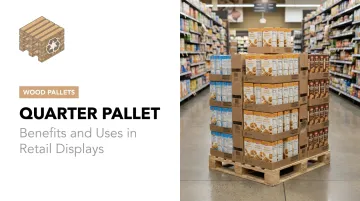
The term "quarter pallet" gets tossed around loosely, sometimes used interchangeably with CHEP display or pooled exchange platforms. But the real value shows up in three measurable places: stocking speed, damage rates, and shelf presence.
This article breaks down what a quarter pallet actually is, the retail benefits backed by data, common display formats, and what to look for when sourcing one for a multi-location program.
Key Takeaways
- Quarter pallets measure 24x20 inches, one-fourth the size of a standard pallet
- Compact footprints fit more product variety into limited promotional space
- Pre-built display units reduce handling labor versus case-picked shipments
- Consistent pallet quality and supply directly impact display safety and scalability
What Is a Quarter Pallet? (Brief Context)
What Is a Quarter Pallet?
A quarter pallet is exactly one-fourth of a full-size pallet's footprint. In North America, that means 24x20 inches; in Europe, the equivalent display pallet runs 400x600mm. Walmart's own Secondary Packaging Supply Chain Standards confirms this exact 24x20 inch specification for approved display programs, giving retailers a shared reference point rather than a loosely defined category.
You'll see quarter pallets in:
- Floor displays and freestanding promotional units
- Action alleys and secondary display zones
- End-caps in grocery, big-box, club, and convenience stores
- In-aisle promotional spots tied to seasonal or limited-time offers
A quarter pallet functions as a tactical display tool for the retail floor. The 48x40 GMA pallet still dominates warehousing, transportation, and distribution overall.
The quarter pallet solves a different problem: presenting a product attractively in a small footprint without sacrificing stability or the display's shelf life.
Key Benefits of Quarter Pallet Displays in Retail
The advantages below aren't abstract. They map directly to metrics that retailers and brand teams track every week: floor space utilization, labor hours, and shrink. Each one connects to a real decision, whether that's approving shelf space for a new SKU or budgeting for a seasonal rollout.
Maximizes Floor Space and Product Variety
A quarter pallet occupies roughly one-quarter the footprint of a full pallet and half the footprint of a half pallet. That smaller footprint opens real options for merchandising teams.
- Retailers can fit multiple brands into the same action alley or end-cap footprint simultaneously
- Smaller units let category managers rotate promotions faster without dead zones
- Fitting more variety into high-traffic zones increases the odds any given shopper stops
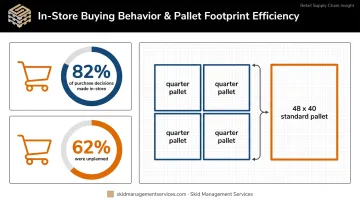
Floor displays matter because most purchase decisions happen in the store, not before it. A POPAI study of nearly 3,000 mass-merchant shoppers found 82% of purchase decisions were made in-store, and 62% were unplanned. Fractional pallets give more brands a shot at that unplanned-purchase moment without retailers giving up an entire aisle end to one product.
Skid Management Services builds quarter pallets in 20x24 and 24x20 configurations sized for exactly this kind of retail-ready program, a common request among the food and beverage manufacturers it supplies.
KPIs impacted: sales per square foot, number of SKUs displayed, incremental/impulse sales volume.
When it matters most: high-footfall grocery and big-box stores where promotional real estate is rationed tightly and every square foot gets scrutinized during planning.
Speeds Store Set-Up and Cuts Handling Labor
A quarter pallet display typically ships pre-built and display-ready. Compare that to a case-picked pallet, where an order picker assembles individual cases at the distribution center, then a store associate breaks it down again on the sales floor.
That's two labor touchpoints a display-ready quarter pallet skips entirely. The DC sends a complete unit; the store rolls it straight to the floor.
- Fewer manual case-picking steps at the distribution center
- No individual stocking required once the unit reaches the sales floor
- Lower risk of running out of stock during a promotion window, since setup happens faster
KPIs impacted: store stocking time, labor hours per display, on-shelf availability rate.
When it matters most: time-sensitive seasonal rollouts, or chains running lean backroom staffing where every stocking hour counts against payroll budgets.
Reduces Product and Brand Damage
A quarter pallet display stays intact from the moment it's built until it lands on the sales floor. Case-picked pallets don't get that luxury. They're assembled, stacked, and often re-stacked multiple times before reaching a shopper.
That repeated handling creates real risk. Distribution center staging and in-transit handling are the two biggest sources of CPG product damage, and every additional touch adds another chance for a crushed case or a torn package.
- The pallet itself often stays visible to shoppers, so a clean, undamaged unit protects brand presentation
- Fewer rebuild steps mean fewer chances for instability or crushing
- Lower shrink translates directly to protected margin on promotional volume
KPIs impacted: damage/shrink rate, product return rate, cost of goods lost in transit.
When it matters most: fragile products, or any brand prioritizing a polished shelf presentation where a beat-up pallet undermines the premium positioning it's trying to build.
Common Uses and Types of Quarter Pallet Displays in Retail
The primary use case is straightforward: promotional floor and in-aisle displays across grocery, big-box, club, and convenience retail channels. But the formats and construction choices behind that use case vary quite a bit.
Popular Display Formats
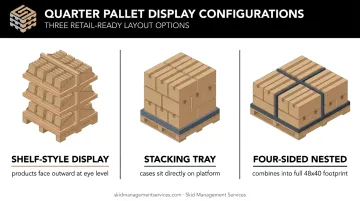
Quarter pallet displays generally show up in a few recognizable configurations:
- Shelf-style displays — tiered shelving built onto the base, letting products face outward at eye level
- Stacking tray configurations — simpler builds where product cases sit directly on the platform, often used for high-volume, lower-margin items
- Four-sided nested configurations — four quarter pallets combined into a full-size 48x40 footprint, used for shared or rotating multi-brand promotions
Pallet Base Options: Custom Wood vs. Pooled Exchange Pallets
Once a display format is chosen, the next decision is what platform it sits on. This is where "quarter pallet" and "CHEP display" get confused most often. CHEP is a pooled exchange pallet brand, not a size designation. CHEP does offer platforms built to quarter-pallet dimensions, but that's a brand-specific product, not the category itself.
The real choice comes down to trade-offs:
| Factor | Pooled Exchange (CHEP-style) | Custom Wood |
|---|---|---|
| Ownership | Rented/pooled, returned after use | Owned outright |
| Consistency | Standardized quality across units | Depends on build specification |
| Flexibility | Limited to pool provider's sizes | Built to exact program requirements |
| Control | Shared across multiple users | Full control over lumber, design, timing |
A custom-built wood quarter pallet, like the 20x24 inch platforms Skid Management Services builds to order, gives brand teams control over specification and supply timing that pooled systems don't offer.
Material Handling and Safety Considerations
Format and base material aside, quarter pallets also create distinct handling demands on the warehouse floor. They require careful balancing when handled on a single fork tine, since the narrower footprint doesn't distribute weight the same way a full pallet does. As display volume scales across multiple locations, specialized handling equipment becomes worth the investment.
On safety: OSHA's 1910.176 standard doesn't set a universal display height limit, but it does require stacked materials to be stable and secure against sliding or collapse, and aisles kept clear of obstructions. Practically, that means:
- Keep floor displays low enough to avoid trip-and-fall risk
- Monitor empty or near-empty pallets and remove them promptly
- Confirm height limits against the specific retailer's own guidelines
What Happens When Pallet Quality Is Overlooked
Cutting corners on quarter pallet quality tends to catch up with a program fast. The most common consequences include:
- Load stability suffers, causing increased breakage during transit or in-store handling
- Safety hazards increase, since weak or damaged pallets create liability exposure retailers won't tolerate
- Replacement costs spike when reactive swaps disrupt promotional timelines right as a campaign needs to launch
- Scaling becomes difficult, since inconsistent quality makes it hard to run the same display reliably across dozens or hundreds of store locations
None of these show up as a single dramatic failure. They show up as a slow accumulation of small delays and small costs, until a promotional rollout that should have taken two weeks takes six.
How to Get the Most Value from Quarter Pallet Programs
Quarter pallet programs deliver the most value when they're built on consistently graded, durable lumber rather than whatever option costs the least upfront. A cheaper pallet that breaks mid-promotion costs far more than the few cents saved per unit.
A few practices separate programs that scale well from ones that stall:
- Review breakage rate and restock speed regularly: treat these as ongoing metrics, not one-time checks
- Adjust supplier or design choices based on that data. If a design consistently underperforms, change it before the next rollout
- Secure a supply partner that can scale with you, since inconsistent availability delays multi-location programs more than any single design flaw
Working with an established national pallet supplier, such as Skid Management Services, helps secure competitive pricing and uninterrupted supply. That combination of owned inventory plus a broad supplier network matters most when a rollout spans dozens of store locations at once. No single point of failure can be allowed to hold up the whole program.
Conclusion
A quarter pallet's real value comes from space efficiency, faster handling, and reduced product damage working together, not any single feature. Each advantage compounds as a display program scales across more stores and more promotional cycles, turning small per-unit savings into meaningful program-wide results.
Sourcing a quarter pallet works best as an ongoing supply chain relationship, not a one-time purchase decision. Consistent quality and reliable availability determine whether your display program scales smoothly or stalls at the worst possible moment. Skid Management Services backs that relationship with its own inventory and supplier network, keeping quarter pallets in stock as programs grow.
Frequently Asked Questions
What is a quarter pallet?
A quarter pallet is one-fourth the footprint of a standard pallet, built for retail floor and in-aisle display use. It's designed to fit compact promotional spaces like action alleys and end-caps.
What is the size of a quarter pallet?
The standard North American dimension is 24x20 inches. The European equivalent runs 400x600mm, sized for off-location and aisle-end display applications.
How many quarter pallets fit on a standard pallet?
Four quarter pallets fit within the footprint of one standard 48x40 pallet. Actual product capacity on each quarter pallet varies depending on item size and packaging.
What are quarter pallets typically used for in retail?
They're primarily used for promotional floor displays, action alleys, end-caps, and in-aisle placements across grocery and big-box stores. The compact footprint lets more brands compete for the same limited space.
How much weight can a quarter pallet hold?
Load capacity depends on the pallet's construction and lumber grade, so figures vary between suppliers and builds. Confirm the rated capacity directly with your supplier before loading a program at scale.
Are CHEP pallets the same as quarter pallets?
No. CHEP refers to a pooled exchange pallet brand, not a size category. CHEP does offer pallets built in quarter-pallet dimensions, but the terms describe two different things entirely.