Introduction
Picture a loading dock at 2 a.m.: a "temporary" stack of empty pallets against the exterior wall, growing week after week because nobody owns the cleanup.
Idle wood pallets look harmless. Stacked together, they're a fuel bed with built-in air channels between every slat, and fire spreads through them faster than through almost any other stored material.
On October 24, 2022, a yard fire at a commercial property in Monrovia, California, consumed roughly half the outdoor pallet storage before fire crews even arrived. The blaze then jumped a 15-foot clear space to threaten a neighboring building. According to a RiskLogic case study on the incident, fire crossed exposed clearances in minutes, not hours.
FM Global Property Loss Prevention Data Sheet 8-24, "Idle Pallet Storage," is the benchmark insurers and risk engineers use to evaluate this hazard. This guide breaks down what DS 8-24 requires for location, separation distances, and sprinkler protection, plus how sourcing decisions support compliance.
Key Takeaways
- DS 8-24 covers indoor and outdoor storage for both wood and plastic pallets
- FM prefers outdoor storage, but building and pile separation distances still apply
- Indoor sprinkler design depends on ceiling height, pallet type, and storage arrangement
- A reliable pallet supplier helps prevent on-site buildup that creates fire-load risk
What Is FM Global Data Sheet 8-24?
FM Global Data Sheets are engineering-based property loss prevention standards. FM Global, a commercial property insurer, publishes them to help risk engineers, facility managers, and underwriters assess and reduce exposure to fire, natural hazards, and other property risks. They're built from decades of claims history, lab testing, and field research.
Among these documents, DS 8-24 carries the official title "Idle Pallet Storage." The current version dates to January 2013, with an interim revision in January 2015. It applies specifically to wood, plastic, and FM Approved idle pallets, separate from the data sheets covering general commodity storage.
DS 8-24 doesn't operate in isolation. NFPA 13 supplies indoor sprinkler design criteria, and adopted fire codes (often based on the International Fire Code) regulate outdoor pallet arrangements where jurisdictions have adopted them.
For FM Global-insured properties, DS 8-24 is the specific document underwriters reference, and its recommendations can differ from what a local fire code requires. Facility teams should confirm which document governs their specific policy and jurisdiction rather than assuming one supersedes the other.
What Does "Idle Pallets" Mean?
Idle pallets are empty pallets not currently transporting or supporting goods. Think of stacks at the end of a rack aisle, piles in the yard awaiting pickup, or dedicated storage areas holding pallets for reuse.
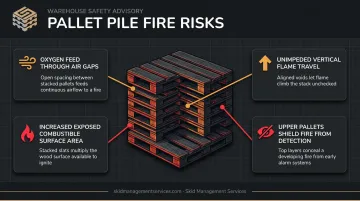
Why treat them differently from stored commodities? Geometry. A pallet stack is mostly air gaps between wood slats. That structure:
- Feeds oxygen directly into the developing fire
- Exposes far more combustible surface area than a solid commodity pile of the same footprint
- Lets flame travel vertically through the stack almost unimpeded
NFPA's own technical guidance notes that stacked pallets create air spaces that optimize fire spread, while the pallets higher in the stack shield the fire below from early detection. A fire can develop considerably before sprinklers or staff even notice it. NFPA explains why idle pallets get separate treatment from ordinary storage in its coverage of NFPA 13's approach.
Storage Location Requirements Under FM DS 8-24
DS 8-24 states plainly that outdoor storage is the preferred option for idle pallets. Moving pallets away from the building envelope reduces the odds that a yard fire becomes a structure fire. That said, outdoor arrangements still require specific separation distances between piles and buildings.
Outdoor Storage Requirements
DS 8-24's Table 1 sets minimum separation distances between idle pallet piles and buildings, scaled by wall construction and pallet count. Here's a condensed view (distances in feet):
| Exterior Wall Type | ≤50 Wood/Approved | ≤50 Plastic | 51–200 Wood/Approved | 51–200 Plastic | >200 Wood/Approved | >200 Plastic |
|---|---|---|---|---|---|---|
| Combustible | 15 | 30 | 40 | 80 | 90 | 150 |
| Noncombustible | 12 | 15 | 30 | 40 | 50 | 100 |
| 2-hour rated | 3 | 6 | 10 | 20 | 15 | 30 |
| 4-hour rated | 3 | 3 | 3 | 3 | 3 | 3 |
Table 2 addresses pile-to-pile spacing, using the same distance figures (15 to 150 ft depending on count and pallet type) to keep one burning pile from igniting the next.
A few practical notes:
- DS 8-24 doesn't set a fixed maximum outdoor pile height or footprint. Instead, it requires piles be kept low enough near buildings that burning pallets can't fall against the structure.
- FM Approved plastic pallets use the same, more favorable wood-pallet columns in these tables. Nonapproved plastic pallets require roughly double the separation distance in most categories.
- For comparison, NFPA guidance commonly caps outdoor piles around 15 ft high and 400 sq ft, with 8 ft of clear space (or 25 ft of stored commodity) between piles. These are useful benchmarks from NFPA/fire code, not DS 8-24 figures.
Indoor Storage Requirements
Indoor idle pallet storage comes with a tighter set of options. DS 8-24 recognizes solid-piled floor storage and single-, double-, or multiple-row rack storage, and each requires dedicated sprinkler protection sized to the arrangement.
Where that dedicated protection isn't in place, DS 8-24 limits storage to small, in-process quantities only:
- Single stacks no higher than 5 feet (1.5 m)
- At least 10 feet (3 m) separation from other pallet stacks, combustible storage, or equipment
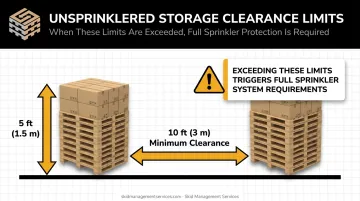
Exceed those limits and you trigger the full sprinkler design requirements covered next. This is where facilities most often get caught off guard: a stack that "just grew a little" during a busy production week can cross the 5 ft threshold without anyone flagging it.
Sprinkler Protection Requirements for Indoor Pallet Storage
DS 8-24 Table 3 lays out the sprinkler design for solid-piled, on-floor wood and FM Approved plastic pallets. Rather than the density/area figures used elsewhere in fire protection engineering, this table specifies the number of sprinklers required and the minimum operating pressure.
A simplified summary:
| Ceiling/Storage Height (ft) | Wet Pendent QR K14.0 | Wet Upright SR K11.2 | Dry Upright SR K11.2 |
|---|---|---|---|
| 15/10 to 30/20 | 12 sprinklers @ 50 psi | 15 sprinklers @ 25 psi | 25 sprinklers @ 25 psi |
| 30/25 | 12 sprinklers @ 50 psi | Not specified | Not specified |
| 35/30 to 40/35 | 12 sprinklers @ 75 psi | Not specified | Not specified |
Key operating parameters:
- Wet-system sprinklers operate at 160°F; dry-system sprinklers at 280°F
- K11.2 designs carry a hose stream allowance of 500 gpm for 90 minutes
- K14.0 designs carry a hose stream allowance of 250 gpm for 60 minutes
- Storage or ceiling heights beyond what Table 3 covers require more extensive, engineered protection under Section 2.2.2
Wood Pallet Protection Criteria
Rack storage of wood pallets is only permitted under the K14.0 QR pendent options in Table 3 — floor storage has more flexibility across sprinkler types. This isn't arbitrary. Racked pallets have more open airflow around and between them than a solid floor pile, which lets fire develop faster and demands a more targeted response.
When Data Sheet 8-9 requires in-rack sprinklers on top of ceiling protection, DS 8-24 only permits upright designs with horizontal barriers installed within the rack structure. Skipping that detail during a rack redesign is a common compliance gap.
Plastic Pallet Protection Criteria
Plastic pallets don't get to borrow the wood-pallet tables just because they look similar in a warehouse. Nonapproved plastic pallets fall under FM's uncartoned unexpanded plastic (UUP) criteria, referenced in Data Sheet 8-9, and expanded-plastic pallets face an even higher-hazard classification.
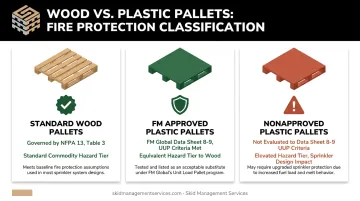
The one exception: FM Approved plastic pallets, fire-tested and certified as equivalent to wood, which then use the same outdoor separation and Table 3 protection as wood pallets.
Practical implication: if your facility stores any plastic pallets, don't assume the wood pallet protection scheme already covers you. Confirm which classification applies before an audit or claim forces the question.
FM-Approved Pallets: What They Are and Why They Matter
Here's a detail that trips up a lot of facility teams: DS 8-24 doesn't actually create a distinct "FM Approved wood pallet" category. The formal approval pathway applies only to FM Approved plastic pallets — plastic pallets fire-tested by FM Approvals and certified as performing equivalent to standard wood pallets.
Once certified, they can use the wood-pallet separation distances and sprinkler criteria instead of the stricter plastic-pallet rules. Standard wood pallets don't need this approval at all; they're already the baseline the tables are built around.
That doesn't make pallet sourcing an afterthought. Construction quality, lumber species, moisture content, and fire-retardant treatment all influence how a pallet performs in a fire. Confirm these factors before you order:
- Construction quality: Solid joinery and grading affect structural integrity under fire exposure
- Lumber species and moisture content: Density and dryness influence burn behavior
- Fire-retardant treatment: Available for facilities with elevated storage requirements
Skid Management Services supplies new, kiln-dried heat-treated, and custom-engineered wood pallets across block, stringer, and wing constructions, with fire-retardant treatment available as a custom build. An expansive supplier network backs that inventory for volume and lead-time flexibility.
Before finalizing any storage or sourcing decision tied to a DS 8-24 allowance, confirm the specifics with your FM Global loss prevention representative or fire protection engineer. Pallet certifications and storage classifications change, and the engineer reviewing your policy has the current, binding answer for your configuration.
Best Practices for FM DS 8-24 Compliance
Compliance requires ongoing maintenance, not a one-time project. A few practices worth building into your routine:
- Audit idle pallet accumulation regularly, covering the yard, dock, rack ends, and production floor. "Temporary" piles are where fire load builds without anyone noticing.
- Separate idle pallets from other commodities and keep documented clearances matching DS 8-24's tables. Loop in a fire protection engineer before increasing height or density anywhere.
- Partner with a supplier that keeps pallets moving instead of sitting. SMS's closed-loop pallet management program pairs new pallet delivery with scheduled pickup of used pallets on the same trip. Pickup schedules run weekly, biweekly, monthly, or on-demand, limiting the accumulation that turns into a fire-load surprise.
- Use trade-in credit structures (SMS offers 15–40% credit against new-pallet spend, based on grade and volume) as a financial incentive to return pallets promptly rather than stockpiling them.
Predictable supply reduces the temptation to over-order and store excess inventory "just in case," one of the quieter contributors to idle pallet buildup.
Frequently Asked Questions
What does FM Global Data Sheet 8-24 say about idle wood pallet storage?
DS 8-24 sets a preferred storage location hierarchy, separation distance tables for outdoor piles, and sprinkler design criteria for indoor storage, covering both wood and plastic idle pallets. Requirements scale with pallet count, storage height, and construction type.
What does "idle pallets" mean?
Idle pallets are empty, unused pallets awaiting reuse, such as those stacked in yards or at rack ends. Their air-gap geometry creates faster fire spread than solid commodity storage, which is why they're regulated separately.
What is an FM-approved pallet?
Under DS 8-24, this specifically refers to FM Approved plastic pallets, fire-tested and certified equivalent to wood pallets. That certification lets them use wood-pallet separation and sprinkler criteria instead of stricter plastic-pallet requirements.
What are FM Global data sheets?
FM Global Data Sheets are engineering-based property loss prevention standards built from claims history, research, and testing. They guide risk engineers and facility managers on hazards ranging from pallet storage to natural disasters.
How high can idle wood pallets be stacked according to FM Global 8-24?
Without dedicated sprinkler protection, DS 8-24 limits stacks to 5 feet with 10 feet of separation. Taller or denser storage requires sprinkler design matched to Table 3, so consult a fire protection engineer for your exact specs.
Where is the safest place to store idle pallets to reduce fire risk?
Outdoor storage, kept at the required building and pile separation distances, is the preferred option under both FM Global and NFPA guidance. It doesn't eliminate risk, but it removes much of the direct exposure to occupied structures.