This guide covers everything procurement officers and supply chain managers need to know: what block pallets are, how they're built, how they compare to stringer pallets, standard sizes, material considerations, and which operations benefit most from them.
Key Takeaways
- Block pallets use 9 solid blocks in a 3×3 grid, creating a stable, multi-point support structure
- Four-way forklift entry from all sides makes them faster to handle and compatible with automation
- According to Modern Materials Handling's 2025 Pallet Report, 55% of facilities now use block wooden pallets
- Ideal for heavy loads, automated warehouses, racking systems, and export shipping
What Is a Block Pallet?
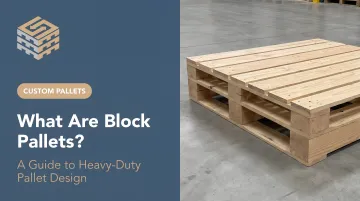
A block pallet is a pallet supported by nine solid blocks arranged in a 3×3 grid — one at each corner, one at the center of each side, and one in the middle. This grid creates a sturdy elevated platform that distributes weight across multiple contact points rather than relying on long parallel boards.
The Four-Way Entry Advantage
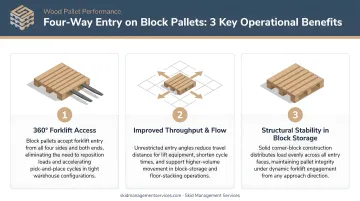
The defining operational feature is forklift access from all four sides. Standard stringer pallets typically allow entry only from two ends, which creates inefficiencies in busy warehouses where forklifts can't always approach from a preferred angle. Block pallets eliminate that constraint entirely.
In practical terms, four-way entry means:
- Faster loading and unloading without repositioning equipment
- More flexible warehouse slotting and positioning
- Direct compatibility with conveyors, robotic palletizers, and AS/RS racking systems
Block Pallets vs. Four-Way Pallets: Is There a Difference?
The terms are often used interchangeably, but there's a technical distinction worth knowing. Per the NWPCA/Woodpack Global Uniform Standard for Wood Pallets 2025, "block pallet" refers to construction type, while "four-way entry" is an access classification. Most block pallets offer full four-way entry, but some configurations with overlapping bottom components technically provide only partial four-way access. In practice, if a supplier quotes you a "four-way block pallet," you're getting full access — the distinction only matters when evaluating non-standard configurations.
Global Relevance
That construction standard has proven durable enough to become the global benchmark. Block pallets are the default across European supply chains, and the EPAL Euro pallet — the most widely used pallet in Europe — is a block pallet design built with 9 blocks and 11 boards. In North America, adoption has grown steadily: block pallets moved from roughly 10% of U.S. new pallet production in 2011 to 21% by 2016, according to Pallet Enterprise, and more recent data suggests that share continues to climb.
Anatomy of a Block Pallet: Key Components
Block pallets share a common set of components — but how those components are configured determines load capacity, entry access, and compatibility with your handling equipment.
Top Deck and Stringer Boards
The top surface consists of horizontal deck boards that form the load-bearing platform. Some designs use a solid plywood panel instead of individual boards — useful for bagged goods or small items that could fall through gaps.
Beneath the top deck, stringer boards run between the deck boards and the block tops. They distribute weight evenly across the structure and add rigidity to the top mat. In reversible block pallets, stringer boards also appear below the blocks.
The Blocks
The blocks are the defining structural element. The NWPCA defines a block as a "rectangular, square, multisided, or cylindrical deck spacer," and they come in three main forms:
- Solid timber: traditional, strong, and widely available
- Wood composite: compressed wood fiber, uniform sizing, typically drier — common in export applications
- Laminated boards: layered construction for consistent dimensions
Nine blocks in a 3×3 layout anchor both the top and bottom decks, creating the structural integrity that makes block pallets suitable for heavy and repeated use.
Nine blocks in a 3×3 layout anchor both the top and bottom decks, creating the structural integrity that makes block pallets suitable for heavy and repeated use.
Bottom Deck Configurations
The bottom deck has three common layouts, each with practical trade-offs:
| Configuration | Description | Best For |
|---|---|---|
| Parallel base | Boards run in one direction | Nestable pallets, space savings |
| Perimeter (picture frame) | Boards form a frame around the base | Racking stability, even floor contact |
| Cruciform base | Boards run in both directions | Conveyor compatibility, AS/RS systems |
Fasteners
Block pallets require multiple nail sizes in a single build — longer nails through stringer boards into blocks, shorter nails for the top mat, and mid-length annular ring nails for the bottom deck. This complexity demands specialized nailing equipment and contributes directly to the higher manufacturing cost of block pallets compared to stringer pallets — a factor worth accounting for when evaluating total cost per trip.
Block Pallets vs. Stringer Pallets: Key Differences
The four dimensions that drive most purchase decisions: structural design, forklift access, durability under load, and total cost of ownership.
Structural Design
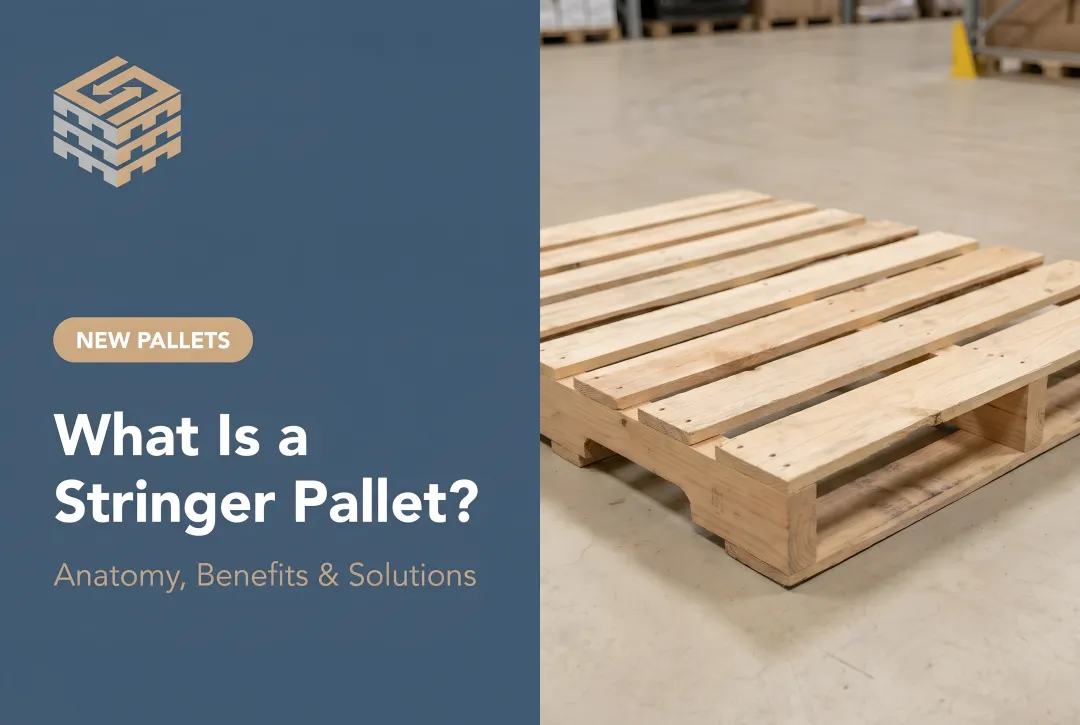
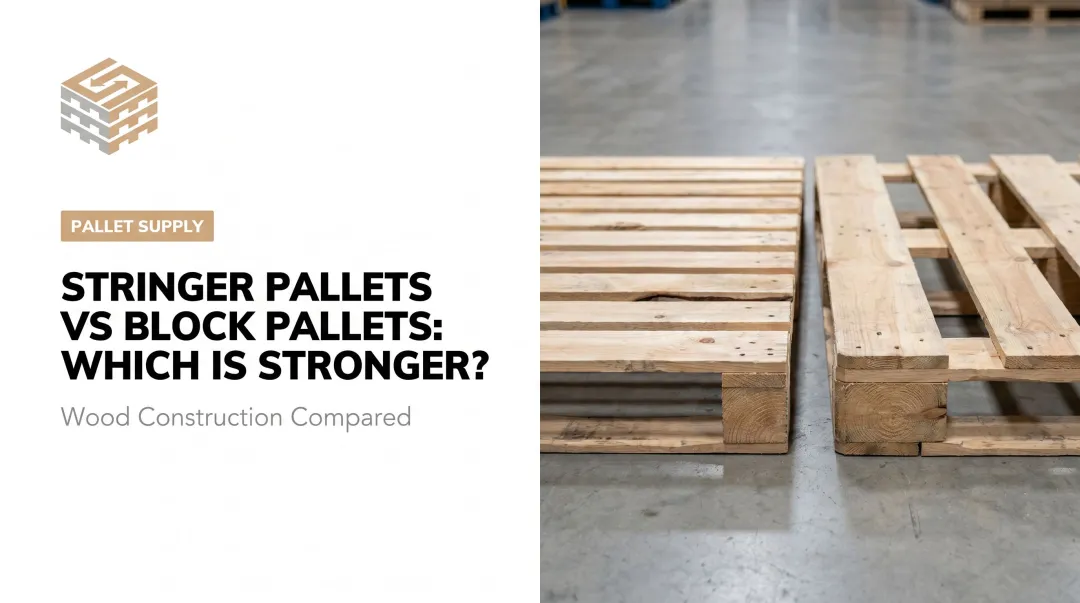
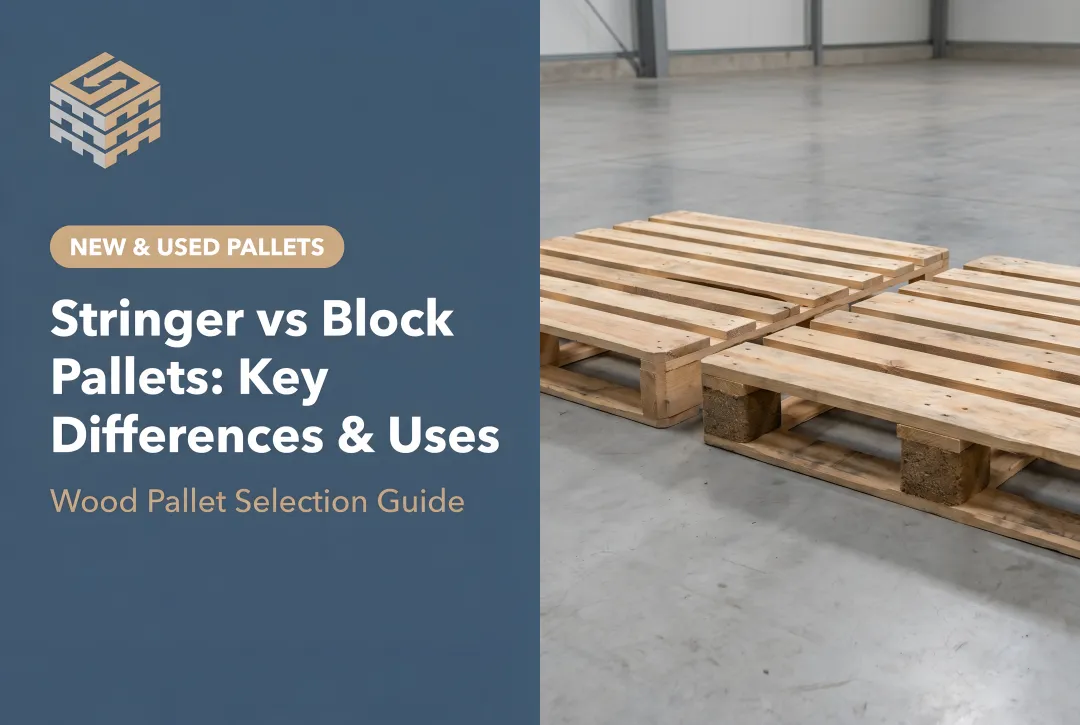
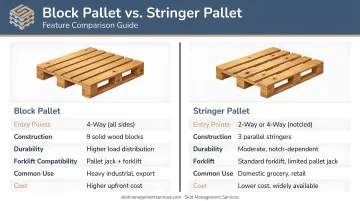
Stringer pallets use two or three long parallel boards running the length of the pallet. Block pallets use nine support blocks, creating more contact points that distribute load more evenly, resist racking damage, and reduce flex under weight.
Forklift Access
| Feature | Block Pallet | Stringer Pallet |
|---|---|---|
| Forklift entry | Four-way (all sides) | Two-way (ends only) |
| Partial four-way | Some configurations | Notched designs only |
| Automation compatibility | High | Limited |
Strength and Durability
Block pallets hold up better to repeated handling. Their multi-point support structure distributes stress more evenly, reducing deck board cracking or block separation over time. For automated warehouses specifically, Virginia Tech's Center for Packaging and Unit Load Design notes that maximum allowable pallet deflection under load in automated systems is 0.5 inches, with individual components limited to 0.25 inches — tolerances that favor a rigid block design.
Pallet load capacity is always design-specific and should be confirmed through standardized tests (ISO 8611 or ASTM D1185) rather than general claims.
Cost and Use Case Trade-offs
Block pallets cost more upfront due to more complex construction and more materials. However, their longer service life in high-frequency applications produces a lower cost per trip over time.
- Choose block pallets for heavy loads, frequent handling cycles, automated systems, or selective racking
- Choose stringer pallets for single-use or light-duty shipments where minimizing upfront cost is the priority
Block Pallet Dimensions and Standard Sizes
North American Standard
The 48" × 40" footprint is the dominant size in North America, used by 72% of facilities according to Modern Materials Handling's 2025 Pallet Report. Block pallets are produced in this footprint — CHEP's U.S. pallet program, for example, moved toward a perimeter-base 48 × 40 block pallet design in the 2000s.
For operations sourcing this size, Skid Management Services stocks 48" × 40" GMA block pallets for food and beverage manufacturers, warehouse operations, and consumer goods distributors across the country.
European (Euro Pallet) Standard
The EPAL Euro pallet is the required standard for businesses shipping into or within Europe. Key specs include:
- Footprint: 1,200 × 800 mm (approximately 47.2" × 31.5")
- Height: 144 mm
- Safe working load: 1,500 kg
- Construction: 11 boards, 9 blocks, 78 nails per EPAL Technical Regulations
Custom Dimensions
Block pallets can be manufactured to custom dimensions for specific racking, conveyor, or load requirements. Skid Management Services offers custom-designed block pallets for operations with non-standard racking footprints or automated line configurations — confirm your dimensional requirements with your supplier before committing to volume orders.
Materials and Compliance Considerations
Skid Management Services specializes in wood block pallets, which covers the majority of industrial and commercial applications.
Wood
Wood remains the most practical choice for most operations — it balances strength, repairability, and cost. For international shipping, heat-treated (HT) wood block pallets are required under ISPM-15 regulations. The standard, administered by the IPPC/FAO, requires wood to reach a minimum 56°C for 30 continuous minutes throughout the entire profile, including the core, and pallets must carry the approved IPPC mark showing country code, producer code, and treatment code.
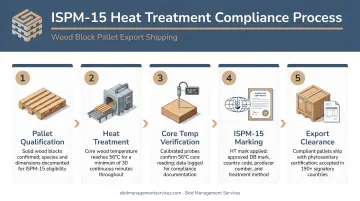
Skid Management Services offers a dedicated ISPM-15 heat-treated export pallet service, including certification and stamping to ensure shipments clear customs without delays.
Other Materials at a Glance
Plastic and steel block pallets exist for specialized use cases — hygienic processing environments or extreme-load closed-loop systems — but they sit outside the scope of most standard and export operations. For the vast majority of domestic and international shipping needs, wood remains the practical, cost-effective default.
When export compliance or custom specifications are part of the requirement, Skid Management Services sources from an expansive national supplier network to match the right pallet to the job.
Key Advantages of Block Pallets and Who Should Use Them
Five Reasons to Choose Block Pallets
- Superior load distribution across 9 contact points versus a stringer's linear support
- Four-way forklift access cuts handling time and eliminates repositioning in tight warehouse environments
- Automation compatibility — consistent dimensions and structural rigidity meet the strict tolerances required by conveyors, robotic palletizers, and AS/RS systems. According to the 2025 Pallet Report, 89% of respondents believe minimum pallet specifications are needed for automated equipment
- Longer service life in high-frequency, high-weight applications compared to stringer pallets
- Export readiness when heat-treated to ISPM-15 standards
Industries That Benefit Most
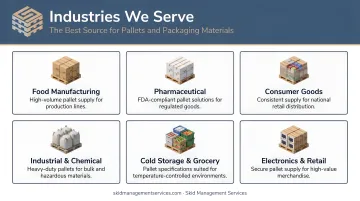
Food and beverage manufacturing relies heavily on block pallets. Frequent pallet rotation, strict sanitation requirements, and automated line environments all point to block pallets as the right fit. Skid Management Services supplies manufacturers in this space, including Campbell Snacks, Knouse Foods, and Nissin.
Other strong-fit sectors include:
- Manufacturing and automotive: heavy loads, automation requirements, and racking applications
- Retail and e-commerce fulfillment: speed-sensitive operations that depend on dimensional standardization
- Pharmaceuticals: compliance-driven environments where consistency and cleanability are non-negotiable
- Global export: ISPM-15 compliance and Euro pallet compatibility
Sourcing Block Pallets at Scale
Consistent quality and reliable availability matter more with block pallets than with commodity stringer pallets — especially for automated lines that can't tolerate dimensional variation or damaged components. Skid Management Services supplies both new and custom block pallets nationally, drawing on a broad network of pallet suppliers to keep large and recurring orders on schedule. For procurement officers managing high-volume programs, reliable availability and per-unit pricing need to work together — and that's the balance worth evaluating before committing to a supplier.
Frequently Asked Questions
What is a block pallet?
A block pallet is a pallet type supported by 9 solid blocks in a 3×3 grid, allowing forklift entry from all four sides. The block structure distributes load more evenly than stringer designs, making it suitable for heavy-duty and high-frequency applications.
What are the dimensions of a block pallet?
The most common North American size is 48" × 40". The European standard (EPAL Euro pallet) is 1,200 × 800 mm. Custom dimensions are also available for specific racking, conveyor, or load requirements — confirm your specs with your supplier before placing bulk orders.
What is the difference between a 4-way pallet and a block pallet?
The terms are largely interchangeable. "Block pallet" refers to construction type; "four-way pallet" describes the access feature. All full four-way block pallets allow entry from all sides, but some notched stringer pallets offer partial four-way access without being block pallets.
Are block pallets stronger than stringer pallets?
Generally, yes. The 9-block support grid improves weight distribution and resistance to racking stress compared to a stringer's linear support. For heavy loads, high-frequency handling, or automated environments, block pallets are the more durable choice. That said, load capacity is design-specific — confirm ratings through standardized testing before committing to a spec.
Are block pallets suitable for automated warehouse systems?
Yes. Block pallets are widely used in automated warehouses because their consistent dimensions, four-way entry, and structural rigidity meet the tight tolerances required by conveyors, robotic palletizers, and AS/RS racking systems — reducing the inconsistency and damage that most commonly disrupts automated operations.