The reality is that heat treatment is a practical operational decision with consequences that extend well beyond regulatory paperwork. According to USDA APHIS, any wood packaging material entering the United States must be treated and marked under ISPM-15 — and noncompliant shipments are not allowed to enter the country, full stop.
This article covers what heat treated pallets actually are, why they matter operationally, what happens when they're skipped, and how to get consistent value from them.
Key Takeaways
- HT pallets must reach a core temperature of 56°C (132.8°F) for 30+ minutes to meet ISPM-15 phytosanitary standards
- ISPM-15 compliance is legally required for wooden pallets entering the US, EU, Canada, Australia, Japan, and most major trading nations
- Heat treatment eliminates pests and fungi without chemical fumigants, making HT pallets the preferred choice for food, pharma, and consumer goods shipments
- A single non-compliant pallet can trigger rejection of an entire shipment, not just the offending unit
- Sourcing from a USDA APHIS-recognized, ISPM-15 certified supplier is the surest way to maintain consistent compliance across shipments
What Are Heat Treated Pallets?
Heat treated (HT) pallets are wooden pallets that have undergone a phytosanitary heat process — certified under the IPPC's ISPM-15 standard — to kill pests, larvae, and fungi living inside the wood before those organisms enter international supply chains.
The treatment requirement is specific: wood must reach a core temperature of 56°C (132.8°F) and hold it for a minimum of 30 continuous minutes throughout the entire wood profile. This applies to all wood packaging material (WPM) used in cross-border shipments — pallets, crates, dunnage, and skids alike.
The ISPM-15 Stamp
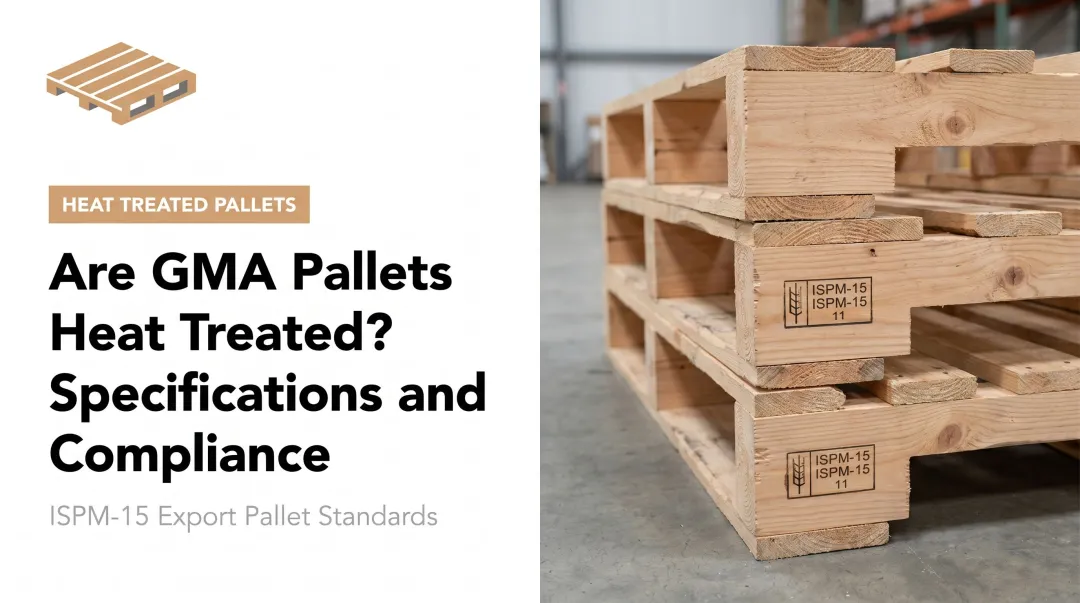
Every compliant HT pallet carries a permanent mark burned or printed on at least two opposite sides. That stamp communicates four things:
- IPPC logo — the two-leaf symbol of the International Plant Protection Convention
- Country code — the ISO two-letter code of the treating country (e.g., "US")
- Producer/treatment provider code — the unique ID issued by the national plant protection authority (USDA APHIS in the US)
- Treatment abbreviation — "HT" for heat treatment
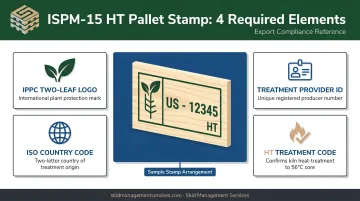
The absence of any one of these elements makes a pallet non-compliant. A smudged or illegible stamp is treated the same as no stamp at all: customs inspectors require every element to be clearly readable before accepting a shipment.
HT pallets are now the default choice for food-grade and pharmaceutical operations — not just export shipments. Food manufacturers and cold-chain operators select them specifically because heat treatment leaves no chemical residues, eliminating contamination risk for products that contact the pallet surface.
Key Advantages of Heat Treated Pallets
Each advantage below connects to metrics that procurement and operations teams track daily: shipment clearance rates, pallet lifespan, cost-per-use, safety incidents, and sustainability performance.
Advantage 1: ISPM-15 Compliance Unlocks Global Shipping Access
ISPM-15 compliance is the legal baseline for wooden pallets in international trade. Without it, shipments cannot legally cross the borders of most major economies. The IPPC's implementation list covers 59 countries enforcing ISPM-15 requirements, including the US, EU member states, Canada, Australia, and Japan.
The HT stamp functions as a universal clearance signal at ports of entry. It reduces inspection friction and allows shipments to move. Non-compliance consequences, though, extend well beyond the value of a single pallet.
Why the financial exposure is disproportionate:
- A single non-compliant pallet can trigger rejection or quarantine of an entire consignment — not just the one unit
- Remediation options per APHIS include safeguarding, treatment at destination, re-export, or destruction — all at the importer's expense
- In May 2021, CBP agriculture specialists at the Port of New Orleans intercepted two South American shipments lacking ISPM-15 stamps on their WPM; the materials were re-exported, with all re-export costs falling to the importer
- Non-compliance doesn't end with one incident — APHIS documentation confirms that shipments from sources with a history of non-compliance are subject to closer future inspections, compounding delays over time
KPIs impacted: Shipment clearance rate, customs hold frequency, supply chain lead time, cost of non-compliance, trade partner eligibility
When this matters most: Any exporter; importers receiving goods on foreign-origin pallets; food, pharma, and regulated-industry operations where supply chain documentation is audited.
Advantage 2: Greater Durability and Lower Moisture Content
The heat treatment process drives moisture from wood as a natural byproduct of the high-temperature chamber environment. A 2019 Wood Research study of conifers used for wood packaging found that core moisture content dropped from 10–12% before treatment to approximately 6% after ISPM-15 processing.
Lower moisture content translates directly to better structural performance:
- Less warping and board cracking during storage and transit
- Reduced mold growth in humidity-controlled or refrigerated environments
- Better load integrity across more use cycles
One clarification matters here: IPPC guidance notes that heat treatment can be performed without significant moisture reduction when wood is heated quickly to the phytosanitary target. The moisture benefit is most pronounced in kiln-dried heat-treated (KD HT) pallets — where kiln-drying and ISPM-15 treatment are combined into a single process. Skid Management Services supplies KD HT pallets as its standard heat-treated product, not basic HT alone, which is why cold storage and food-grade customers choose this specification.
Why this matters for cost-per-use:
A pallet that resists warping, moisture damage, and structural failure lasts more trips. The NWPCA's Environmental Product Declaration, based on data from 85 million wood pallets, notes that wooden pallets can typically be reused 10 to 15 times or more — and that longevity improves meaningfully when moisture content is managed.
A 2023 BioResources study found stringer notch damage in 52% of field pallets examined — the most common structural failure mode in real-world use. Moisture-driven degradation accelerates that failure curve. A structurally superior pallet delays it.

KPIs impacted: Pallet replacement frequency, product damage rate, cost-per-use, warehouse safety incident rate
When this matters most: High-humidity storage, long-distance multi-leg shipments, cold-chain logistics, and heavy or high-value load applications.
Advantage 3: Chemical-Free Pest Elimination
HT pallets achieve full pest and larvae elimination through heat alone. No fumigants. No residue. This matters because the alternative — methyl bromide (MB) fumigation — carries a risk profile that has become increasingly difficult to justify.
The EPA classifies methyl bromide as a Class I ozone-depleting substance. Production was phased out for most uses by January 1, 2005 for developed countries (with quarantine and preshipment exemptions remaining). The CDC describes bromomethane as a neurotoxic gas capable of causing pulmonary edema, convulsions, neurological damage, and other serious effects at occupational exposure levels.
For food and pharmaceutical supply chains, the practical concern is contamination risk. MB is still an approved ISPM-15 treatment option where permitted — but fumigated pallets introduce chemical exposure pathways that HT pallets eliminate entirely. Retailers, food safety auditors, and FDA-regulated operations are increasingly specific about this.
Food manufacturers like Knouse Foods, Campbell Snacks, and Nissin Foods operate under FSMA Preventive Controls and GFSI certification schemes including SQF and BRCGS. These programs require pallets to pass three contamination risk categories: chemical, biological, and physical. New kiln-dried heat-treated pallets with no MB fumigation satisfy all three at once.
The environmental case adds further weight:
- Approximately 95% of wooden pallets in the US are recycled, according to NWPCA data
- Wood pallets carry a documented "Climate Positive Effect" per NWPCA's EPD certified by UL
- Chemical-free HT pallets support ESG commitments without the liability of fumigant residue
KPIs impacted: Product contamination incident rate, regulatory audit pass rate, ESG compliance score, worker safety metrics
Operations that rely on this most: Food and beverage manufacturers, pharmaceutical logistics, consumer goods brands with sustainability reporting obligations, and operations subject to retailer compliance audits.
What Happens When Heat Treatment Is Skipped
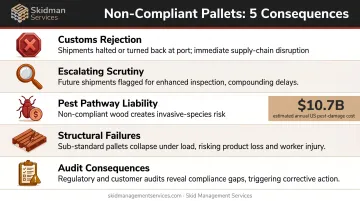
Skipping heat treatment to save on pallet costs tends to backfire the moment a shipment hits a compliance checkpoint. The downstream consequences include:
- Customs rejection: APHIS-flagged shipments face Emergency Action Notifications. Remediation options (re-export, fumigation at destination, or destruction) all come at the importer's expense. There is no low-cost exit once a shipment is held.
- Escalating scrutiny: Shippers with a documented non-compliance history face heightened inspection frequency on future shipments. One incident creates ongoing friction.
- Pest pathway liability: Before ISPM-15, pests like the emerald ash borer (linked to solid wood packaging from Asia) caused damage APHIS estimates at up to $10.7 billion in costs to state and local governments over 10 years. After ISPM-15 took effect, wood packaging infestation rates dropped 52%.
- Structural and safety failures: Untreated pallets in storage absorb moisture more readily, accelerating degradation and increasing pallet replacement frequency. Pallet failure mid-transit or in warehouse racking creates product damage and worker safety incidents.
- Audit consequences: Non-compliance discovered during a retailer or third-party audit can result in lost contracts or heightened monitoring — a reputational cost that extends well beyond any single shipment.
Businesses that choose non-HT pallets for cost reasons often find that reactive costs — emergency sourcing, expedited shipping, compliance remediation, re-export logistics — run several times higher than the original savings. The per-pallet price difference rarely accounts for a single held shipment.
Best Practices for Getting the Most Value from Heat Treated Pallets
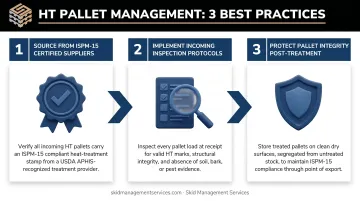
Consistent value from HT pallets requires three ongoing habits, not a single procurement decision.
1. Source exclusively from ISPM-15 certified, audited suppliers. Verify that the producer code on the HT stamp traces to a facility with active USDA APHIS authorization. A supplier with a broad national network provides both compliance reliability and supply continuity when regional demand spikes. Skid Management Services sources HT pallets exclusively through USDA APHIS-recognized treatment providers and can support export-compliance documentation across standard and custom pallet sizes.
2. Implement incoming inspection protocols. Train receiving staff to verify all four elements of the ISPM-15 stamp on inbound pallets before they enter the warehouse or production floor. The four required elements:
- IPPC two-leaf logo
- ISO country code
- Unique treatment provider ID
- "HT" treatment-method code
Cross-contamination with non-certified pallets is a documented risk at storage facilities. Pallets without a verifiable, legible stamp should not be assumed compliant regardless of the supplier's assurances.
3. Protect pallet integrity post-treatment. Heat treatment eliminates pests present in the wood at the time of treatment — it doesn't make pallets immune to re-contamination afterward. Store HT pallets in covered, dry conditions away from soil contact and pest-prone environments.
Pallets that have been repaired or had boards replaced may require re-certification before use in export shipments. ISPM-15 defines remanufactured wood packaging as requiring full re-treatment and re-marking when more than one-third of components are replaced.
Frequently Asked Questions
How long do heat treated pallets last?
HT pallet lifespan depends on load weight, usage frequency, and storage conditions. NWPCA data suggests wooden pallets can be reused 10 to 15 times or more. Kiln-dried HT pallets tend toward the higher end of that range due to reduced moisture content at the point of manufacture.
What pallets should you not use?
Avoid non-ISPM-15 certified pallets for any international shipment, methyl bromide fumigated pallets for food or pharmaceutical applications, visibly damaged or structurally compromised pallets, and pallets of unknown origin that lack a verifiable, legible treatment stamp.
Do heat treated pallets need to be recertified after repair?
Yes, when used for export. Under ISPM-15, pallets with more than one-third of components replaced are classified as remanufactured: old marks must be obliterated, the unit re-treated by an authorized facility, and re-marked. Repairs replacing one-third or less require only that treated wood is used for replacement components.
Are heat treated pallets required for domestic US shipping?
ISPM-15 compliance is not legally required for domestic US shipments. In practice, major retailers and food manufacturers increasingly mandate HT pallets for audit compliance under FSMA Preventive Controls and GFSI schemes such as SQF and BRCGS.
How can I tell if a pallet is heat treated?
Legitimate HT pallets carry a permanent IPPC/ISPM-15 stamp on at least two opposite sides, including the IPPC logo, country code, treatment provider code, and the letters "HT." CBP requires these marks to be visible and permanent. Pallets without a complete, legible stamp should not be assumed compliant.
Are heat treated pallets safe for food contact applications?
HT pallets are the recommended wood pallet option for food supply chains because they use no chemical fumigants. Direct food contact still depends on product packaging and retailer requirements. For pallet-level contamination risk, new kiln-dried HT pallets with no prior-load history are the lowest-risk wood pallet option available.