Introduction
A cracked pallet in a freezer rarely announces itself. It sits quietly under 2,000 pounds of frozen product until a corner gives way, product hits the floor, and a supervisor is filling out an incident report.
Mold growing inside a warped deck board is even harder to catch until a food safety audit flags it.
These failures cost warehouses real money in product loss, downtime, and safety exposure. And the stakes keep rising: the U.S. cold storage market was valued at $48.23 billion in 2025 and is projected to hit $135.84 billion by 2033, according to Grand View Research.
As more facilities come online, pallet selection matters just as much as racking design.
This guide covers what actually makes a pallet "cold storage grade" and how to match materials and sizes to your racking system. It also breaks down maintenance habits that extend service life and the true cost of pallet ownership in refrigerated environments.
Key Takeaways
- Cold storage pallets must resist brittleness, moisture, and mold from 34°F coolers to sub-zero freezers.
- Material choice (wood or steel) should match temperature range and hygiene needs, not just price.
- Match pallet dimensions and load ratings to your racking system to avoid safety risks and wasted space.
- A supplier with multiple material options and reliable national supply cuts downtime from stockouts.
- True pallet cost includes replacement frequency and labor, not just the per-unit price.
What Is a Cold Storage Pallet?
A cold storage pallet is engineered to stay structurally stable, non-brittle, and moisture-resistant in low-temperature, high-humidity environments, typically ranging from about -20°C to 10°C (-4°F to 50°F). That's a different job than what a standard warehouse pallet is built for.
Standard pallets fail in these conditions for predictable reasons:
- Untreated wood absorbs ambient moisture, gains weight, and becomes a breeding ground for mold in humid, cold air
- Unprotected steel corrodes from condensation, a well-documented risk when moisture gets trapped under poor ventilation, according to the American Galvanizers Association
- Some recycled plastics lose flexibility and crack under impact in sustained low temperatures, though the exact brittle-transition point varies significantly by resin blend and manufacturer
A true cold-storage-grade pallet needs to hold up under sustained rack-beam pressure, resist chemical exposure from sanitation chemicals, and be easy to clean for food or pharmaceutical compliance work.
Why Industries Rely on Specialized Cold Storage Pallets
Food, seafood, pharmaceutical, and chemical storage operations all depend on pallet integrity to protect cold chain compliance. A compromised pallet introduces a contamination pathway that puts product safety at risk.
SQF's Storage and Distribution code requires food-storage pallets to be suitable for purpose, clean, in good condition, and regularly inspected. BRCGS goes further, discouraging wooden pallets in open-product areas due to splinter risk.
Not every cold storage use case stresses a pallet the same way:
- Floor storage exposes pallets to moisture pooling and condensation
- Racking storage puts sustained pressure on the deck and stringers for weeks at a time
- Frequent-handling operations (like cross-docking) demand higher impact resistance
Choosing the Right Pallet Material for Cold Storage
No single material wins across every scenario. The right choice depends on temperature range, load frequency, and hygiene requirements working together.
| Material | Temperature Tolerance | Moisture/Mold Resistance | Relative Weight | Best Fit |
|---|---|---|---|---|
| Kiln-dried/HT wood | Moderate cold, ambient | Good when properly treated | Light-moderate | Standard freezer racks, moderate handling |
| HDPE plastic | Deep freeze capable | Excellent | Light | Hygiene-sensitive, deep-freeze use |
| PP plastic | Moderate cold | Good | Lightest | Cost-sensitive moderate cold |
| Galvanized steel/aluminum | Wide range | Requires coating maintenance | Heavy | Heavy, long-term static storage |
Wood Pallets
Treated and kiln-dried wood pallets remain a cost-effective choice for moderate cold storage and lower-frequency handling. The key is moisture management: kiln-dried lumber starts with significantly less moisture content than ambient-dried wood, so it re-absorbs humidity more slowly once it's sitting in a freezer environment.
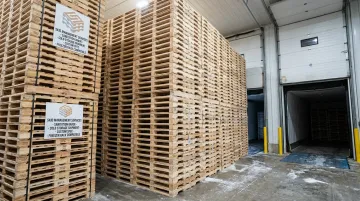
Skid Management Services builds its cold storage program around this exact principle. Its kiln-dried heat-treated (HT) pallets, treated to ISPM-15 standards at a core temperature of 56°C for at least 30 minutes, combine reduced starting moisture with reduced biological load. SMS describes this combination as the most cold-storage-stable wood pallet it offers.
For hygiene-sensitive applications like ice cream and frozen-treat production, SMS also supplies sanitation-grade pallets with an FDA food-grade overlay.
Standard wood doesn't fit every freezer rack, so SMS builds custom-spec pallets for non-standard SKU dimensions. It also serves as an access point to alternative cold-storage-grade materials through its supplier network when a job calls for something other than wood.
Plastic Pallets (HDPE/PP)
HDPE plastic offers wide temperature stability, with some finished pallet models rated down to -40°C, plus strong moisture and chemical resistance. That combination makes HDPE a common pick for deep-freeze and hygiene-sensitive operations where washdown sanitation is routine.
PP plastic suits moderate cold storage above roughly -20°C. It costs less and weighs less than HDPE, but it isn't the right call for true deep-freeze applications.
Metal Pallets (Steel/Aluminum)
Galvanized steel and aluminum pallets deliver the highest load capacity and durability for heavy, long-term storage. The tradeoff is cost and weight — both run higher than wood or plastic. Humid freezer conditions also demand anti-corrosion coatings, since trapped moisture under poor ventilation can produce wet-storage stain even on newly galvanized surfaces.
Service life varies dramatically depending on material and use assumptions. A peer-reviewed lifecycle assessment review found that many studies assumed wooden pallets last around 10 years, while plastic pallet scenarios commonly assumed 50–100 use cycles, ranging as high as 300 in some models.
These are planning assumptions, not guarantees, but they're a useful starting point for weighing upfront cost against replacement frequency.
Matching Pallets to Cold Storage Racking Systems
Pallet size, load rating, and base design all need to match your specific racking system. Get this wrong, and you risk safety hazards and wasted storage capacity.
Before ordering pallets, confirm three measurements:
- Upright depth — does the pallet length fit properly within the rack frame?
- Beam length — how many pallets fit per row without crowding?
- Usable tier height — is there enough clearance for the pallet plus cargo? RMI recommends roughly 6 inches of clearance above the load when handling varying pallet sizes in selective rack.
Racking Type Determines Pallet Spec
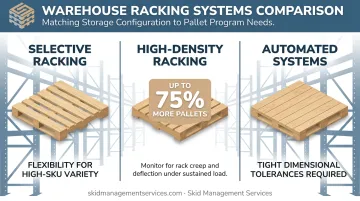
- Selective racking typically uses standard four-way entry pallets sized for single-deep aisle access. It's the right fit for high-SKU-variety cold storage where flexibility matters more than density.
- High-density racking (drive-in, push-back, pallet flow) causes long-term pallet deflection ("creep") under sustained beam pressure, requiring reinforced, flat-deck designs matched to FIFO or LIFO flow. Drive-in configurations can hold up to 75% more pallets than selective racking, per Food Logistics.
- Automated systems (pallet shuttle, AS/RS) demand tight dimensional tolerances. Even minor deviations in stringer straightness or deck-board bow can trigger equipment jams or errors.
Maintaining Cold Storage Pallets for Longer Service Life
A few habits go a long way toward extending pallet life in refrigerated environments.
- Remove frost buildup in a warmer area, not inside the freezer. Chipping ice off a frozen pallet risks cracking the deck boards.
- Inspect every 1–2 months for cracks, warping, or deformation, especially on racked units. Remove compromised pallets immediately to prevent safety incidents.
- Center loads on rack beams. Off-center placement creates uneven stress that accelerates deformation and shortens usable life.
The upstream fix is often more effective than the downstream one. Skid Management Services builds in moisture resistance from the start, using kiln-dried lumber, HT treatment, and moisture-resistant covers. This reduces the maintenance burden compared to standard pallets that absorb humidity and degrade faster under freeze-thaw cycling.
Cost Considerations: What It Really Costs to Store a Pallet in Cold Storage
Cold storage costs run meaningfully higher than dry warehousing. In the Asia-Pacific region, cold storage rents can carry a 30–50% premium over traditional dry warehouse space, according to a JLL industry forecast. Costs in the U.S. vary by market and facility type, so a facility-specific quote is the only reliable number.
The full pallet cost picture includes more than the sticker price:
- Purchase price by material and grade
- Replacement frequency, which climbs fast with untreated wood or the wrong plastic in deep-freeze conditions
- Product loss from pallet failure under load
- Labor and handling costs, tied directly to pallet weight and durability
Sourcing strategy is a real lever here. Skid Management Services pairs its own maintained inventory with an expansive supplier network, covering both everyday orders and non-standard freezer rack sizes when demand spikes.
That combination delivers three concrete advantages:
- Same-day and next-day delivery across the core Pennsylvania, South Jersey, and Delmarva footprint
- Supplier-network backup that closes gaps outside that core coverage area
- Cost-tiering flexibility, from Grade A/B recycled pallets to new kiln-dried, heat-treated builds
For cold storage operators, that mix means fewer production delays from pallet shortages or mismatched inventory.
Frequently Asked Questions
What is a pallet in cold storage?
A cold storage pallet is engineered specifically for low-temperature, high-humidity environments. Compared to a standard pallet, it resists brittleness, moisture absorption, and mold growth over repeated freeze-thaw cycles.
How much does it cost to store a pallet in cold storage?
Cold storage costs more per pallet position than dry warehousing due to refrigeration overhead. Rates vary widely by facility, contract terms, and turnover, so requesting a facility-specific quote is the best next step.
What is the best pallet material for freezer storage?
Kiln-dried, heat-treated wood pallets hold up well across most cold storage and freezer environments, resisting moisture damage at a lower cost than alternatives. HDPE plastic can offer a slight edge in the deepest sub-zero applications, though at a much higher price per unit.
How long do cold storage pallets last?
Service life varies by material, use pattern, and maintenance. Regular inspection and correct rack loading position extend usable life regardless of material.
Can wood pallets be used in cold storage?
Yes, treated and kiln-dried wood pallets perform well in moderate cold storage with lower humidity exposure. They need proper moisture treatment and aren't the best fit for deep-freeze or high-hygiene applications.
What size pallet is standard for cold storage racking?
48×40 and 40×48 (GMA standard) are the most common pallet sizes used across U.S. industries. Final sizing should always match your specific racking system's upright depth and beam length rather than a generic standard.