Cold chain operators often treat pallets as an afterthought, a commodity line item buried in procurement. But walk any freezer aisle and you'll see the truth: a warped deck board or a moisture-swollen stringer can stop a pick line cold. Pallet quality shows up in spoilage rates, safety incidents, and throughput numbers every single shift.
This article breaks down why wooden pallets remain the backbone of cold chain logistics, and what happens when their quality gets ignored.
Key Takeaways
- Kiln-dried, heat-treated wood resists cracking and moisture damage in sub-zero storage
- Wood pallets cost less upfront than plastic and offer a more resilient supply chain
- Standard wood dimensions fit most existing racking, forklifts, and ASRS systems
- Ignoring pallet specs leads to spoilage, downtime, and failed customs inspections
- Routine inspection and FIFO rotation stretch pallet life and protect product integrity
What Are Wooden Pallets in Cold Chain Logistics?
Wooden pallets used in cold chain settings are treated, load-bearing platforms built to move and store temperature-sensitive goods through freezers, refrigerated trucks, and cold storage racking without breaking down under moisture and cold.
You'll find them in a handful of specific environments:
- Cold storage warehouses and blast freezers
- Refrigerated trucking fleets
- Retail and grocery distribution centers
- Pharmaceutical cold chain facilities
A pallet's real job is protecting what's stacked on top of it. One that holds its shape at -20°C keeps the frozen chicken, the vaccine shipment, or the dairy case intact, and keeps the warehouse moving instead of stopping for a cleanup.
Online grocery sales alone grew 55%, from $62 billion in 2019 to $96 billion in 2023, according to USDA's Economic Research Service. That kind of growth doesn't just mean more product moving through cold storage — it means more pallet cycles, more racking pressure, and less tolerance for equipment that fails under load.
Key Advantages of Wooden Pallets in Cold Chain Logistics
The advantages below aren't theoretical. They're tied to numbers cold chain operators track every week: spoilage rate, unplanned downtime, procurement cost, and compliance pass rate. Here's where wood earns its place.
Structural Strength & Load-Bearing Reliability in Sub-Zero Conditions
Wood's natural fiber structure gives it strong compressive and dynamic load capacity, which matters when pallets are stacked three or four tiers high in a freezer rack. Properly kiln-dried wood holds that strength as temperatures drop, instead of turning brittle and shedding splinters into product zones.
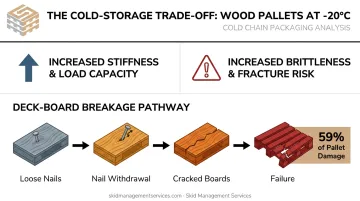
A 2024 peer-reviewed study testing wooden pallets at -20°C found a clear trade-off: cold, high-moisture conditions actually increased stiffness and maximum load capacity, but also raised brittleness and the risk of sudden fracture. The same research identified deck-board breakage as roughly 59% of all pallet damage, typically progressing from loose nails to withdrawal to cracked boards.
That's the trade-off cold storage buyers need to understand: cold doesn't automatically make wood weaker, but it does change how failure happens.
Why this matters:
- Reduced structural failure risk protects product and prevents spills, rework, and freezer-floor injuries
- Fewer collapsed loads mean lower safety-incident rates and reduced insurance exposure
- Consistent, properly dried lumber avoids the freeze-thaw cracking that degrades cheaper stock
KPIs impacted: load capacity, safety incident rate, product damage and spoilage rate.
This advantage matters most in high-volume automated freezer warehouses, multi-tier racking systems, and heavy palletized loads like meat, dairy, or frozen produce, where a failed pallet means more than an inconvenience.
Cost-Effectiveness with Dependable, Uninterrupted Supply
Wooden pallets cost significantly less upfront than plastic or composite alternatives. At the volumes cold chain operations run, often hundreds of pallets moving weekly, that price gap compounds fast.
Supply reliability matters just as much as unit cost. In May 2021, the United Fresh Produce Association reported pallet costs jumping as much as 400% amid a shortage tied to lumber costs, extended inventory dwell time, and constrained trucking capacity for repositioning pallets. Some suppliers reportedly stopped taking new customers altogether.
That kind of volatility is exactly why sourcing strategy matters as much as pallet price. Skid Management Services combines its own inventory with an expansive network of pallet and packaging suppliers, which is built to keep customers supplied with competitive pricing even when the broader pool market tightens.
Why this matters:
- Price volatility and supply gaps directly hurt shipping schedules and margins
- Dependable sourcing turns procurement into a planning exercise instead of a scramble
- Closed-loop programs with scheduled delivery cadence reduce exposure to spot-market price spikes
KPIs impacted: total cost of ownership, procurement lead time, supply chain resilience.
This advantage carries the most weight during seasonal demand spikes, across multi-site distribution networks, and for operations that haven't locked into long-term plastic pallet leasing contracts.
Compatibility with Racking, Automation & Regulatory Compliance
Standard wood pallet dimensions (48x40 being the most common) already integrate with the racking, ASRS equipment, and forklifts installed in most cold storage facilities. That's not a small detail. Retrofitting racking or automation to accommodate a different pallet footprint is expensive and disruptive.
For international shipments, heat-treated, ISPM-15 compliant wood pallets clear customs without the fumigation delays that trip up noncompliant loads. The standard requires the wood profile, including the core, to reach 56°C (132.8°F) for a minimum of 30 continuous minutes, followed by an authorized stamp showing the IPPC logo, country code, treatment provider ID, and treatment code.
Skid Management Services sources ISPM-15 heat-treated export pallets through USDA APHIS-recognized providers, handles stamp verification on existing inventory, and coordinates re-treatment when stamps are missing or illegible, a service particularly relevant for Port of Baltimore corridor exporters shipping to enforcement-heavy destinations like China, the EU, and Japan.
Why this matters:
- Dimensional compatibility avoids costly retrofits of racking or automation infrastructure
- Kiln-drying combined with heat treatment produces a more cold-storage-stable pallet
- Verified ISPM-15 stamps mean faster customs clearance for frozen and pharmaceutical exports
KPIs impacted: equipment compatibility costs, customs clearance time, compliance audit pass rate.
This advantage matters most for facilities running legacy racking systems, international frozen or pharma exporters, and mixed-fleet cold chain operations juggling both domestic and export loads.
What Happens When Wooden Pallet Quality Is Ignored
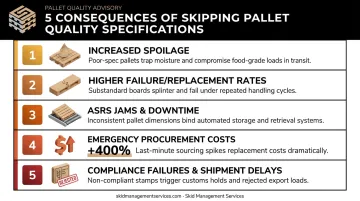
Skip the specification step, and the consequences show up fast — and expensively.
- Increased spoilage from unstable loads, moisture damage, or mold growth on untreated wood
- Higher failure and replacement rates as freeze-thaw cycling cracks boards and works nails loose ("nail creep")
- Automated storage and retrieval system (ASRS) jams and downtime caused by warped or splintered boards that automated systems can't grip properly
- Emergency procurement costs that spike during unexpected shortages, echoing the 400% price surge seen in 2021
- Compliance failures and shipment delays for international loads lacking a valid ISPM-15 stamp
Standard wood is hygroscopic by nature: it absorbs ambient moisture, gains weight, and loses structural integrity faster in cold storage than at ambient temperature. Skip the kiln-drying step, and that saved cost resurfaces later as a spoiled pallet, a jammed conveyor, or a rejected shipment.
How to Get the Most Value from Wooden Pallets in Cold Chain Operations
Getting real value from wooden pallets requires ongoing practices that extend well beyond the initial purchase decision.
- Source from a supplier with consistent quality and inventory. Kiln-dried, heat-treated stock needs to be available every cycle, not just when convenient. Skid Management Services pairs owned inventory with a broad supplier network to keep supply uninterrupted through seasonal spikes or pool shortages.
- Inspect on a routine schedule. Catch moisture buildup, loose nails, and cracked deck boards before they cause a failure on the rack or the line.
- Rotate stock FIFO. First-in, first-out rotation keeps older pallets from sitting in humid conditions long enough to degrade structurally.
- Match the pallet to the load. Weight, racking type, and temperature range should drive the pallet spec, not the other way around. A pallet built for dry-goods storage isn't automatically right for a blast freezer.
Treating pallets as interchangeable commodities is where most of the risk described above actually starts.
Conclusion
The real value of wooden pallets in cold chain logistics comes down to three factors:
- Structural control that holds up under freezer stress and repeated handling
- Cost clarity instead of surprise repair or reject charges
- Supply consistency that keeps loads moving during peak season
None of these are one-time wins. Quality and sourcing compound over time into fewer failures, lower total costs, and smoother compliance audits, but only when they stay a priority instead of a checkbox.
Pallet strategy works best as an ongoing operational practice, revisited each quarter rather than locked into a single purchase order.
Frequently Asked Questions
What are pallets in cold storage?
Cold storage pallets are load-bearing platforms specifically prepared, often kiln-dried or heat-treated, to withstand freezing temperatures, high humidity, and repeated freeze-thaw cycles without losing structural integrity.
How much does it cost to store a pallet in cold storage?
Costs vary by facility, size, and duration, with per-pallet monthly rates depending on temperature zone and volume. Consult a local cold storage provider for exact pricing in your region.
Can wooden pallets be left outside?
Short-term outdoor storage is fine, but prolonged exposure to rain, snow, and sun accelerates rot, warping, and moisture absorption. That's especially risky right before pallets enter a freezer environment.
How long do wooden pallets last in a freezer or cold storage environment?
Properly treated wood pallets typically last several years in cold storage with routine inspection and rotation, though lifespan depends heavily on load frequency, moisture control, and handling practices.
Are wood pallets better than plastic pallets for cold chain logistics?
Wood offers greater upfront cost savings and solid load performance, while plastic offers longer trip life and easier sanitation. The better choice depends on your budget, volume, and hygiene requirements.
Do wooden pallets need to be heat-treated for cold chain or export shipping?
Heat-treated, ISPM-15 compliant pallets are required for most international shipments and recommended for cold storage use, since heat treatment reduces both moisture content and pest risk. Skid Management Services supplies ISPM-15 heat-treated pallets with stamp verification for exporters and cold storage operations nationwide.