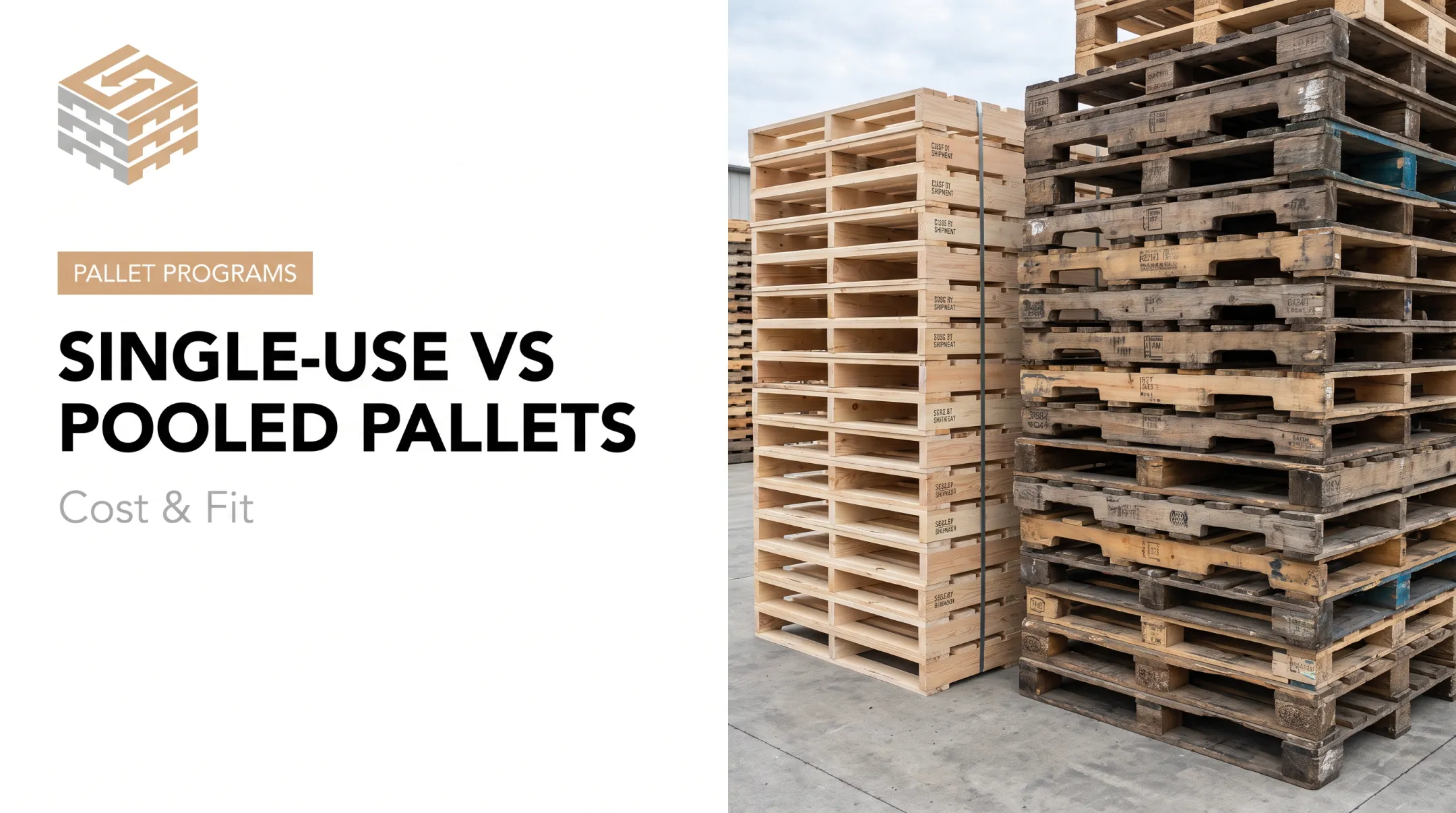

The choice affects more than your pallet budget. It shapes who owns the assets, who's responsible for repairs, how reliable your supply chain stays during demand spikes, and how much administrative overhead your team carries. Get it wrong, and you're either bleeding cash on recurring fees you didn't need or stuck chasing down lost pallets with no recovery network.
This article breaks down pooled pallets versus recycled pallets across cost, ownership, and real-world use cases, so you can match the model to your actual operation.
Key Takeaways
- Rent pooled pallets for provider-managed flow; buy recycled pallets when you want full ownership control
- Less day-to-day tracking with pools, offset by recurring fees and leakage risk
- Recycled pallets cut upfront costs by 40-60% versus new pallets with full ownership control
- High-exchange retail networks favor pooling; closed-loop operations favor recycled ownership
- Blend both models by shipping lane when retail exchange and closed-loop routes coexist
Pooled Pallets vs Recycled Pallets: Quick Comparison
| Factor | Pooled Pallets | Recycled Pallets |
|---|---|---|
| Cost | Recurring rental/exchange fees, no capital outlay | One-time purchase, lower than new pallets |
| Ownership | Provider-managed, standardized specs | Full ownership, customizable sizes and grades |
| Supply reliability | Depends on provider's regional depot network | Depends on supplier's inventory and repair capacity |
| Sustainability | Extends life through cross-company reuse | Extends life through repair and reconditioning |
| Best fit | High-exchange, multi-partner supply chains | Closed-loop operations, cost-focused buyers |
Cost is the most visible difference. Pooling shifts pallet spending from a capital expense to a recurring service charge, similar to leasing equipment instead of buying it. Recycled pallets require an upfront purchase, but you own them outright, with no ongoing fees.
Ownership control matters just as much. Pooled networks like CHEP and PECO standardize pallet specs across every participant, which simplifies handoffs but limits customization. Recycled pallets let you choose grade, size, and construction to match your exact application, whether that's a food-grade sanitation requirement or a heavy-duty industrial load.

Which model wins depends on exchange volume and how much control you need over specs, inventory, and cost structure.
What Are Pooled Pallets?
Pooled pallets are rented through a third-party network, most commonly CHEP or PECO, that circulates standardized pallets between multiple companies. You don't own the pallet. You pay to use it, and the provider handles collection, inspection, and repair after it leaves your dock.
Core benefits of pooling include:
- No repair or disposal responsibility falls on you
- Standardized handling specs reduce friction across partners
- Access to a built-in recovery network reduces empty-mile freight
CHEP describes its US model as a pay-for-what-you-use system. The provider owns maintenance and replacement, so those cycles stay off your operations team's plate.
PECO's network runs on more than 2,900 recovery locations across the US, Canada, and Mexico, handling roughly 70 million pallet issues annually.
The cost structure changes with pooling. Instead of a capital expense on your balance sheet, pallet spend becomes a predictable, recurring operating expense. That's attractive if administrative bandwidth is tight and you'd rather not manage repair cycles internally.
Use Cases of Pooled Pallets
Pooling works best in high-exchange retail and grocery distribution, where pallets pass through many companies before returning to a depot. Standardization reduces the friction of mismatched pallet specs between suppliers, distributors, and retailers.
Industries where pooling tends to fit:
- Large grocery and retail distribution with frequent cross-company handoffs
- Operations with dense depot coverage in their shipping region
- Businesses that would rather outsource tracking and repair entirely
One historical estimate from Supermarket News pegged pooled pallets at 25% of US dry-grocery volume as far back as 1996, showing the model has deep roots in high-turnover retail supply chains.
CHEP's own case study on a major North American food company found more than $210,000 in expected annual savings after switching to pooled half pallets. Those gains came largely from eliminating carrier pallets and cutting banding labor.

What Are Recycled Pallets?
Recycled pallets are used wood pallets that are retrieved, inspected, repaired, and put back into service. They offer near-new functionality at a fraction of new-pallet pricing.
You buy them once. You own them outright. There's no recurring fee structure attached.
Core benefits include:
- Save 40–60% versus new pallets
- Stock faster than waiting on new lumber production
- Cut landfill waste and demand for fresh timber
Not all recycled pallets are equal, though. Quality varies by repair history and grading standard:
- Grade A — All seven deck boards present, no broken stringers, minimal repair history. Functionally equivalent to new for most applications.
- Grade B — One or two minor board repairs, but full structural integrity intact. Fine for general warehouse and distribution use.
- Utility Grade (#2) — Lowest cost, best suited for internal-flow applications where cosmetic condition doesn't matter.

Use Cases of Recycled Pallets
Recycled pallets fit best in closed-loop or single-facility operations where pallets circulate internally rather than across dozens of external partners. Manufacturers who want ownership without a recurring fee lean toward this model.
Industries where recycled pallets are common:
- Food and beverage processing with steady internal pallet flow
- Packaging and distribution centers running predictable lanes
- General manufacturing with consistent, controllable freight patterns
A 2025 peer-reviewed industry survey published in BioResources found that of recovered pallet cores in 2021, roughly 94% were reused, repaired, or remanufactured, with less than 1% landfilled. That's a strong sustainability case for recycled ownership.
Skid Management Services supplies this model for anchor clients like Knouse Foods, Campbell Snacks, and Hain Celestial Group. The company’s national network of pallet and packaging suppliers, plus its own inventory, keeps recycled Grade A, Grade B, and utility-grade pallets moving without supply interruptions—even in high-demand periods.

Sanitation-grade recycled options are also available for food programs that need solid top decks and no protruding fasteners.
Pooled vs Recycled: Which Is Better for Your Operation?
There's no single right answer here. It depends on how your pallets move.
Weigh these factors before deciding:
- Exchange frequency — How often do your pallets change hands across companies?
- Budget structure — Do you prefer a capital purchase or a recurring operating expense?
- Storage capacity — Can your facility hold inventory between delivery cycles?
- Administrative bandwidth — Does your team have time to track pallet flow and repairs?
Choose pooled pallets if your product moves through many external partners and you want to offload repair and tracking entirely.
Choose recycled pallets if you want ownership, lower upfront cost, and consistent supply without a recurring fee structure.
Many manufacturers land on a hybrid approach: owned recycled pallets for core, predictable routes, and pooled pallets for select high-exchange partners who require standardized specs. That mix simply matches the model to each route.
For companies looking to exit a pooling contract altogether, closed-loop programs typically become economically favorable at around 500 or more pallets per month in two-way volume. Trade-in credit against new purchases can offset 15-40% of spend depending on grade mix, which softens the cash-flow hit of moving to ownership.
Frequently Asked Questions
What is the average lifespan of a wooden pallet?
Pooled pallets are often estimated around 10 years of service life. Recycled and reconditioned pallets can deliver many more use cycles when repaired properly, depending on construction and repair frequency.
Are recycled pallets as strong as new pallets?
Yes, when sourced from a reputable supplier that inspects and repairs to a documented grading standard. Grade A recycled pallets, with all deck boards intact and no broken stringers, perform equivalently to new pallets in most applications.
Do pooled pallets cost more than owning pallets long-term?
Pooling shifts cost into recurring fees, which can exceed ownership costs for low-exchange, closed-loop operations. High-volume, high-turnover retail networks often see better economics from pooling than low-frequency shippers do.
Can I mix pooled and recycled pallets in the same supply chain?
Yes. Many companies run recycled pallets on predictable internal routes and pooled pallets for partners who require standardization. This hybrid model is common.
Which option is more sustainable, pooled or recycled pallets?
Both extend pallet life through reuse rather than landfilling. The better outcome depends on transport distances and repair efficiency; long backhauls in either model can offset the environmental benefit of reuse.
How do I switch from pooled pallets to owned recycled pallets?
Start by auditing your current pallet flow and volume, then partner with a national supplier who can model the cost difference. Skid Management Services offers pool-exit economics analysis at no cost to help map the transition.