Storage type, location, volume, and pricing model all push that figure up or down. A frozen-food client in Los Angeles pays a completely different bill than a dry-goods distributor in rural Ohio.
This guide breaks down average US pallet storage rates, the factors driving cost, how to calculate your own monthly spend, and practical ways to trim the bill.
Key Takeaways
- Dry storage averages $20.17/pallet/month, with most operators charging $18-$25
- Cold storage costs significantly more due to refrigeration and insulation, though no verified US average exists
- Alternative pricing includes $0.46/cubic foot, $1.73/square foot, and $3.08/bin per month
- Location, monthly volume, and contract length swing pricing more than any other factor
- Standardized pallets and consolidated loads reduce billable pallet positions and cut costs
How Much Does Pallet Storage Cost Per Month? (Pricing Overview)
Pallet storage gets billed monthly, but the unit of measurement varies by warehouse and inventory type. Some providers charge per pallet position, others by cubic footage, square footage, or even per storage bin. Knowing which model applies to your goods is the first step in budgeting accurately.
Dry (Ambient) Storage Cost
Standard 40x48 dry pallet storage averages $20.17 per pallet per month in 2025, with the majority of surveyed warehouses reporting $18-$25 (The Fulfillment Advisor, 2025). Spot or on-demand pricing has shown figures as low as $13.13/pallet, though that excludes handling fees and doesn't specify a clear monthly basis.
Enterprise-volume clients typically pay less per pallet than small shippers. Warehouses favor high-volume accounts because:
- Spreads fixed operating costs (labor, utilities, insurance) across more billable units
- Reduces the provider's forecasting risk through predictable, recurring revenue
- Locks in occupancy through longer contract commitments from larger accounts
Cold (Temperature-Controlled) Storage Cost
Refrigerated and frozen storage costs more, and the reason is structural, not arbitrary. Cold facilities require insulated panels, industrial refrigeration systems, specialized concrete slabs, and temperature-controlled loading docks.
Construction alone runs 2-3 times the cost of a dry warehouse and takes 4-5 months longer to build (Food Logistics, citing CBRE research). Those upfront costs carry straight into daily operations.
Labor is the single largest operating expense at refrigerated facilities, with property costs and electric power following close behind. There's no single confirmed US market-average rate for cold pallet storage, but the underlying cost structure means quotes typically land meaningfully above dry-storage rates for comparable volume.
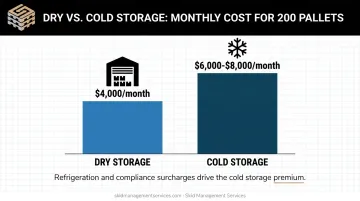
Simple comparison: Storing 200 pallets of dry goods at $20/pallet runs $4,000/month. The same 200 pallets in a freezer facility, even at a modest premium, could easily push past $6,000-$8,000/month once refrigeration surcharges and compliance handling are factored in.
Alternative Pricing Models
Not every warehouse bills by the pallet. Some charge by cubic foot, square foot, or bin, depending on how your inventory is packed and picked.
| Pricing Unit | Average Rate | Typical Range | Best Fit |
|---|---|---|---|
| Cubic foot | $0.46/month | $0.35-$0.60 | Small, irregular, or variable-volume inventory |
| Square foot | $1.73/month | $1.25-$2.25 | Dedicated floor space or exclusive-use areas |
| Bin | $3.08/month | $2.50-$4.00 | Loose units, individual SKUs, frequent each-picking |
(Rates from The Fulfillment Advisor's 2025 survey.)
If your inventory doesn't fit neatly onto standard pallets, ask providers to quote you under more than one billing model. It sometimes changes the math significantly.
Cost Trend Over Time
Dry pallet storage rates have climbed steadily since 2020, though the pace has cooled recently.
| Year | Average Rate |
|---|---|
| 2020 | $14.58 |
| 2021 | $14.79 |
| 2022 | $16.21 |
| 2023 | $18.30 |
| 2024 | $20.37 |
| 2025 | $20.17 |
That's a 38.3% increase from 2020 to 2025, but rates actually dipped 1.0% between 2024 and 2025. Translation: prices remain elevated compared to pre-pandemic norms, but they're stabilizing rather than continuing to spike.
Key Factors That Affect Pallet Storage Cost
Monthly pallet pricing isn't one flat number. It's shaped by where you store, what you store, how much you store, and how you handle it.
Location
Urban and port-adjacent warehouses charge more than rural facilities, largely because industrial real estate itself costs more in those markets. Los Angeles asking rents ran $1.39 per square foot per month in Q4 2024 (Cushman & Wakefield), while Midwest markets averaged closer to $0.60/sq. ft./month in Q2 2025.
Real estate rent isn't the same as a pallet-storage quote, but it's a strong directional signal of why coastal facilities charge more.
Storage Type and Special Requirements
Standard dry storage is the baseline. Anything beyond it adds cost:
- Climate-controlled storage adds refrigeration and insulation costs, plus ongoing energy overhead
- Bonded/customs storage requires CBP authorization and audit-ready inventory controls
- Hazmat storage demands trained handlers, physical segregation, fire suppression systems, and strict regulatory compliance
- Food-grade/SQF storage requires environmental monitoring and traceability, plus allergen control protocols
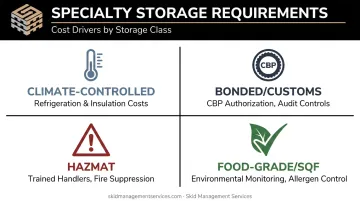
Each requirement adds operational complexity that warehouses pass along, even without a single published industry-wide premium percentage.
If you're storing a modest volume today but expect growth, ask providers about tiered pricing that kicks in automatically as your pallet count rises.
Inventory Volume and Contract Length
Volume matters. About 42% of surveyed warehouses offer 5-10% discounts for clients storing more than 100 pallets per month. Longer-term contracts can unlock similar savings too, though terms are negotiated case by case rather than set by a published formula.
Handling and Additional Service Fees
The base storage rate is rarely the whole bill. Common add-on fees include:
- Pallet in/out handling: $4-$8 per pallet, each direction
- Receiving: averaged $10.52/pallet in 2025, or $30-$60/hour, or $250-$600/container
- Pick-and-pack (B2C): roughly $3.20-$3.25/order
- Pick-and-pack (B2B): roughly $4.80-$4.85/order
- Long-term storage surcharge: 30-50% above the standard rate for aged inventory
These fees stack quickly. A quote that looks cheap on paper can end up costlier once handling gets added.
Pallet Type, Size, and Configuration
Non-standard pallet sizes, damaged pallets, and inefficient stacking all reduce rack density, which means paying for more billable pallet positions than necessary. A warped stringer or a missing deck board doesn't just look bad; it forces uneven stacking, wastes vertical rack space, and in some cases triggers compliance rejections at retail distribution centers.
Uniform, quality-built pallets solve this at the source. Skid Management Services supplies standardized GMA 48x40 pallets in both new and Grade A/B recycled options, along with true 4-way entry block pallets designed specifically for high-density rack systems.
Dimensional consistency matters more than people expect. New kiln-dried pallets are generally recommended for automated rack builds, since even small tolerance issues in recycled stock can cause clearance problems or conveyor jams.
For operations with unusual SKU dimensions, custom-engineered pallets are built to the exact footprint of the product rather than forced onto a generic size. This cuts down on wasted space and the extra dunnage that ill-fitting pallets require.
How to Calculate Your Monthly Pallet Storage Cost
Estimating costs accurately upfront prevents budget surprises later and makes it easier to compare providers on an apples-to-apples basis.
The basic formula:
Monthly Storage Cost = Number of Pallets × Cost per Pallet
Example: 150 pallets × $20.17/pallet = $3,025.50/month in base storage, before handling fees.
If you're not sure how many pallets your inventory actually needs, work backward from carton dimensions:
- Calculate cases per layer using the pallet footprint (typically 40x48 inches)
- Determine layers by dividing your allowed stack height by carton height
- Multiply cases per layer by layers to get cartons per pallet
- Divide total cartons by cartons-per-pallet, rounding up, to get total pallet positions
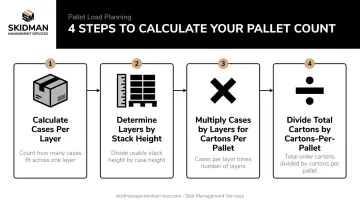
Weight limits, load stability, and overhang restrictions can all reduce that theoretical maximum, so validate any calculation against your warehouse's actual racking limits.
Once you know your actual pallet count, though, multiplying it by the per-pallet rate only tells part of the story. Budget for three cost categories, not just one:
- One-time: initial receiving, setup, account onboarding
- Recurring: monthly storage rate, ongoing handling
- Periodic: long-term storage surcharges on aged inventory
Before signing with any provider, request a fully itemized quote. A rate card that separates receiving, in/out handling, and surcharges from the base storage fee is the only way to avoid hidden costs distorting your estimate.
Tips to Reduce Pallet Storage Costs (and Mistakes to Avoid)
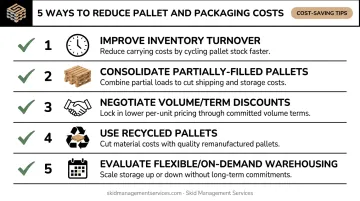
Small changes in how inventory moves and how pallets are configured can meaningfully lower a monthly bill.
- Improve inventory turnover. Slow-moving stock triggers long-term storage surcharges of 30-50% above standard rates. Move it before that clock starts.
- Consolidate partially-filled pallets. Fewer, fuller pallets mean fewer billable positions, and standardized GMA 48x40 stock makes safe stacking far easier than mismatched or damaged units.
- Negotiate volume and term discounts. With roughly 42% of warehouses offering 5-10% breaks above 100 pallets/month, it's worth asking even if you're below that threshold.
- Consider recycled pallets where appropriate. Grade A and Grade B recycled pallets typically run 40-60% cheaper than new stock, a real lever for operations without strict food-grade or cleanroom requirements.
- Evaluate flexible or on-demand warehousing for seasonal spikes instead of committing to year-round space you only need part-time.
The most common mistake: comparing providers on the base per-pallet rate alone. An $18/pallet quote with steep handling fees can easily cost more than a $22/pallet quote with modest add-ons. Always compare the full monthly invoice, not the sticker price.
Conclusion
Pallet storage costs swing widely based on storage type, location, volume, and pricing model. Dry storage generally lands in the high-teens to mid-$20s per pallet monthly, while cold storage costs substantially more due to refrigeration and construction demands.
Understanding the full cost breakdown, not just the advertised rate, avoids budget surprises. Smart choices around pallet configuration and contract terms can turn a mediocre quote into real long-term savings. Focus on total value, not just the sticker price: reliable service and efficient space use matter as much as the rate itself.
Frequently Asked Questions
How much does a warehouse charge to store a pallet?
Standard dry pallet storage averages $20.17/month, with most warehouses charging $18-$25. Cold or temperature-controlled storage costs noticeably more due to refrigeration and infrastructure demands.
How to calculate pallet storage cost?
Multiply your total pallet count by the monthly per-pallet rate. For a worked example, including how to convert carton counts into estimated pallet positions, see the calculation section above.
How much more expensive is cold storage than dry storage?
There's no single confirmed US market average for cold storage pricing. However, refrigerated facilities cost 2-3 times more to build and carry higher labor and energy costs. This typically translates into a real premium on your quotes.
What is the difference between per-pallet and per-square-foot pricing?
Per-pallet pricing is flat and predictable, averaging around $20/month per position. Per-square-foot pricing (roughly $1.73/month on average) suits dedicated or non-palletized space better than standard rack storage.
Does storing more pallets reduce my per-pallet rate?
Yes. About 42% of surveyed warehouses offer 5-10% discounts for clients storing more than 100 pallets per month, and longer contracts can unlock further savings.
What's the easiest way to lower my monthly pallet storage bill?
Improve inventory turnover to avoid long-term surcharges, consolidate partially-filled pallets using standardized pallet stock, and negotiate volume or contract-length discounts with your provider.