More businesses are now comparing PalletOne against national brokers, pooling providers, and regional distributors. The goal is simple: better pricing flexibility, supply that doesn't stall when one facility hits capacity, and lead times that match actual production schedules.
This guide breaks down the top PalletOne alternatives for 2026, the criteria we used to evaluate them, and how to pick the right fit for your operation.
Key Takeaways
- Manufacturer, pooling, and network sourcing models carry different cost and reliability tradeoffs
- PalletOne's manufacturer model favors large, consistent-volume buyers of new GMA pallets
- Skid Management Services offers nationwide coverage with competitive pricing and no volume lock-in
- CHEP, PECO, UFP Industries, and Millwood serve distinct volume, sustainability, or customization needs
- Match your supplier model to actual volume and flexibility needs, not brand recognition
Overview of PalletOne and the Pallet Manufacturing Industry
PalletOne is one of the nation's largest new-pallet manufacturers, built around high-volume production of 48x40-inch GMA pallets from its Bartow, Florida headquarters.
UFP Industries (Nasdaq: UFPI) closed on its acquisition of PalletOne for approximately $232 million in December 2020, folding the company into UFP Packaging's broader industrial packaging portfolio. PalletOne kept its brand and management team, but it now operates as part of a much larger Fortune 500 organization rather than as an independent manufacturer.
That matters because pallet sourcing isn't a small line item. The U.S. pallet market reached roughly 2.3 billion units in 2025 and is projected to hit 3.0 billion units by 2034, growing at a 2.85% CAGR. At that scale, even small differences in pricing structure or lead time ripple through a supply chain fast.
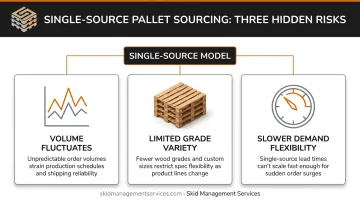
Here's the friction point: PalletOne's manufacturer model works well for large, consistent-volume orders of a fairly narrow product range. It creates challenges when:
- Monthly volume fluctuates instead of staying steady
- You need mixed pallet grades beyond standard GMA
- You want a supplier that can flex quickly with demand
That's why many businesses are now looking at alternatives that offer broader product variety and a more resilient, multi-supplier network to match their changing order patterns.
Top PalletOne Alternatives for 2026
We selected the alternatives below based on supply network strength, pricing competitiveness, pallet variety, and delivery reliability for businesses of every size — not just enterprise-scale buyers.
Skid Management Services
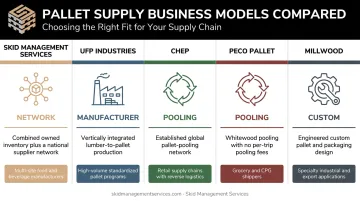
Skid Management Services is a national provider of wood pallets and packaging products backed by its own inventory plus an expansive network of pallet and packaging suppliers. That combination keeps pricing competitive and supply uninterrupted, even during regional shortages.
The company's anchor client base spans major food and beverage brands, including Knouse Foods, Campbell Snacks, Nissin, Hain Celestial Group, Stauffer's, and Plainville Farms, accounts that demand consistent, compliance-ready supply, not occasional delivery.
What sets it apart from a single-facility manufacturer is the model itself. Instead of depending on one production plant, Skid Management Services aggregates supply across multiple partners nationwide.
If one region faces a shortage, another can pick up the slack. That structural redundancy is something a manufacturer-only buyer simply doesn't have.
The company also runs a full-spectrum pallet portfolio: new, Grade A/B/Utility recycled, custom-engineered, and ISPM-15 heat-treated export pallets, plus closed-loop pickup and CHEP/PECO pool-exit programs. Recycled and remanufactured options typically deliver 40 to 60% cost savings versus new pallets, which gives buyers a pricing lever a new-pallet-only manufacturer can't offer.
| Business Model | National network of pallet and packaging suppliers offering aggregated sourcing rather than single-facility manufacturing |
| Key Strength | Competitive pricing plus uninterrupted supply continuity through supplier diversification |
| Ideal For | Food & beverage, CPG, pharma, and manufacturing businesses needing reliable nationwide sourcing without volume lock-in |
UFP Industries (PalletOne's Parent Company)
UFP Industries is a Fortune 500 wood products manufacturer that acquired PalletOne in 2020 and now runs pallet manufacturing at enormous scale across North America, Europe, Asia, and Australia.
For buyers who want PalletOne's manufacturing muscle, UFP Industries offers a single point of contact across its broader packaging and industrial product lines. That model can feel less like an alternative and more like a natural extension of the same relationship. Worth knowing going in: you're not really diversifying your supply chain by choosing UFP.
| Business Model | Large-scale manufacturer with global operations and multiple industrial product lines |
| Key Strength | Manufacturing scale, automation, and production consistency for high-volume new pallet orders |
| Ideal For | Enterprise buyers needing consistent, large-volume new GMA pallet production |
CHEP
CHEP, operated by Brambles, is a global leader in pallet pooling. Instead of buying pallets outright, businesses rent them through a share-and-reuse network that CHEP inspects, repairs, and recirculates.
This model shifts pallet ownership and lifecycle management off your books entirely. It's a strong fit for companies prioritizing sustainability metrics and closed-loop retail programs, since fewer single-use pallets end up discarded. CHEP's scale is hard to ignore, too — the company reports roughly 347 million pallets and containers in circulation and 750+ service centers as of early 2026.
| Business Model | Rental/pooling model with reusable pallets tracked through a closed-loop network |
| Key Strength | Sustainability positioning and reduced single-use pallet waste |
| Ideal For | Large retailers and CPG companies in closed-loop distribution with major chains |
PECO Pallet
PECO Pallet runs a similar reusable wooden pallet pooling model, but its focus stays on North American retail and manufacturing supply chains specifically.
The pitch is straightforward: lower upfront capital costs since you're renting rather than buying, plus nationwide coverage backed by compliance-focused quality control. PECO reports 40+ full-service depots and roughly 2,900 recovery locations spanning the United States, Canada, and Mexico. That network is dense enough that grocery and CPG buyers rarely worry about pallet availability at retail dock doors.
| Business Model | Pallet pooling with rental/reuse structure and nationwide logistics network |
| Key Strength | Lower capital outlay and consistent quality through pooled asset management |
| Ideal For | Retailers and manufacturers wanting rental flexibility over pallet ownership |
Millwood
Millwood specializes in tailored, heavy-duty pallet and packaging solutions for niche industrial applications rather than high-volume standard production.
Its engineering focus sets it apart. Millwood uses design tools like the Pallet Design System and SolidWorks to build specialized, non-standard pallets for automotive, heavy manufacturing, and clients with unusual load requirements. If your loads don't fit a standard 48x40 footprint, this is where a dedicated engineering team earns its keep.
| Business Model | Custom manufacturing focused on specialized and heavy-duty pallet designs |
| Key Strength | Flexibility in design and engineering for non-standard applications |
| Ideal For | Automotive, heavy manufacturing, and retail businesses needing custom pallet specs |
How We Chose the Best PalletOne Alternatives
Most buyers compare pallet suppliers on sticker price alone. That's a mistake. Sticker price rarely accounts for supply continuity, lead times, or the hidden costs that come with depending on a single source.
We evaluated each alternative against five factors, each tied to a measurable business outcome:
- Supplier network breadth and geographic coverage: reduces downtime risk when one region or facility falls behind
- Pricing competitiveness at scale: affects total spend across recurring orders, not just the first invoice
- Product and pallet variety (new, recycled, custom, heat-treated): lets buyers match pallet grade to actual application instead of overpaying for new stock every time
- Reliability of delivery and supply continuity: determines whether a supplier can absorb demand spikes without stockouts
- Industry-specific experience, including food-grade and CPG compliance: lowers the risk of failed audits or rejected shipments
Suppliers who scored well across most of these categories made the list. Those built around a single production model, no matter how large, scored lower on flexibility and continuity.
Conclusion
The right PalletOne alternative depends on matching the supplier model (manufacturer, pooling, or network-based broker) to your actual volume, industry, and flexibility needs. Brand recognition alone shouldn't drive the decision.
Before fully committing, run a new supplier alongside your existing one for at least one full sourcing cycle. Watch pricing consistency, delivery performance, and how the supplier handles an unexpected volume spike.
For businesses that want competitive pricing and uninterrupted supply without manufacturer-style volume constraints, Skid Management Services' nationwide supplier network offers a practical starting point. This model relies on diversified sourcing rather than a single production facility.
Frequently Asked Questions
What is PalletOne?
PalletOne is one of the largest U.S. manufacturers of new wood pallets, headquartered in Bartow, Florida. It has operated as part of UFP Packaging since UFP Industries acquired it in December 2020.
What is a good substitute for pallets?
Depending on your load, hygiene, and export requirements, alternatives include plastic pallets, corrugated slip sheets, and heat-treated recycled wood pallets. Each carries different cost and handling tradeoffs, so match the option to your specific application.
Is PalletOne still in business after the UFP Industries acquisition?
Yes. PalletOne continues operating under its own brand as part of UFP Packaging, retaining its original manufacturing facilities and management team.
What should businesses look for in a PalletOne alternative?
Prioritize network coverage, pricing flexibility, product variety across new, recycled, and custom pallets, and proven supply continuity. These four factors determine whether a switch actually reduces your total cost of ownership.
Are recycled pallets a reliable alternative to new manufacturer pallets?
Grade A recycled pallets often perform comparably to new pallets for non-food-grade use, at 40-60% lower cost. They suit general warehouse and distribution needs, though new pallets remain safer for cleanroom or first-time automated rack builds.
How do I switch pallet suppliers without disrupting my supply chain?
Run a parallel trial order with the new supplier alongside your existing one for about 30 days before shifting full volume. This lets you confirm quality, lead times, and pricing before you commit entirely.