Introduction
Pallets pile up fast. One week you've got a clean dock, the next you're stepping over broken stringers just to reach the loading bay.
Many warehouse managers assume "pallet pickup" just means calling a hauler to cart away trash. That's a costly misunderstanding.
In 2023, the average landfill tipping fee hit $56.80 per ton, according to the Environmental Research & Education Foundation's 2023 analysis of MSW landfill tipping fees. That number doesn't include hauling and container rental costs.
This article breaks down what pallet pickup actually means, how the process works step by step, and why it matters for warehouses, manufacturers, and distributors trying to reclaim space and time.
Key Takeaways
- Pallet pickup clears out surplus, used, or damaged pallets for reuse, resale, recycling, or disposal
- Unlike waste hauling, reusable pallets can generate buyback revenue instead of a flat fee
- Benefits span cost savings, reclaimed space, safety, revenue recovery, and sustainability
- A provider who handles both pickup and supply closes the loop on pallet management
What Does Pallet Pickup Mean?
Pallet pickup is a service where a provider collects surplus, used, or unwanted pallets directly from your facility — for reuse, resale, recycling, or disposal. It's the opposite of hauling pallets to a landfill or dumpster yourself.
Pallet or Skid? The Terms Overlap
Technically, a pallet has bottom deck boards; a skid doesn't. In practice, most pickup and packaging providers use the two terms interchangeably, so don't get hung up on the distinction when requesting service.
Not All Pickup Is the Same
Pallet pickup typically falls into three categories:
- Buyback: the provider pays for reusable pallets
- Free removal — no charge, common for qualifying volumes
- Paid removal applies when loads are damaged or contaminated
At Skid Management Services (SMS), this plays out as a graded system. Pallets are sorted into Grade A (premium, near-new condition), Grade B (minor repairs, full structural integrity), repair candidates, or end-of-life stock destined for biomass and mulch. The grade a load receives, plus its volume and distance from a service hub, determines whether it earns cash, qualifies for free pickup, or requires a removal fee.
Pallet pickup isn't a standalone task, either. It sits inside a broader pallet management ecosystem that includes new pallet supply, repair, and recycling. Businesses that request pickup are usually generating surplus as a byproduct of receiving inbound freight: warehouses, manufacturers, distribution centers, retailers, and multi-site 3PLs among them.
Condition and standardization matter too. GMA 48x40 remains the most common U.S. pallet size, and standard dimensions make grading and resale far easier than custom or oddly-sized loads.
How Does Pallet Pickup Work?
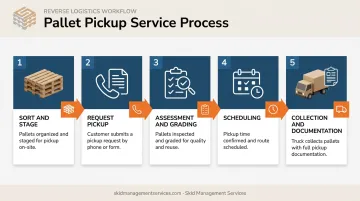
The process follows a predictable sequence, whether you're clearing one dock or coordinating pickups across five facilities.
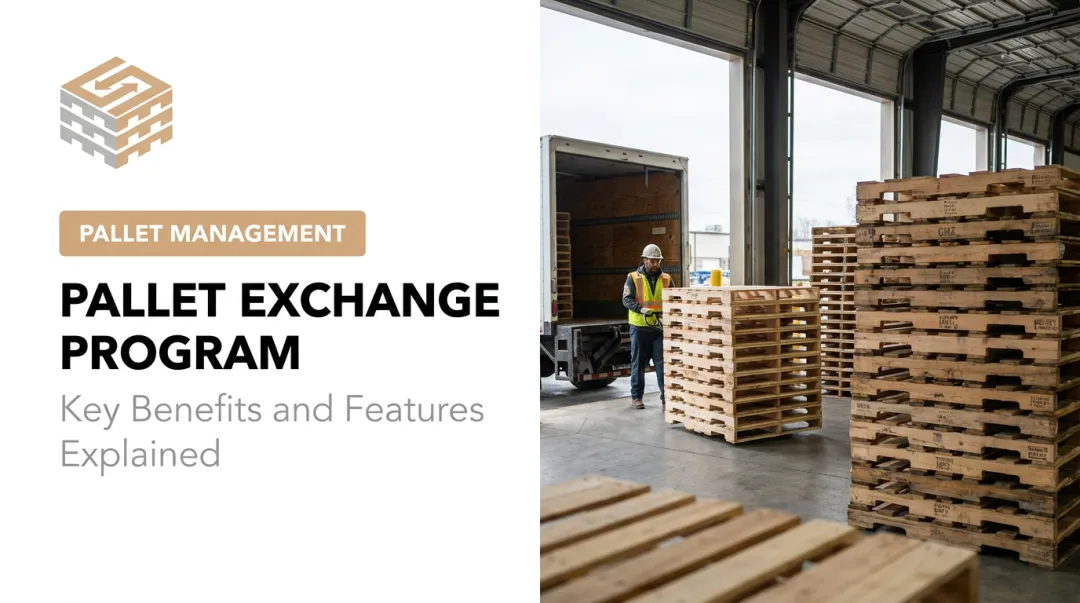
- Sort and stage. Separate reusable pallets from broken or mixed debris before requesting service. Grouping by size and condition speeds up grading later.
- Request pickup. Contact the provider by phone, online form, or account manager with pallet type, estimated quantity, location, and photos if you have them.
- Assessment and grading. The provider evaluates the load (reusable, repairable, or scrap-only) to determine payment, free pickup, or a removal fee.
- Scheduling. Choose between recurring service (weekly, bi-weekly, or monthly) for steady volume, or on-call pickup for one-off cleanouts.
- Collection and documentation. Pallets are removed, and reputable providers issue records showing what was resold, recycled, or disposed of.
Grading Determines the Payout
Here's where it gets specific. SMS grades every incoming load pallet-by-pallet, not by the truckload, using four tiers:
| Grade | Condition | Typical Outcome |
|---|---|---|
| Grade A | All deck boards intact, no broken stringers | Re-enters inventory, highest buyback value |
| Grade B | 1–2 minor repairs, full structural integrity | Repaired and recycled, moderate credit |
| Repair Candidate | Salvageable but damaged | Refurbished, lower credit |
| End-of-Life | Not repairable | Chipped for biomass or mulch, minimal value |
For clients enrolled in a closed-loop program, trade-in credit typically offsets 15–40% of new-pallet spend, depending on grade mix and volume — a meaningful offset if you're buying pallets regularly anyway. That savings potential raises the next question: how often should pickups actually happen?
Scheduling Flexibility
Operations generating roughly 500+ pallets per month (two-way volume) tend to benefit most from a closed-loop model, where used-pallet pickup happens on the same trip as new pallet delivery. A single-site food or beverage plant moving a few dozen pallets a week usually does better with on-call requests instead, since there's no fixed schedule or minimum commitment. One-time cleanouts fall into that same category.
Benefits of Pallet Pickup for Businesses
The value goes well beyond "getting rid of stuff." Here's what actually changes on the ground.
Cost Savings and Revenue Recovery
Every pallet you haul yourself carries layered costs: transportation, tipping fees, and sometimes container rental. With the ton-weighted national average tipping fee at $57.63 in 2023, per EREF's 2024 landfill tipping fee analysis, those costs add up fast for high-volume sites. Pallet pickup either avoids that fee entirely or replaces it with buyback revenue.
Structurally sound, standard-sized pallets aren't trash; they're inventory. Instead of paying to dispose of them, businesses can earn a per-pallet buyback rate or trade-in credit, turning a cost center into modest recurring revenue.
Reclaimed Space and Improved Safety
Pallet piles aren't just an eyesore; they're a hazard. OSHA's exit route standard (1910.37) requires clear, unobstructed pathways, and blocked docks are a common citation trigger. The transportation and warehousing sector reported 4.0 injury cases per 100 workers in 2020, according to BLS data on transportation and warehousing injury rates. Clearing pallet clutter reduces trip hazards and keeps emergency exits accessible.
Sustainability and Compliance
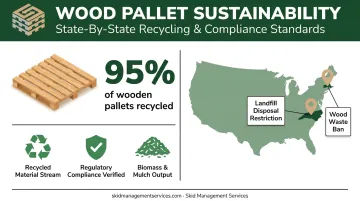
Wood pallets have one of the better recovery stories in industrial waste. A study cited by the Pallet Foundation found that 95% of wooden pallets are recycled. Some states go further: North Carolina restricts pallet disposal in landfills, and Massachusetts bans wood waste outright. Pickup and recycling programs help meet both ESG goals and state-level compliance.
Simplified Operations and Reliable Supply
For multi-site operators, fragmented vendor management is a real drag. Centralizing pickup under one provider means one invoice, one credit structure, and one sustainability report, replacing five separate contracts across five facilities.
Pickup and supply aren't separate problems, either. Skid Management Services' buyback activity replenishes its own recycled inventory. Combined with an expansive supplier network, this helps maintain competitive pricing and uninterrupted supply for clients who need pallets back on the dock next week, not next month.
Pallet Pickup vs. Other Disposal Options
Not every pallet situation calls for the same solution. Here's how the options stack up.
Specialized pickup/buyback vs. general waste hauling:
- Buyback programs recover material value; dumpster rental doesn't
- Pallet-specific pickup frees space faster since providers know how to stage and sort loads
- General waste haulers charge flat fees regardless of pallet condition
Recurring pickup vs. one-time cleanouts:
Scheduled service is almost always more cost-effective for steady-volume sites. It's easier to budget, and in closed-loop arrangements, pickup piggybacks on delivery trips, cutting freight costs on both ends.
One-time cleanouts still make sense for irregular volume or a single overflow event, just don't expect the same rate.
When straight disposal is still the right call:
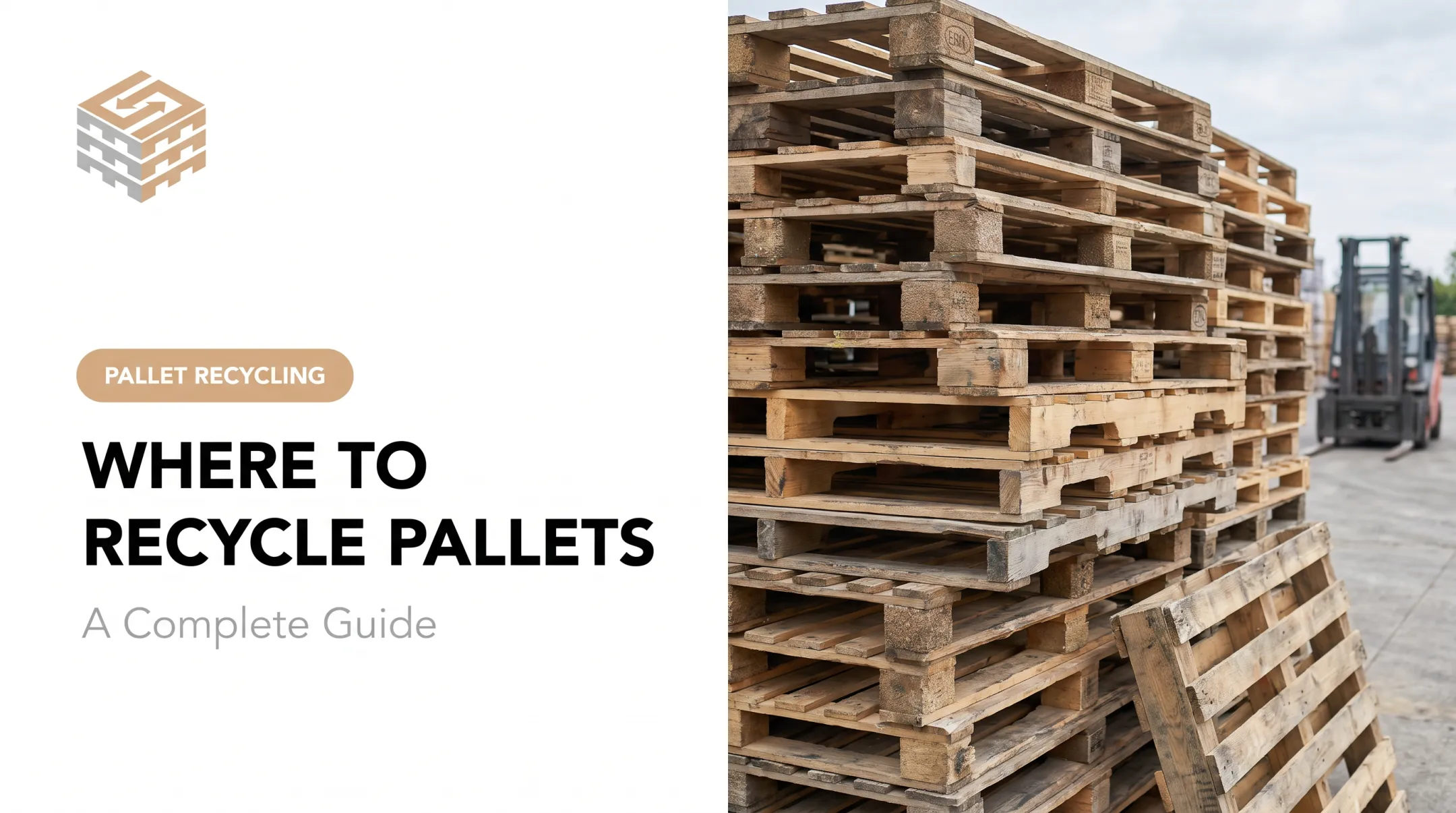
Some loads simply won't qualify for buyback or standard recycling: think pallets that are broken beyond repair, saturated with moisture, contaminated with chemicals, or built from non-wood composite materials. In those cases, disposal (not pickup) is the practical choice.
Choosing the Right Pallet Pickup Partner
A handful of criteria separate a good pallet pickup provider from a mediocre one:
- Transparent grading standards: you should know exactly why a load earned buyback, free removal, or a fee
- Clear pricing: rates tied to grade, volume, and distance, not guesswork
- Consistent scheduling: recurring or on-call, whichever fits your volume
- Multi-location capability: one provider, not five regional contracts
There's also a structural advantage to working with a single provider across the full pallet lifecycle: new supply, packaging materials, and pickup. Rather than juggling separate vendors for buying and removing pallets, one relationship covers the whole cycle.
When delivery and pickup happen on the same trip, freight costs drop on both legs. There's also no risk of packaging materials being mismatched to the pallets they're securing.
Skid Management Services operates this way. The company is a national provider of wood pallets and packaging products with an expansive supplier network, supporting businesses on both ends of the pallet lifecycle. That means competitive pricing on the supply side, and dependable buyback or removal on the recovery side.
Frequently Asked Questions
How do I get a pallet picked up?
Contact a pallet pickup provider like SMS by phone, email, or online form. Share your pallet type, estimated quantity, and location, then schedule either a recurring or one-time collection.
What does "pallet pickup" mean exactly?
It's a service where a provider collects surplus or used pallets from your site for reuse, resale, recycling, or disposal, rather than you hauling them away yourself.
Is pallet pickup free?
It depends on condition and volume. Reusable, structurally sound loads may earn payment or free pickup, while damaged or contaminated loads often involve a paid removal fee.
What's the difference between a pallet and a skid?
A pallet has bottom deck boards; a skid doesn't. In pickup and packaging services, though, the two terms are used interchangeably almost universally.
How do I know if my pallets qualify for buyback instead of disposal?
Standard sizes, dry condition, and structural soundness (intact deck boards, no broken stringers) typically qualify pallets for buyback. Damaged or contaminated loads usually require paid removal instead.
How often should a business schedule pallet pickup?
It depends on volume generated. High-volume sites (roughly 500+ pallets monthly) benefit from weekly or monthly recurring pickup, while lower-volume operations can rely on on-demand requests.
Ready to turn surplus pallets into working capital instead of a disposal bill? Skid Management Services can be reached at (717) 202-0304 or Info@SkidManagementServices.com to discuss buyback rates, scheduling, and coverage across the Greater Philadelphia, Lehigh Valley, South Jersey, Central PA, and Maryland/Delmarva corridors.