
This guide breaks down standard pallet sizes, their dimensions, typical weight capacities, and how to match the right pallet to your product and industry. You'll find a full size chart below, plus guidance on picking the correct footprint for your operation.
Key Takeaways
- The 48×40 GMA pallet is the default US footprint, representing roughly 29-35% of new wood pallets produced nationally
- Weight capacity depends on construction and support conditions, not dimensions alone — always verify with your supplier
- Sizes like 42×42, 48×48, and 44×44 serve specialized loads in chemicals, drum shipping, and IBC tote handling
- Choosing the right pallet size protects freight, maximizes trailer space, and keeps warehouse racking efficient
Standard Pallet Size Chart
Here's a breakdown of the most common pallet footprints used across US industries:
| Size (inches) | Size (mm) | Typical Use | Notes |
|---|---|---|---|
| 48×40 | 1,219×1,016 | Grocery, retail, general distribution | GMA standard; most widely produced size |
| 48×48 | 1,219×1,219 | Chemical drums, beverage containers | Fits four 55-gallon drums in a 2×2 layout |
| 42×42 | 1,067×1,067 | Chemical specialty, telecom, paint | Lighter-duty than 48×48 |
| 44×44 | 1,118×1,118 | IBC totes (275-330 gallon) | Common in chemical manufacturing |
| 40×48 | 1,016×1,219 | DoD and government freight | Rotated GMA footprint |
| 48×42 | 1,219×1,067 | Chemical, telecom (non-GMA) | Middle spec between 48×40 and 48×48 |
| 36×36 | 914×914 | Beverage, brewery distribution | Compact footprint for bottled goods |
| 40×40 | 1,016×1,016 | Specialty applications | Less common than other sizes |
| 48×20 | 1,219×508 | Retail end-aisle displays | Half-pallet for merchandising |
| 24×24 | 610×610 | Quarter pallets, small loads | Custom and retail display use |

A quick note on weight and dimensions: load capacity isn't baked into a pallet's footprint. It depends on construction (stringer vs. block), deck configuration, lumber grade, and how the load is supported (floor, rack, or forklift tines).
Empty pallet weight also varies by construction and lumber type, so don't assume every 48×40 pallet weighs the same off the truck.
The 48×40 GMA pallet made up about 29% of new wood pallet production in 2021, down slightly from roughly 35% in 2016, and it remains the dominant single size in the US market (BioResources, 2025).
What Is the Standard Pallet Size?
The 48×40-inch GMA pallet is the closest thing the US has to a universal pallet standard. GMA (Grocery Manufacturers Association) developed the spec in the 1970s for grocery and general distribution, and it stuck.
Why This Size Won
The 48×40 footprint became dominant because it fits neatly into:
- Standard trailer widths without wasted space
- Common warehouse racking bay dimensions
- Standard dock door openings
Stringer vs. Block Construction
GMA pallets are built one of two ways:
- Stringer — parallel wood boards; 2-way or partial 4-way entry
- Block — corner blocks; true 4-way forklift access
Most run 5.5 to 5.6 inches tall, though exact height varies by manufacturer and deck configuration.

Pallet vs. Skid — What's the Difference?
In everyday freight conversation, people use "pallet" and "skid" interchangeably. Technically, a skid has no bottom deck, meaning it rests on parallel runners instead of a solid base. A pallet has both top and bottom decking. Most freight moving today uses true pallets, but the terms still get mixed up on the dock floor.
Static vs. Dynamic Load Capacity
Two ratings matter more than the footprint alone:
- Static capacity — how much weight the pallet holds when stationary, typically in racking or floor storage
- Dynamic capacity — how much weight it can safely carry while being moved by forklift
A pallet rated for one condition isn't automatically safe for the other. Check the manufacturer's spec sheet—don't assume a universal "standard" capacity. Major pallet pool operators publish figures around 2,800 pounds for tested 48×40 block designs; that number applies to their build only.

Other Common Pallet Sizes by Industry
Standard GMA dimensions don't cover every load. Several industries use non-GMA footprints because their products demand it.
- 42×42 ("42 Square"): Chemical specialty, telecom equipment, and paint/coatings shipping. Traces back to military mortar-round packaging, later adapted for civilian industrial use.
- 48×48 ("48 Square"): Go-to size for drums and barrels. The square footprint fits four 55-gallon drums in a 2×2 layout, so chemical and beverage shippers rely on it. Custom builds can support 2,500–3,000+ lb dynamically.
- 44×44: Built for 275- and 330-gallon IBC totes in chemical manufacturing.
- 40×40: Specialty size for distribution applications where compact stacking matters.
- 36×36: Common in beverage and brewery distribution for bottled and canned goods.
- 48×45: Automotive voluntary standard for shipping engine components and parts between suppliers, formalized in a December 2023 specification.
- 48×20 and quarter pallets (24×24, 24×20): Retail end-aisle displays and merchandising, where a smaller footprint fits promotional space better than a full pallet.

What Is the Largest Pallet Size Available?
Among common standard formats, 48×48 is typically the largest you'll find in regular circulation. But for heavy machinery, industrial equipment, and oversized freight, custom-built pallets go well beyond that.
Watch for carrier surcharges. Some carriers cap pallet dimensions in their tariffs. One major LTL carrier sets a maximum envelope of 48×48×99 inches including overhang, with additional charges if you exceed it. Before building an oversized pallet, check your carrier's current rules.
If your product doesn't fit a standard footprint, a custom build is usually faster and cheaper than forcing an oversized load onto a standard pallet. Custom builds can be engineered for 4,000 to 10,000+ pounds of dynamic capacity, depending on:
- Lumber grade
- Deck configuration
- Stringer or block construction
Two-Way vs. Four-Way Pallets
Entry direction is a separate decision from pallet size — and it applies to every footprint you might choose.
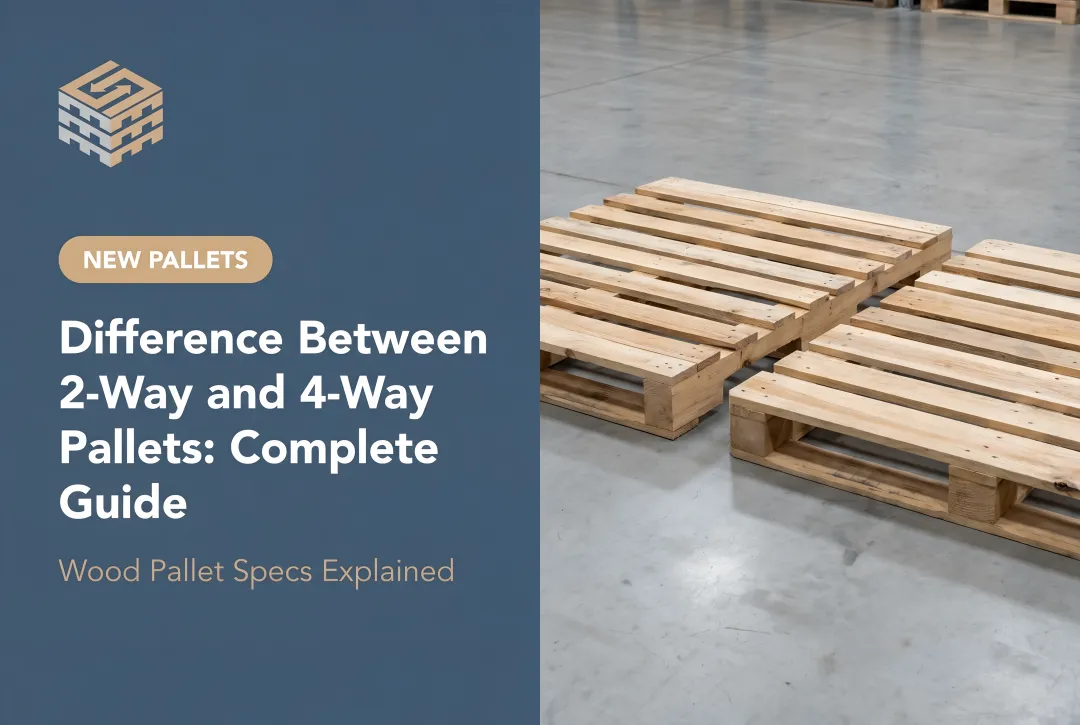
- Two-way pallets allow forklift entry from only two sides (the ends). They're simpler and more affordable to produce.
- Four-way pallets (usually block construction) allow forklift entry from all four sides, giving warehouse teams more flexibility when maneuvering loads.

If your warehouse handles fast-moving inventory or works with tight aisle space, four-way entry often pays for itself in handling speed. For slower-moving, single-trip shipments, two-way construction may be all you need.
Choosing the Right Pallet Size for Your Business
Picking a pallet size isn't guesswork. Work through these factors in order:
- Measure your product first. Avoid overhang: product past the pallet edge risks transit damage and carrier surcharges.
- Check your receiver's requirements. Many big-box retailers mandate GMA 48×40 or four-way entry pallets. Confirm before you ship.
- Match your warehouse racking. A pallet that doesn't fit your rack bays creates storage inefficiency, even if it's a "standard" size.
- Decide reusable vs. single-trip. Higher-grade lumber costs more upfront but holds up across multiple shipping cycles.
Sourcing the right size consistently is often the harder part. Skid Management Services works with a national network of pallet and packaging suppliers so you can lock in the size, construction, and quantity you need—with competitive pricing and steady supply:
- GMA 48×40 for retail and general freight
- 48×48 drum pallets for chemical and industrial loads
- 42×42 pallets for telecom and specialty shipping
- Fully custom builds when standard sizes won't fit
Frequently Asked Questions
What are standard pallet sizes?
The 48×40 GMA pallet is the US default for grocery, retail, and general distribution. Other common sizes include 42×42, 48×48, and 40×48 for chemicals, drums, and government freight.
What is the largest pallet size available?
Among common standard sizes, 48×48 is typically the largest in regular use. Custom-built pallets go beyond that for oversized machinery or industrial equipment, though carrier surcharges may apply.
How much weight can a standard pallet hold?
Weight capacity depends on construction, deck configuration, and support conditions, not just size. Published examples for official 48×40 block pallets cite figures around 2,800 pounds, but always verify with your supplier.
What is the difference between a pallet and a skid?
A skid has no bottom deck and rests on parallel runners, while a pallet includes both top and bottom decking. The terms are often used interchangeably in everyday freight conversation.
How tall is a standard pallet?
Most GMA 48×40 pallets measure about 5.5 to 5.6 inches tall, depending on manufacturer and construction.
Where can I buy pallets in bulk for my business?
Skid Management Services supplies bulk new, used, and custom wood pallets plus packaging materials through its own inventory and a national supplier network, with competitive B2B pricing and steady availability.