Most guides explain 3PL in the abstract: outsourcing, efficiency, scale. Few explain the physical object that actually makes a 3PL warehouse work: the pallet. Every pick, every shipment, every rack slot depends on it.
This guide defines 3PL, breaks down the full 1PL-5PL logistics spectrum, and explains exactly what a "3PL pallet" is. Along the way, you'll see how pallets move through receiving, storage, picking, and shipping, and why the supplier behind them matters as much as the 3PL itself.
Key Takeaways
- 3PL means outsourcing warehousing, inventory, and fulfillment to a specialized provider.
- Pallets are the foundation of every 3PL warehouse, driving speed, safety, and cost.
- Ownership models (client-owned, 3PL-provided, or pooled) can trigger unexpected fees.
- A reliable pallet supplier is just as critical to fulfillment success as the 3PL contract itself.
What Is 3PL? Understanding Third-Party Logistics
Third-party logistics, or 3PL, is the practice of outsourcing warehousing, inventory management, and order fulfillment to an external provider instead of running those operations yourself. Rather than leasing a warehouse and hiring a fulfillment team, you hand that work to a company built specifically for it.
This isn't a niche industry: the U.S. 3PL market generated $323.4 billion in gross revenue in 2025, up 5.0% year over year, according to Armstrong & Associates' 3PL market data. That scale reflects how many businesses, from startups to enterprise brands, now rely on external partners to move goods.
Most 3PLs provide a similar core service set:
- Warehousing — receiving, storing, and organizing inventory
- Inventory management — tracking stock levels and coordinating replenishment
- Pick-pack-ship — fulfilling individual customer or retailer orders
- Reverse logistics — processing returns, repairs, and disposals
The Infrastructure Behind Every Service
Each of those services depends on physical infrastructure: racking systems, dock doors, forklifts, and pallets. Without a standardized pallet moving through the building, none of it functions at scale. This is the piece most beginner guides skip entirely.
Asset-Based vs. Non-Asset-Based Providers
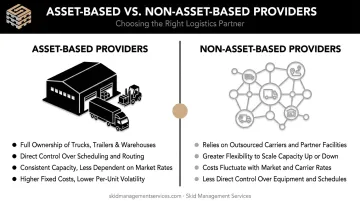
That physical footprint also determines how a 3PL is structured, and providers generally fall into two camps. Asset-based providers own their warehouses, trucks, and equipment. Non-asset-based providers broker capacity through a network of outside carriers and facilities. Neither is inherently better; the right fit depends on your volume, geography, and how much direct control you want over operations.
What Is a 3PL Pallet?
A "3PL pallet" isn't a distinct product category. It's simply the pallet used to receive, store, and ship goods inside a third-party logistics warehouse, the physical base that inventory rests on as it moves through the building. Understanding its specs, ownership, and condition matters just as much as understanding the 3PL contract itself.
Standard Dimensions and Construction
The 48 x 40 inch pallet, standardized under ANSI MH1, is the most recognized footprint in U.S. warehousing (ANSI MH1 pallet standard). A 2016 industry survey found it represented 35% of new wood pallets and 69% of recycled pallets in circulation. Two construction types dominate:
- Stringer pallets: three parallel support boards; the most common and cost-effective option, typically offering two-way or notched four-way entry
- Block pallets: nine-block support grid; true four-way entry, generally more durable under repeated handling
Standardization matters because racking, conveyors, and automated systems are calibrated to tight tolerances. A pallet that's warped or off-spec can jam a conveyor line or fail to seat properly in a rack bay.
Who Actually Owns the Pallets?
Ownership in a 3PL relationship typically falls into three models:
- Client-supplied: you provide your own pallets, giving you control over spec but adding a logistics step on your end
- 3PL-provided/billed: the warehouse supplies pallets and charges you per use, convenient but unpredictable on cost
- Pooled programs (like CHEP or PECO): a third party owns and circulates the pallets industry-wide, simple in theory, but pool fees compound over time and "pallet declaration" disputes are common
Each model has tradeoffs. Pooled programs reduce upfront pallet management but hand over control of quality and cost predictability. Direct ownership or a closed-loop supply arrangement gives operators more control, particularly when outbound volume is steady.
Whichever model you choose, condition isn't optional. A cracked stringer, protruding nail, or missing deck board isn't just cosmetic. Damaged pallets slow putaway, create safety hazards near forklifts, and can get an entire load rejected at a retailer's distribution center. Poor pallet quality remains one of the most preventable causes of warehouse downtime.
Wood vs. Plastic Pallets
| Factor | Wood | Plastic |
|---|---|---|
| Typical service life | ~5-30 cycles (modeled) | ~50-100+ cycles (modeled, varies widely) |
| Initial cost | Generally lower | Generally higher |
| Repairability | Well-documented repair and remanufacturing processes | More limited; design-dependent |
| Other factors | May require ISPM-15 treatment for export | Nonporous, easy to clean |
Neither material wins universally. Wood offers lower upfront cost and strong repair infrastructure. Plastic can offer longer service life but demands reliable recovery to justify the price.
Many businesses assume pallet sourcing is automatically handled by their 3PL. In practice, it's often a separate relationship entirely. A dedicated supplier like Skid Management Services keeps 3PL warehouses and shippers stocked with consistent, compliant pallets, supplying new, Grade A/B recycled, and custom-built options across standard and specialty sizes for exactly this reason.
1PL, 2PL, 3PL, 4PL, and 5PL: Understanding the Logistics Spectrum
These terms describe a spectrum of increasing outsourcing and complexity, not just variations on "3PL." Here's how each tier breaks down:
| Tier | What It Means |
|---|---|
| 1PL | The company manages all logistics in-house. No outsourcing at all. |
| 2PL | A single function, usually transportation, is outsourced to an asset-based carrier. |
| 3PL | Warehousing, inventory management, and fulfillment are outsourced comprehensively to a specialized provider. |
| 4PL | A lead provider coordinates multiple 3PLs and vendors on the company's behalf, acting as one strategic point of contact. |
| 5PL | An emerging, tech-driven model that integrates and optimizes entire supply chain networks across multiple 4PLs, often powered by AI and analytics platforms. |
Most small and mid-size businesses operate somewhere between 2PL and 3PL. Larger enterprises with complex, multi-vendor networks are the ones typically exploring 4PL or 5PL arrangements.
The further right you move on this spectrum, the more strategic control you hand over. Your success then depends on the physical execution happening underneath, starting with pallets.
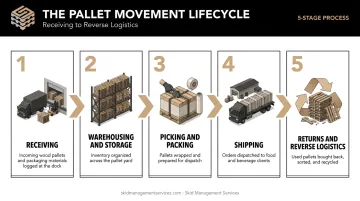
How Pallets Move Through the 3PL Fulfillment Process
Pallets touch every stage of the fulfillment cycle. Here's the path they follow inside a typical 3PL warehouse.
Receiving: Inbound goods arrive on pallets, get inspected, and get logged into the warehouse management system. Catching a damaged pallet here prevents problems that would otherwise surface all the way through shipping.
Warehousing and storage: Workers slot pallets into racking, using either selective racking (one-pallet-deep, full accessibility) or pallet flow lanes (gravity-fed, FIFO rotation, sometimes 20-25 pallets deep). Pallet dimensions directly affect how much storage density a facility can achieve.
Picking and packing: Full-pallet picks move entire units at once, while case-level picks pull individual cartons from palletized storage. Either way, pallet stability affects picker speed and safety around forklifts and order pickers.
Shipping: Outbound pallets get wrapped, staged, and loaded onto trucks to meet carrier and retailer compliance requirements. According to the Walmart Supply Chain Packaging Guide, merchandise must fit within a 48 x 40-inch footprint with no overhang, with general pallet height capped at 96 inches.
Returns and reverse logistics: Pallets consolidate returned merchandise as it flows back into 3PL storage for restocking, refurbishment, or disposal.
Choosing a Reliable Pallet Supplier for Your 3PL Operations
An uninterrupted pallet supply isn't a nice-to-have. A shortage can stop receiving or shipping cold, regardless of how well the 3PL itself is run.
When evaluating a pallet partner, look for:
- Consistent, competitive pricing across new and recycled grades
- Quality control that catches broken stringers, missing boards, and protruding nails before delivery
- Multi-location capability, especially if your 3PL runs several facilities or handles multiple client accounts under one roof
Skid Management Services works as this kind of partner for 3PLs and shippers across food and beverage manufacturing, retail distribution, and export programs. It combines its own inventory with an expansive supplier network to keep clients supplied at volume pricing.
Quality stays consistent across new, Grade A, and Grade B recycled pallets. Closed-loop programs add another layer of value, picking up used pallets and applying trade-in credit against future orders.
Frequently Asked Questions
What is a 3PL pallet?
A 3PL pallet is the pallet used to store and ship goods inside a third-party logistics warehouse. It's the base unit that inventory rests on as it moves through receiving, storage, and shipping.
What is 1PL, 2PL, 3PL, 4PL, and 5PL logistics?
This spectrum runs from fully in-house logistics (1PL) to single-function outsourcing (2PL) and full warehousing and fulfillment outsourcing (3PL). It continues through multi-vendor coordination (4PL) and finally fully integrated, tech-driven supply chain networks (5PL).
What size pallet do most 3PL warehouses use?
The 48 x 40 inch GMA pallet is the most common standard in U.S. 3PL warehouses. Variations exist based on industry, such as 48x48 for chemical drums or 44x44 for IBC totes.
Who owns the pallets in a 3PL relationship?
Ownership varies by contract. Pallets can be client-supplied, provided and billed by the 3PL, or managed through a pooled program like CHEP or PECO.
Can I supply my own pallets to a 3PL warehouse?
Yes, this is common practice. However, most 3PLs will require your pallets to meet specific size and quality standards to stay compatible with their racking and handling systems.
How much does a 3PL pallet cost?
Pricing depends on material, size, grade, and order volume, with recycled pallets typically running 40-60% cheaper than new. Partnering with a dedicated supplier like Skid Management Services helps lock in consistent, competitive pricing through volume-based programs and network sourcing.