Introduction
Warehouse space costs money — and right now, it costs a lot. JLL's Q1 2026 U.S. industrial market report puts average asking rent at $10.34 per square foot, with vacancy sitting at just 7.5% nationwide. In that environment, every square foot has to work.
Yet many operations treat pallets as a throwaway input — stacking them wherever there's room, skipping inspections, and addressing damage only after a load fails. That approach has a measurable cost: product write-offs, accelerated pallet deterioration, blocked aisles, and surprise procurement gaps that stall production lines.
Those costs compound quietly. How pallets are stored day-to-day directly affects product integrity, labor efficiency, and total operational cost. This guide covers why pallet storage deserves serious operational attention — and the practical steps that keep facilities running efficiently instead of constantly playing catch-up.
Key Takeaways
- Proper pallet storage prevents moisture damage, mold growth, and product contamination — reducing write-offs and compliance risk
- Organized storage with racking, zoning, and FIFO systems speeds retrieval and maximizes usable floor space
- Poor storage accelerates pallet deterioration, increases replacement frequency, and creates unplanned procurement costs
- Maintaining adequate airflow, controlled humidity, safe stacking heights, regular inspections, and consistent labeling all directly extend pallet service life
- Quality pallets are the foundation: inconsistent or low-grade units will compromise every other storage practice you put in place
What Is Pallet Storage?
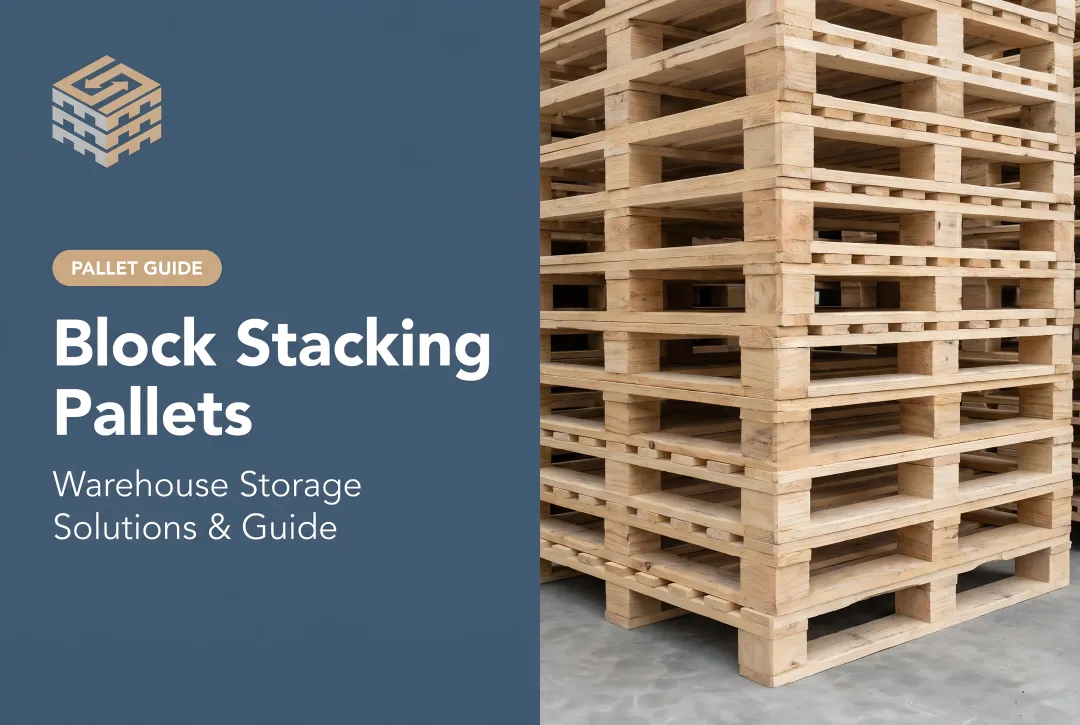
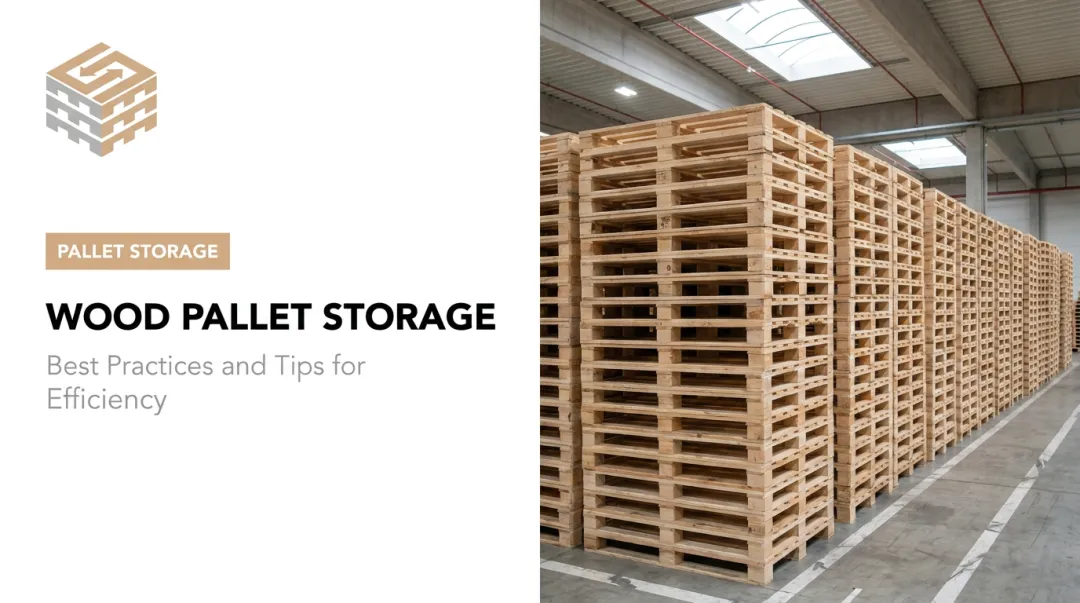
Pallet storage is the organized system of keeping goods on pallets within a warehouse, distribution center, or manufacturing facility. The pallet serves as the standardized unit that enables stacking, racking, and forklift handling — making it the foundational element of how physical inventory moves and sits at rest.
The scale of this system is significant. According to the National Wooden Pallet and Container Association (NWPCA), more than 1.8 billion pallets are in service in the United States every day, and 93% of them are made from wood. Pallets reach virtually every industry — food and beverage manufacturing, pharmaceutical distribution, retail supply chains, chemical and industrial operations, and e-commerce fulfillment.
Pallet storage is an active operational decision. Where pallets are stored, under what environmental conditions, at what stacking heights, and with how much organization directly affects:
- How long pallets remain structurally usable
- Whether stored goods arrive at the customer undamaged
- How quickly workers can locate, retrieve, and move inventory
- What it costs to keep the operation running week over week
Facilities that treat storage as an afterthought — filling whatever space is available — tend to absorb damage claims, slower pick rates, and pallet replacement costs that add up well before anyone identifies the source.
Key Advantages of Proper Pallet Storage
The benefits of organized, disciplined pallet storage aren't abstract. They map to specific operational outcomes that show up in cost reports, compliance audits, and fulfillment metrics.
Advantage 1: Product Protection and Damage Reduction
Proper pallet storage keeps goods elevated off the floor and away from moisture, pests, and contamination. SQF Food Safety Code Edition 9 specifically requires materials and products to be stored off the floor, with pallets kept clean, in good order, and subject to regular inspection.
Beyond regulatory compliance, the physical storage environment determines whether a wood pallet holds its structural integrity or becomes a liability. Damp conditions accelerate wood degradation, mold development, and board warping. Improper stacking — too high, unevenly loaded, or without adequate airflow — creates load instability that can result in crushed or contaminated inventory.
KPIs directly affected:
- Product damage rate
- Inventory shrinkage and write-off costs
- Customer return rate
- Compliance incident frequency
When this matters most: Seasonal transitions, facilities with any outdoor or semi-exposed storage, and industries with strict contamination standards — food manufacturing, pharmaceutical, and consumer goods. For operations under GFSI frameworks like SQF or BRCGS, a pallet with mold or physical damage is an audit finding.
Advantage 2: Space Optimization and Operational Efficiency
Disorganized pallet storage — no designated zones, no labeling, no consistent layout — forces workers to spend time on retrieval and repositioning instead of productive picking. A foundational literature review on order picking found that picking can account for as much as 55% of total warehouse operating expense. Storage organization directly shapes that number.
Organized pallet storage — racking systems, FIFO lanes, labeled zones — accomplishes three things at once:
- Maximizes vertical space — reducing floor area consumed per pallet stored
- Reduces retrieval time — workers and forklifts can move directly to the right location
- Improves inventory accuracy — clear zones prevent pallets from being misplaced or buried
KPIs directly affected:
- Order picking time
- Labor hours per pallet handled
- Floor space utilization rate
- Inventory accuracy
When this matters most: High-SKU operations, facilities experiencing seasonal volume surges, and warehouses mixing bulk storage with individual item picking — where layout confusion compounds quickly.
Advantage 3: Cost Savings and Supply Chain Reliability
Every pallet has a finite service life, and storage conditions determine how much of it you actually use. Pallets kept in damp, poorly ventilated environments — or stacked beyond safe limits without weight distribution — deteriorate faster and require more frequent replacement.
Pallet replacement isn't a trivial cost. New 48x40 GMA pallets run approximately $49–$52 each at retail catalog pricing (Uline, 2026), and Grade A recycled pallets are priced around $30–$32 each. For a high-volume operation replacing pallets prematurely due to preventable storage damage, that adds up fast across hundreds or thousands of units per month.
The supply chain impact goes beyond cost. Operations that run short on usable pallets face:
- Shipping delays while replacement stock arrives
- Emergency spot-buy purchases at above-market prices
- Production line holds when pallet supply can't meet outbound demand
A disciplined storage program, combined with a reliable supply relationship, is the practical defense against these disruptions.
KPIs directly affected:
- Pallet replacement frequency
- Cost per pallet cycle
- Unplanned downtime due to pallet failures
- Procurement lead time variance
When this matters most: High-volume manufacturing operations, facilities with tight fulfillment windows, and any operation where an uninterrupted pallet supply is a production requirement. For food manufacturers like Campbell Snacks or Knouse Foods, a pallet shortage doesn't slow the line — it stops it.
What Happens When Pallet Storage Is Ignored
Even well-run facilities accumulate compounding problems when pallet storage is treated informally or inconsistently. The issues compound because each problem creates the conditions for the next.
Mold growth is among the fastest-developing risks. According to USDA Forest Service research on wood pallet mold, mold spores can germinate in as little as 24 to 48 hours under the right moisture and temperature conditions. NWPCA confirms that keeping wood moisture below 19% reduces that risk — but pallets stored in damp, poorly ventilated areas cross that threshold fast and are often condemned entirely.
Improper stacking causes structural damage that compounds quickly. Overloaded pallets, uneven weight distribution, and excessive stacking heights crack boards, drive nails loose, and bow stringers. The result isn't just a damaged pallet — it's a load failure mid-operation, a forklift delay, and a potential worker safety incident.
Blocked aisles and congested storage create their own cascade. OSHA 29 CFR 1910.176(a) requires permanent aisles and passageways to be kept clear — unorganized pallet accumulation violates this standard and creates forklift safety hazards that slow throughput and expose the facility to regulatory risk.
The cumulative cost of ignoring storage practices shows up across multiple budget lines:
- More frequent pallet purchases to replace prematurely condemned units
- Increased labor to sort, inspect, and reposition damaged inventory
- Product write-offs from moisture-soaked or contaminated loads
- Potential compliance findings from regulatory or certification audits
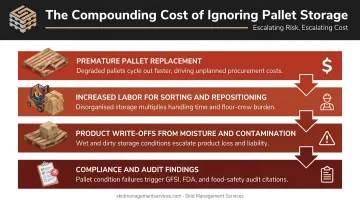
Each of these costs is preventable. The storage practices covered below address the root causes directly — before condemned pallets, compliance findings, or product losses appear on the balance sheet.
Best Practices for Pallet Storage
Effective pallet storage comes down to consistent habits. The following practices build on each other — applied regularly, they reduce damage, extend pallet life, and prevent the compliance failures that cost food and industrial facilities the most.
Ensure Adequate Airflow and a Dry Storage Environment
Wood pallets are hygroscopic — they absorb moisture from the surrounding air. In enclosed or poorly ventilated storage areas, this absorption accelerates mold development and wood degradation.
Practical steps:
- Leave gaps between stacks to allow air circulation
- Use dehumidifiers in enclosed storage to keep humidity below the mold-development threshold
- Keep floors dry with proper drainage, particularly near loading docks where door openings introduce outside air
- Avoid storing pallets directly against walls, which can trap moisture and restrict airflow
For food manufacturing and pharmaceutical environments, this isn't just a pallet-lifespan issue — it's a contamination control requirement under SQF, BRCGS, and FSMA.
Follow Safe Stacking Height and Load Distribution Rules
Stacking height limits protect two things: pallet structural integrity and load stability. OSHA 29 CFR 1910.176(b) requires tiered materials to be stacked, blocked, interlocked, and height-limited to prevent collapse. Specific numeric limits vary by facility — driven by racking load ratings, NFPA 13 fire code (which flags idle pallet piles as a significant fire hazard), and insurer or local code requirements. Across all of these, three rules apply consistently:
- Weight must be distributed evenly across the pallet deck — concentrated loads stress individual boards and cause cracking
- Heavier pallets go on the bottom of stacked configurations
- Racking load ratings must be observed — never exceed the engineered capacity of your rack system
Organize Storage with Labeling, Zoning, and FIFO
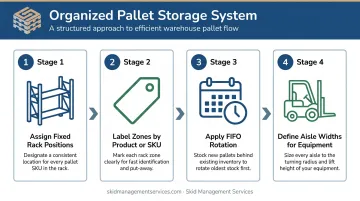
The fastest way to recover labor hours lost to warehouse inefficiency is to make storage predictable. When every pallet has a defined location and workers know exactly where to find it, retrieval time drops and inventory accuracy improves.
Key elements of organized storage:
- Assign pallets to specific rack positions — eliminate "wherever there's space" placement
- Label storage zones by product type, frequency of use, or customer/SKU
- Apply FIFO (First In, First Out) so older inventory moves before newer stock — critical for date-sensitive or regulated goods
- Define clear aisle widths matched to your forklift or pallet jack equipment
Inspect Pallets Regularly and Remove Damaged Units
A damaged pallet in active use is a liability — for the load it carries, for the workers handling it, and for the equipment moving it.
Recommended inspection cadence:
- Daily visual checks for pallets in active rotation: cracked boards, protruding nails, structural deformation
- Monthly thorough inspections of all stored pallets, including early mold, moisture absorption, and board integrity
- Annual professional audit of the full pallet inventory to flag units needing repair or retirement
Damaged units should be pulled immediately and processed through a replacement or recycling channel. Operations working with Skid Management Services can return condemned pallets through their pickup and reverse-logistics program — recovered pallets are sorted, graded, and either reintroduced to inventory or processed for chip and biomass recycling. Trade-in credit typically offsets 15–40% of new pallet spend, and formal ESG documentation of diverted-waste tonnage is available for sustainability reporting.
Start with Quality Pallets from a Reliable Supplier
Storage practices can only preserve what the pallet brings to the floor. Low-quality or inconsistently sized pallets warp faster, create unstable loads under racking, and generate more frequent replacement needs regardless of how carefully they're stored.
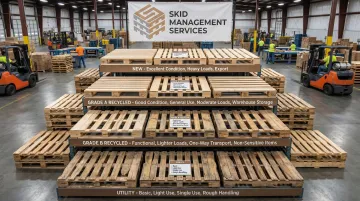
Skid Management Services supplies wood pallets across a defined grade spectrum:
| Grade | Structural Condition | Best For |
|---|---|---|
| New | Virgin lumber, no repair history, dimension-controlled | FDA/food-grade, automated racking, retail-DC compliance, export |
| Grade A Recycled | All 7 boards present, no broken stringers | General warehousing, 3PL, FBA, distribution |
| Grade B Recycled | 1–2 minor board repairs, full structural integrity | General warehouse/distribution, non-spec-strict outbound |
| #2 / Utility | Lower cosmetic/structural standard | Internal flow, floor-level movement, non-racking applications |
For moisture-sensitive environments, kiln-dried heat-treated pallets start with lower baseline moisture content — slowing re-absorption and reducing mold risk in cold storage and refrigerated food applications. Skid Management Services combines its own standing inventory with a national supplier network to support 24/7 availability for high-volume food manufacturing and distribution programs.
Conclusion
Pallet storage isn't a back-of-house detail. It's an operational practice with direct, measurable consequences for product safety, warehouse efficiency, and total cost of ownership.
The advantages of proper storage — protecting goods from damage, maximizing usable space, and extending pallet service life — compound when applied consistently. The cost of neglecting it shows up in damage claims, replacement budgets, and fulfillment slowdowns that quietly erode margins over time.
Good pallet storage starts with good pallets. Businesses that treat sourcing and storage as connected decisions — choosing the right grade, construction, and specification for their environment — are better positioned for supply chain continuity and long-term cost control.
For operations where pallet availability can't slip, partnering with a reliable supplier who understands both product quality and volume consistency is what keeps those two decisions aligned.
Frequently Asked Questions
What is a pallet in storage?
A pallet in storage is a standardized flat platform — typically made of wood — on which goods are stacked, organized, and kept in a warehouse or distribution facility. It serves as the base unit for racking systems, forklift handling, and inventory management across most warehouse operations.
What is the proper way to store a pallet?
Store pallets in a dry, well-ventilated area off the ground, with gaps between stacks to allow air circulation. Keep pallets away from direct moisture sources, stack within safe height limits with evenly distributed weight, and inspect regularly for damage. Avoid storing pallets in closed trailers overnight, where condensation accumulates.
How much does it cost to store a pallet in a warehouse?
According to a 2026 warehousing pricing survey covering more than 600 North American warehouses, average dry warehouse pallet storage runs $20.17 per pallet per month, with a typical range of $18–$25. Climate-controlled or specialized storage runs higher; high-volume 3PL contracts can fall below that range.
How high can you safely stack pallets in a warehouse?
OSHA requires pallets to be stacked stably and securely but sets no universal numeric height limit. Safe stacking depends on three factors: your racking system's engineered load ratings, applicable fire codes (NFPA 13 governs idle pallet pile configurations), and local facility or insurer requirements. Always follow your rack manufacturer's specifications.
How often should pallets be inspected for damage?
Pallets in active use need a visual check daily; stored pallets should be inspected monthly, with a full inventory audit at least once a year. Any unit showing cracked boards, protruding nails, or a warped deck should be pulled immediately to prevent load failures and injuries.