
Introduction
Every day, U.S. warehouses, food plants, and distribution centers face the same tradeoff: pay more for new pallets, or trust Grade A recycled stock to carry the load. Both show up on shipping docks and in racking systems nationwide, and both can move product safely from origin to destination.
What matters is whether a Grade A recycled pallet can match new-pallet performance for your specific load, equipment, and customer requirements.
U.S. producers made an estimated 919 million new pallets and 280 million repaired or remanufactured pallets in 2021, according to a peer-reviewed study published in BioResources. That repaired and remanufactured volume is roughly 23% of combined output, so recycled stock is a core part of U.S. supply—not a niche substitute.
This guide breaks down cost, condition, dimensional consistency, durability, hygiene, and total cost of ownership, so you can match the right pallet grade to the right shipment.
Key Takeaways
- Grade A recycled pallets are inspected, repaired, and sorted stock—not damaged pallets resold as-is
- Grade A units handle domestic shipping, warehouse storage, and internal transfers reliably
- New pallets offer more uniform dimensions and a cleaner, more predictable build
- The right fit depends on load weight, racking or automation, hygiene rules, export status, and budget
- Many operations run both grades side by side, matching pallet type to shipment risk
Grade A Recycled Pallets vs. New Pallets: Quick Comparison
| Factor | Grade A Recycled | New |
|---|---|---|
| Cost | Lower upfront cost | Higher, reflects raw lumber and manufacturing |
| Condition | Inspected and repaired, sound boards | Unused components, no repair history |
| Dimensions | Some variation possible | Highly uniform |
| Durability | Comparable rough-handling life in controlled tests | Comparable rough-handling life; stronger in some racking tests |
| Hygiene/Export | Requires supplier verification | Easier to document, especially kiln-dried HT stock |
Cost
Grade A recycled pallets typically cost less upfront because they reuse existing lumber instead of requiring fresh-cut boards and full manufacturing. Recycled and remanufactured pallet programs commonly deliver 40 to 60% savings versus new pallets, though the actual spread depends on grade, size, and regional supply.
New pallets carry the full cost of raw lumber, milling, and assembly. That price buys known construction with zero prior-use history. Still, purchase price is only part of the equation. Freight, rejection risk, and replacement frequency all factor into true cost of ownership.
Condition and Construction
Grade A recycled pallets must have:
- All deck boards present and secured
- No broken or split stringers
- Minimal repair history under most supplier grading systems
- No protruding nails or other hazards
New pallets are built once, from unused components, to an agreed footprint or specification. There's no repair history to track, and no unknowns about how previous loads or handling affected the wood.
Dimensional Consistency
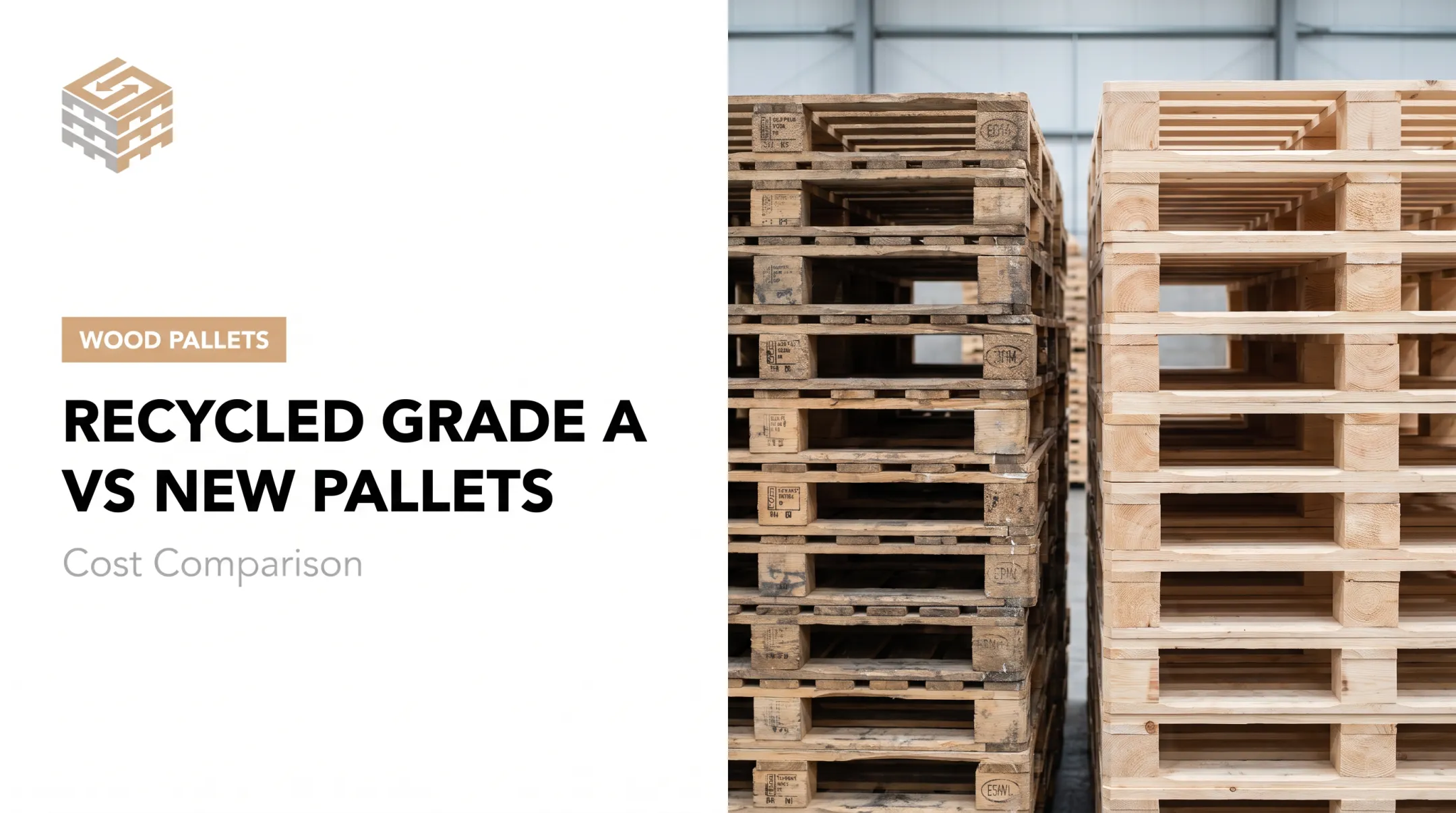
New pallets hold tighter, more uniform dimensions because every board comes from the same production run. Grade A recycled pallets can vary slightly, a repaired deck board here, a reset stringer there, even when each pallet passes inspection individually.
That variation matters more in some settings than others:
- Higher risk: automated conveyors, robotic palletizers, narrow-aisle racking, tightly specified retail-DC programs
- Lower risk: general floor-stacking, manual handling, most domestic freight
If your equipment reads pallet footprint automatically, small dimensional swings can cause jams. If a forklift operator is stacking pallets in a warehouse aisle, a quarter-inch difference rarely matters.
Durability and Load Performance
Durability comes down to construction quality, load weight, load distribution, and handling conditions, not simply whether a pallet is new or recycled.
A USDA Forest Service study comparing new, remanufactured, and Grade A repaired GMA-style pallets found comparable rough-handling durability across all three. That points to similar service life under normal use.
The same study found Grade A repaired pallets scored 19% lower in one specific test: strength when racked across their stringers. Bending strength and stiffness barely differed when pallets spanned their deckboards instead. Load orientation matters more than a blanket new-versus-used label.

Appearance, Hygiene, and Compliance
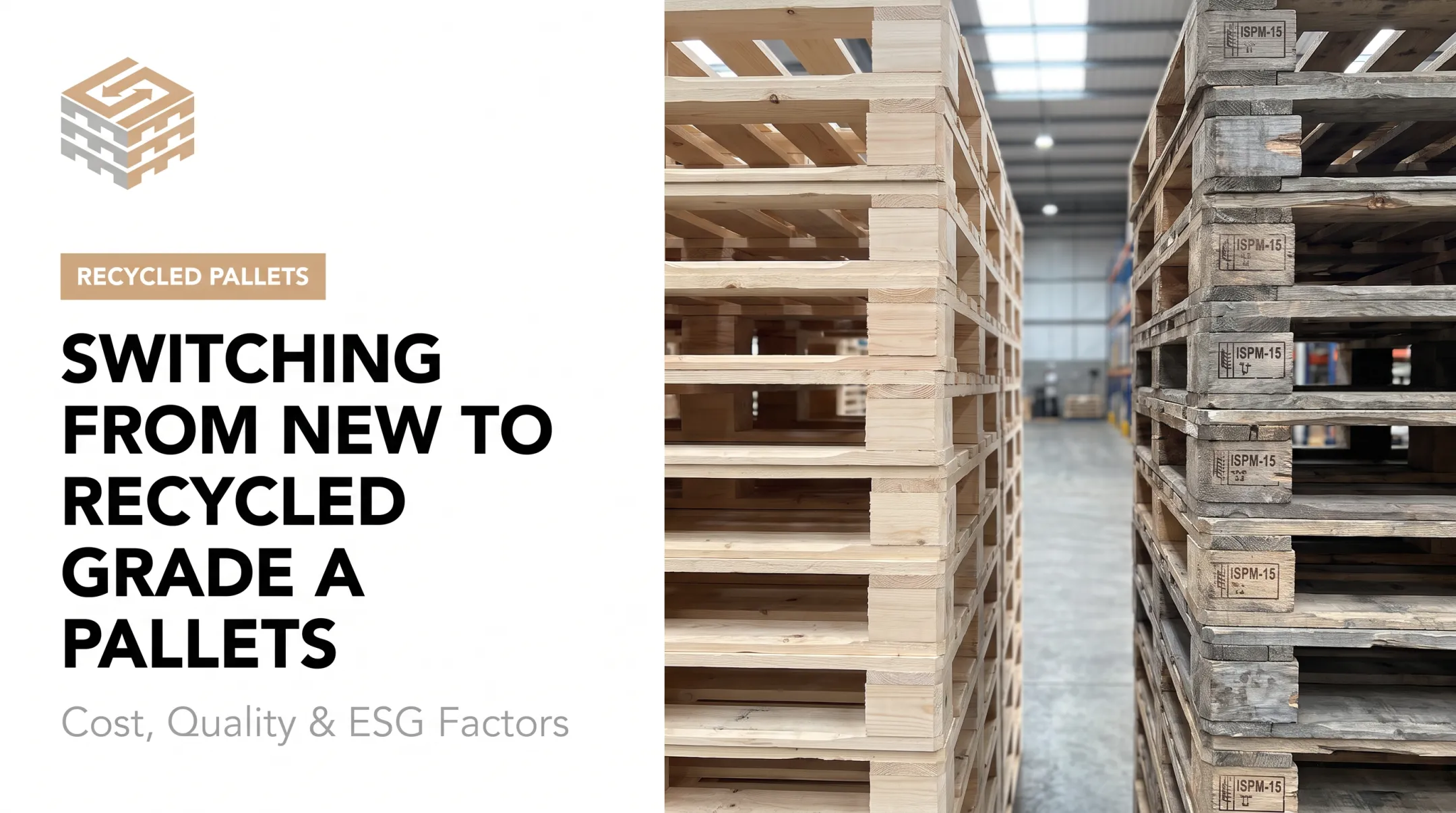
New pallets typically look cleaner and more uniform, with no board repairs, discoloration, or signs of prior use. Grade A recycled pallets may show minor color variation, light handling marks, or repaired components.
Neither appearance nor grade alone determines food, pharmaceutical, or export suitability. Federal sanitary-transportation rules require that transport equipment, including pallets, be suitable, easy to clean, and maintained in sanitary condition for food shipments. That standard depends on actual condition and handling.
Export shipments carry a separate requirement: verified ISPM-15 heat treatment and marking, checked against destination rules.
What Are Grade A Recycled Pallets?
Grade A recycled pallets are previously used wood pallets picked up, inspected, sorted, and repaired or reconditioned before returning to service. That sets them apart from a plain "used" pallet sold as-is: Grade A means the pallet was checked and repaired before it shipped. "Grade A" isn't one fixed industry standard. Suppliers define it differently: acceptable repairs, board condition, stringer condition, cleanliness, and load expectations can all vary. Confirm your supplier's exact grading criteria before ordering.
What a Reputable Grade A Program Should Deliver
- No broken or missing deck boards
- Secure fasteners with no protruding nails
- Structurally sound stringers or blocks
- Dimensions suited to your stated application
Benefits and Limitations
Grade A recycled pallets deliver clear operational value:
- Lower upfront cost than new pallets
- Existing wood returned to service instead of discarded
- Common footprints such as GMA 48x40, 48x48, 42x42, and 36x36
- Strong fit for recurring domestic shipping and warehouse movement They are not a one-for-one stand-in for new stock. Previous use leaves an unknown service history, and repairs create unit-to-unit variation. Cosmetic condition will not match new lumber. Without extra verification, a Grade A pallet may not clear:
- Automation tolerances
- Hygiene programs
- Export rules
- A customer's specific receiving spec
Where They Make Sense
Grade A recycled pallets fit domestic distribution, warehouse storage, internal transfers, retail replenishment where appearance is secondary, and high-volume operations balancing pallet spend against reliable recurring supply. Many manufacturers run new and Grade A recycled pallets side by side, assigning each grade where it fits rather than standardizing on one option.
Buyer Inspection Checklist
Before accepting a Grade A shipment, check:
- Footprint matches your order (48x40, 48x48, etc.)
- Deck-board condition shows no cracks, splintering, or looseness
- Stringer or block integrity has no fractures or crushing
- Fasteners are secure with no exposed nails
- No contamination, moisture damage, or odors
- Supplier's repair history and replacement policy are documented Need recurring Grade A supply across multiple specs? Skid Management Services sources from its own inventory and a broad supplier network for competitive pricing and uninterrupted supply. Call 717-202-0304 for availability.
What Are New Pallets?
New pallets are built from unused lumber and components, either to a standard footprint like GMA 48x40 or to a customer's specified dimensions, load rating, lumber grade, and entry configuration.
Core Advantages
- Predictable construction with no prior-use history
- Consistent dimensions, board to board and pallet to pallet
- Clean, uniform appearance
- Easier alignment with strict internal or customer specifications
Best-Fit Applications
New pallets are the stronger choice for:
- First-time builds of automated rack systems
- Heavy or high-value loads
- Customer-facing shipments
- Regulated or hygiene-sensitive operations
- Closed-loop pallet programs
- Export orders requiring verified ISPM-15 treatment
Kiln-dried, heat-treated new pallets are especially common in food-grade programs since they carry no treatment-chemical residue and no prior-load history, details auditors often ask about directly.
Trade-Offs
Trade-offs include:
- Higher cost per unit
- Added lead time for custom designs
- More virgin material used per unit than reusing existing wood
A 2020 USDA Forest Service lifecycle assessment modeled new wood pallets' cradle-to-grave footprint at 10.4 kg CO2-equivalent per functional unit of delivering 100,000 lb of product, based on one modeled repair cycle.

Additional repairs and extended reuse could lower that modeled impact further. Many operations blend new and recycled pallets for this reason rather than choosing one exclusively.
Which Is Better: Grade A Recycled or New Pallets?
Neither option wins universally. The right call depends on what happens if a pallet fails, what your equipment demands, and how much consistency your receiving customer expects.
Choose Grade A recycled pallets when:
- Cost control matters more than cosmetic uniformity
- Shipments are domestic and floor-stacked or manually handled
- Standard footprints (GMA 48x40, 48x48, and similar) cover your needs
- Your supplier's grading process is transparent and verifiable
Choose new pallets when:
- Automated equipment demands tight dimensional tolerances
- Loads are heavy, high-value, or customer-facing
- Hygiene or export documentation is required
- You need a custom-engineered design
Comparing Total Cost, Not Just Price
A lower sticker price doesn't guarantee lower total cost. Weigh:
- Purchase price and freight
- Pallet rejection or chargeback risk at the receiving dock
- Product damage from pallet failure
- Labor time lost to inspection or handling interruptions
- Repair needs and replacement frequency
- The cost of a supply shortage during peak season
Some operators also face inconsistent used-pallet quality and occasional supply gaps. Fold those risks into total cost instead of judging on unit price alone.
Many operations don't pick one grade exclusively. Instead, they run new pallets for automated, export, or customer-facing loads and Grade A recycled pallets for domestic or internal movement.
Real-World Buying Scenarios
Scenario 1: Domestic warehouse, standard outbound loads. A distribution center shipping palletized goods to regional retailers doesn't need automation-grade tolerances. Grade A recycled pallets, verified against a clear checklist, cover the load without the new-pallet premium.
Scenario 2: Manufacturer running automated palletizing. A plant with robotic palletizers and narrow-aisle racking needs every pallet to hit the same footprint, every time. New pallets, built to spec, remove the dimensional guesswork Grade A stock can introduce.
Scenario 3: Blended program across shipment types. A company exporting part of its product and shipping the rest domestically splits the fleet. New, ISPM-15-treated pallets handle export loads; Grade A recycled pallets cover domestic moves. Grade follows shipment risk instead of one standard for every load.

Before ordering, give your supplier the full picture:
- Pallet size and quantity
- Load weight and storage method
- Equipment requirements
- Destination, hygiene expectations, and export status
- Delivery schedule
Skid Management Services uses that detail to recommend the right mix of new and recycled pallets, drawing on its own inventory and supplier network for dependable supply.
Conclusion
Grade A recycled pallets can perform just as well as new pallets for many general-purpose domestic and warehouse work. But "as good" doesn't mean identical. Condition, consistency, use history, and suitability for automation, hygiene, or export programs still separate the two.
Match pallet grade to shipment risk:
- Use Grade A recycled pallets where cost control and standard handling matter most
- Reserve new pallets for automated systems, high-value loads, and compliance-heavy shipments
- Verify your supplier's grading standards either way
For most operations, a blend of both grades, sourced from a supplier with reliable inventory and supply continuity, delivers the best balance of cost, reliability, and uninterrupted supply.
Frequently Asked Questions
Are recycled pallets as good as new?
Grade A recycled pallets perform comparably to new pallets for many standard domestic and warehouse applications. New pallets remain the better choice for automation, strict hygiene programs, custom specifications, export compliance, or highly sensitive loads.
How long do Grade A recycled pallets last?
Lifespan depends on load weight, handling practices, storage conditions, and how often units are inspected and repaired. In standard warehouse use, sound Grade A pallets often complete multiple reuse cycles before they need major reconditioning or retirement.
Are pallets sprayed with chemicals?
Not every pallet is chemically treated. Treatment depends on the pallet's history, intended use, and export requirements. Ask your supplier about treatment method, contamination controls, heat treatment, and available documentation.
What is a Grade A recycled pallet?
A Grade A recycled pallet is a previously used pallet that's been inspected, sorted, and repaired or reconditioned to meet a supplier's Grade A criteria. Grading definitions vary by supplier, so confirm specifics before ordering.
Are Grade A recycled pallets safe for shipping?
Properly inspected, structurally sound Grade A pallets are commonly used for commercial shipments nationwide. Safety still depends on load weight, handling, condition, cleanliness, and any compliance requirements specific to your shipment.
When should I choose new pallets instead of Grade A recycled pallets?
Choose new pallets for automated handling, heavy or high-value loads, tight dimensional tolerances, customer-facing presentation, hygiene-sensitive operations, custom designs, or international shipments requiring verified ISPM-15 compliance.