
Inspectors don't care that your goods are perfectly fine. If the pallet lacks a valid stamp, or the wood wasn't treated correctly, your shipment sits in quarantine while you pay demurrage fees and answer angry emails from your customer overseas.
ISPM-15 is the universal foundation most countries build on, but "universal" doesn't mean "identical." Individual countries layer on their own documentation, marking, and material rules exporters often discover too late.
This guide covers the global standard, country-by-country quirks, approved treatment methods, exempt materials, and how to source pallets that won't get flagged at the port.
Key Takeaways
- ISPM-15 is the baseline nearly every trading nation recognizes, but enforcement and paperwork vary by destination
- Heat treatment (HT) is the preferred, most widely accepted method, ahead of methyl bromide fumigation
- Plywood, OSB, particle board, and non-wood pallets are exempt from ISPM-15 entirely
- Working with an experienced pallet supplier cuts compliance risk and prevents shipment delays
Understanding ISPM-15: The Global Export Pallet Standard
ISPM-15 (International Standard for Phytosanitary Measures No. 15) was first adopted in 2002 by the International Plant Protection Convention, with a revised annex adopted in 2018. Its purpose is straightforward: stop pests like wood-boring insects from hitching a ride across borders inside pallets, crates, and dunnage.
The IPPC estimates that roughly 80% of international trade consignments involve some form of wood packaging material, which is exactly why regulators treat this as a biosecurity priority rather than a paperwork formality.
What the Stamp Must Show
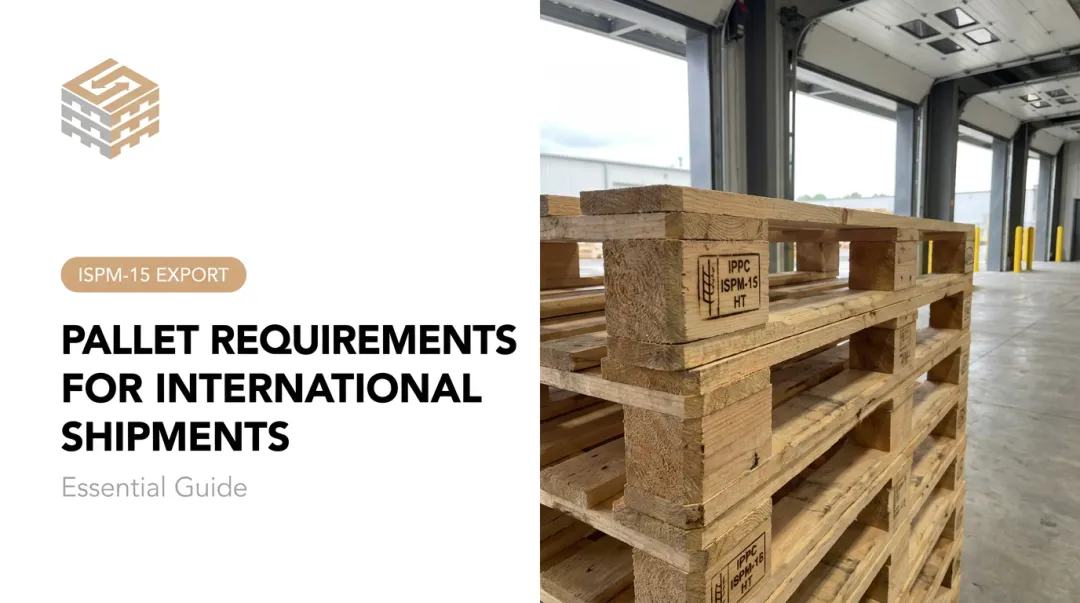
Every compliant mark needs four elements:
- IPPC symbol — the official logo
- Country code — the two-letter ISO code of the treatment location
- Provider ID — a unique code assigned to the certified treatment facility
- Treatment code — HT (heat treatment), MB (methyl bromide), DH (dielectric heating), or SF (sulfuryl fluoride)

That mark is recognized only in countries that have adopted ISPM-15, and adoption is not universal. The IPPC publishes a country-by-country implementation table rather than one master count, so verify requirements for your specific destination instead of assuming blanket coverage.
Repairs Void the Certification
Here's a mistake exporters make constantly: they repair a marked pallet and assume the stamp still counts. It doesn't. Once a treated pallet is repaired, the original certification is void.
The pallet must be re-treated, and the old mark permanently obliterated before a new one is applied. Skip this step, and customs will reject the shipment on sight.
Keep your treatment records even though the stamp is your primary proof at the port. If a shipment gets flagged, documentation is what gets it released faster.
Export Pallet Requirements by Country: What Exporters Need to Know
ISPM-15 is only the baseline. Many countries add their own invoicing rules, treatment reports, or inspection regimes on top of the base standard.
United States (outbound): APHIS gives exporters three paths:
- Buy pre-marked wood packaging material
- Reuse marked wood packaging that hasn't been altered
- Use a registered facility to treat and mark it yourself
Enrollment with an ALSC-accredited inspection agency is required for treatment providers. Note: a US phytosanitary certificate isn't issued just for the pallet transporting your goods.
European Union: The EU applies risk-based port controls under Regulation (EU) 2019/2125. Non-compliant material can be destroyed, re-dispatched, or specially treated at the importer's expense. Exemptions exist for wood under 6mm and wholly processed wood like plywood and OSB.
Canada: Wood packaging made from continental US or Canadian-origin wood is exempt from Canada's D-98-08 requirement. Material from other origins needs full treatment, debarking, and marking under NPPO authority.
Mexico: NOM-144-SEMARNAT-2017 governs wood packaging entering Mexico, with its own mark format specifying country abbreviation, authorized number, and treatment code. Don't assume USMCA gives you a blanket pass here. Check the norm directly.
China: Runs a stringent biosecurity inspection regime. Its port interception database logged over 464,000 records between 2003–2016, with insects accounting for over half of findings—marks and treatment evidence get close scrutiny.
Australia: The BICON system requires treatment declarations for containerized cargo. Untreated material can require treatment, re-export, or disposal at the importer's expense.
Turkey: Exporters can't sell wood packaging material without a heat-treatment report or graphical proof showing at least 56°C for 30 minutes. That report must accompany the invoice for the shipped batch, not just sit in a file somewhere.
Brazil: All overseas wood packaging and dunnage must be ISPM-15 treated. If the origin country hasn't formally adopted ISPM-15, a phytosanitary certificate or NPPO-guaranteed treatment certificate is required instead.
Packaging without a valid stamp, or carrying quarantine pests, can simply be returned to origin at your cost.
A valid ISPM-15 mark is necessary, but it may not be sufficient. Always check the destination's current rules before loading.

ISPM-15 Treatment Methods and Marking Requirements
Heat Treatment (HT)
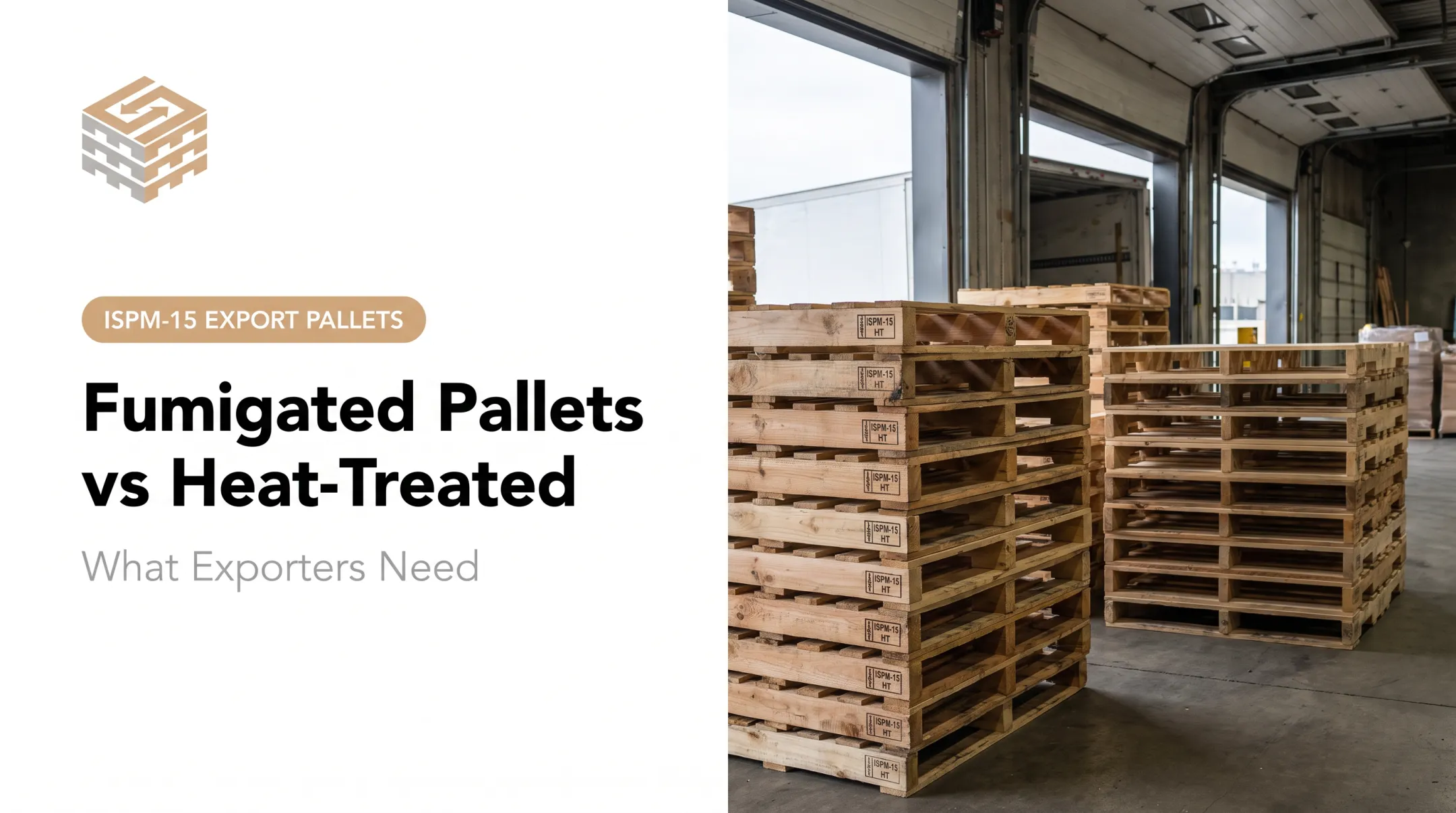
Heat treatment is the most widely accepted ISPM-15 method. The wood core must reach 56°C (132.8°F) for at least 30 continuous minutes.
HT leaves no chemical residue and is recognized in nearly every destination market. Skid Management Services sources HT pallets exclusively for its export programs, through USDA APHIS-recognized providers.
Methyl Bromide (MB) Fumigation
MB remains an approved treatment code, but it's being phased down. US production and consumption were phased out in 2005 under the Montreal Protocol, with narrow exceptions for critical use and quarantine/preshipment. Expect fewer facilities offering it over time.
Dielectric Heating (DH) and Sulfuryl Fluoride (SF)
Both are approved for specific applications:
- DH: Wood must reach 60°C throughout its profile within 30 minutes, then hold that temperature for at least one continuous minute.
- SF: Accepted in some jurisdictions only. Confirm the destination allows sulfuryl fluoride before you specify it.
Debarking Comes First
All wood must be debarked before treatment, regardless of method. Small bark fragments are tolerated (under 3 cm wide, or under 50 cm² if wider), but full bark coverage is a rejection risk.
Debarking is especially critical before MB or SF, because bark blocks fumigant penetration.

ISPM-15 Marking Requirements
Treated wood packaging must carry a legible, permanent ISPM-15 mark. At minimum it shows:
- IPPC wheat-stamp logo
- Two-letter ISO country code (for example, US)
- Unique producer or treatment-provider number
- Treatment code: HT, MB, DH, or SF
Apply the mark on at least two opposite sides of the unit. Do not paint over, damage, or obscure it. If a reused pallet’s stamp is missing or unreadable, it needs re-treatment and re-stamping through a recognized provider before export—Skid Management Services coordinates stamp verification and re-stamping for HT export programs.
Materials and Pallets Exempt from ISPM-15
Not every pallet needs a stamp. ISPM-15 exempts:
- Plywood, OSB, particle board, and veneer — because the manufacturing process (heat, glue, pressure) already kills pests
- Wood 6 mm or thinner (about 1/4 inch) — too thin to harbor larvae
- Non-wood materials — plastic, metal, and other synthetic pallets fall outside the standard entirely
One important caveat: a composite pallet with some solid-wood components isn't automatically exempt just because part of it is plywood. The exemption applies only to material that is wholly processed wood or thin wood, not partially.
Plastic and metal pallets need no ISPM-15 stamp, debarking, or treatment paperwork—useful for strict-enforcement destinations such as China or Australia. Higher unit cost and tighter supply often outweigh that benefit on high-volume, tight-margin shipments, which is why most U.S. exporters still ship on heat-treated solid-wood pallets.
Sourcing Compliant Export Pallets: What to Look for in a Supplier
Not all "ISPM-15 compliant" pallets are actually compliant. The mark needs to be legible, complete, and applied by an authorized provider, not slapped on after the fact by someone hoping nobody checks.
When vetting a supplier, look for:
- Stamp verification before shipment: someone physically checking the IPPC logo, country code, provider ID, and treatment code are present and legible
- Access to USDA APHIS-recognized treatment providers: not just a claim of compliance, but a real network behind it
- Re-treatment and re-stamping capability: for pallets that fail inspection or need correction
- Consistent supply: especially for exporters running recurring container volumes
Skid Management Services operates this way for exporters moving freight through the Central Pennsylvania–Maryland–Port of Baltimore corridor. The company combines its own inventory with an expansive supplier network, supplying kiln-dried, heat-treated pallets in standard sizes like GMA 48x40, 48x48, and 42x42, alongside custom export builds.
Every pallet gets stamp verification before it leaves. If a mark is missing or invalid, SMS coordinates re-treatment and re-stamping through APHIS-recognized providers rather than letting a bad pallet ship.

Before signing any pallet contract, add explicit language requiring ISPM-15 compliant, properly marked material for export orders. Verbal assurances don't hold up when customs asks for proof.
Common Compliance Mistakes Exporters Make
Most rejected shipments trace back to a handful of avoidable errors:
- Grabbing domestic pallets for an international order. Warehouse stock used for local deliveries is rarely heat-treated or ISPM-15 marked—mixing it into an export load is a frequent, costly error.
- Skipping re-treatment on repaired pallets. A replaced board or deck plank voids the original stamp; shipping without re-treatment and a fresh mark risks rejection at inspection.
- Assuming the ISPM-15 stamp is the only document you need. Turkey may require treatment reports with the invoice; Brazil may require a phytosanitary certificate when the origin has not adopted the standard. The stamp opens the door—it does not guarantee entry everywhere.
Build a destination checklist before you stage the load: confirm treatment marks, re-stamp repaired units, and match any extra paperwork the receiving country requires.
Frequently Asked Questions
What are the 5 basic export requirements?
Product classification, export licensing, shipping documentation, packaging/labeling compliance, and destination-country regulatory checks. Wood packaging compliance falls under both packaging rules and destination regulations.
What are the ISPM-15 pallet regulations?
Wood packaging must be debarked, treated with an approved method (typically heat treatment at 56°C (133°F) for 30 minutes), and marked with the IPPC symbol, country code, provider ID, and treatment code.
Do all countries require ISPM-15-compliant pallets?
Most major trading economies require it, but enforcement strictness varies widely. Some countries, like Turkey and Brazil, add documentation requirements beyond the standard mark itself.
What happens if my export pallet isn't compliant?
Outcomes range from quarantine and on-site treatment to shipment delays, reshipment, or outright destruction, all typically at the exporter's or importer's expense.
Are plastic pallets a good alternative for international shipping?
Plastic pallets are ISPM-15 exempt and durable, so they skip wood-treatment rules. Higher per-unit cost and tighter availability often make heat-treated wood the more practical choice for most export volumes and destinations.