Introduction
One non-compliant pallet is all it takes to stop an international shipment cold. Customs officials don't care that the rest of your cargo is perfect. If the wood packaging fails inspection, customs holds the entire container.
Many businesses assume domestic pallets automatically qualify for export. They don't. That assumption leads to fines, forced re-exports, or destroyed freight sitting at a foreign port while invoices pile up.
This guide breaks down exactly what compliance requires:
- ISPM-15 heat treatment rules
- Material selection standards
- Size and weight limits
- Container loading capacity
- Labeling and documentation that keep freight moving instead of sitting in customs limbo
Key Takeaways
- Wood pallets need ISPM-15 heat treatment or fumigation before crossing any international border
- Plastic and metal pallets skip ISPM-15 entirely but trade off cost and weight capacity
- US (48x40in), Euro (1200x800mm), and Australian sizes differ, so check destination standards first
- Loaded pallets should stay under 60 inches tall for safe international transport
- Labeling and documentation errors cause more customs holds than almost any other issue
Why International Pallet Requirements Matter
Millions of units of wood packaging material move through US ports every year, carrying everything from snack foods to industrial machinery. Pallet compliance keeps invasive pests out of foreign ecosystems and keeps your freight moving on schedule.
Non-compliance carries real consequences:
- Customs holds that stall delivery timelines and trigger demurrage fees
- Forced re-export at the shipper's expense
- Fines levied by the destination country's plant health authority
- Destroyed goods when treatment or return isn't feasible
The stakes are high because untreated wood packaging is a documented pathway for invasive insects. The US Forest Service reports that invasive insects cause $4.2 billion in annual losses to the forest-products industry, naming wood packaging material as one of the two primary entry routes for non-native pests. The Asian longhorned beetle, one of the most destructive invasive species in North America, is believed to have entered the country hidden inside wood packaging.
That same risk explains why requirements aren't uniform across shipping modes. Ocean, air, and rail each carry slightly different documentation expectations, and destination countries enforce ISPM-15 with varying strictness. What clears customs in Canada might get flagged in China. Due diligence before every shipment is essential.
ISPM-15 Compliance: Heat Treatment, Fumigation & Stamping Requirements
ISPM-15 is the International Standard for Phytosanitary Measures No. 15, created by the International Plant Protection Convention (IPPC). It exists for one reason: to stop pests like the Asian longhorned beetle and emerald ash borer from hitching a ride in wood packaging material and establishing themselves in new countries.
Heat Treatment vs. Fumigation
Two treatment methods satisfy ISPM-15:
- Heat treatment (HT): Wood must reach an internal temperature of 56°C (132.8°F) throughout the entire wood profile, including the core, and hold that temperature for at least 30 continuous minutes.
- Methyl bromide fumigation (MB): Still recognized under the standard, though the US phased out routine domestic use in 2005. It's now largely limited to quarantine and preshipment applications within 21 days of export.
Heat treatment remains the more widely recommended path since it skips the chemical process entirely.
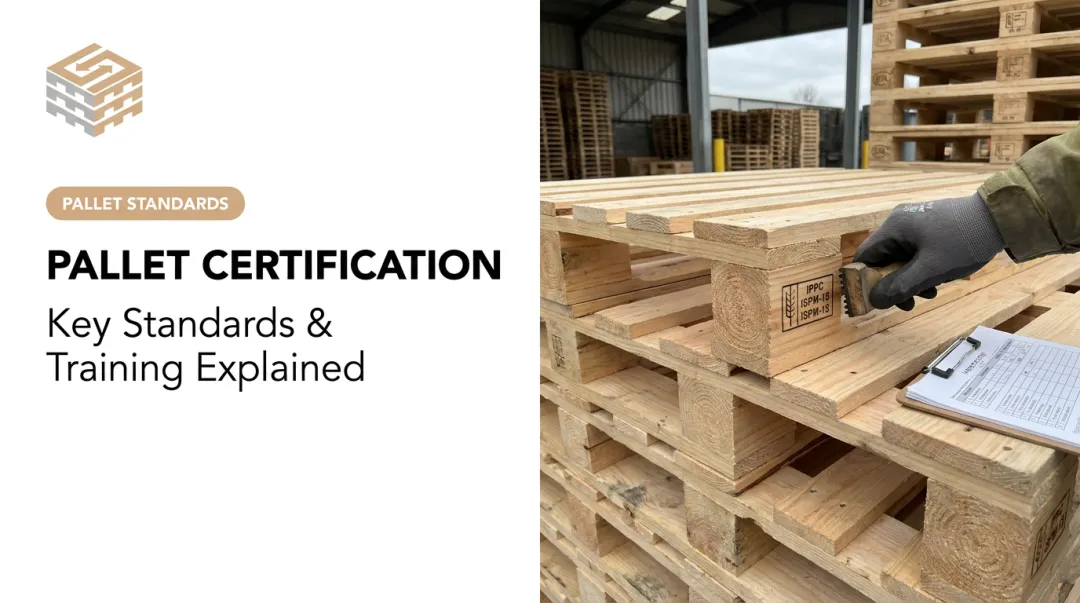
What a Compliant Stamp Actually Looks Like
Every treated pallet needs a visible stamp with four required elements:
- IPPC logo (the two-leaf symbol)
- Two-letter ISO country code
- Facility ID code assigned to the treatment provider
- Treatment code — HT for heat treatment, MB for methyl bromide
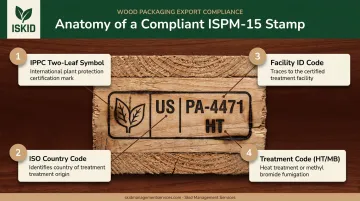
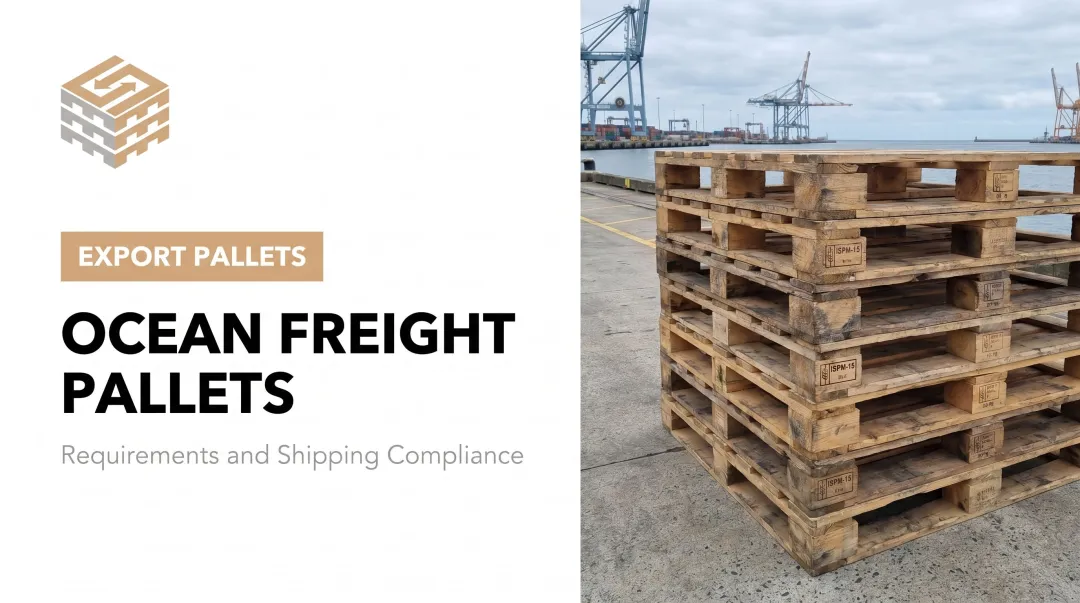
A smudged, incomplete, or unauthorized stamp is grounds for rejection just as much as an untreated pallet. One missing element can hold up an entire container.
Not every pallet needs this treatment, though. Engineered wood is exempt. Plywood, oriented strand board (OSB), and hardboard don't need ISPM-15 treatment because the manufacturing process (heat, pressure, adhesives) already eliminates pest risk.
Working with an established national pallet supplier removes most of this guesswork. Skid Management Services sources ISPM-15 heat-treated, HT-stamped pallets through a network of USDA APHIS-recognized treatment providers, in standard sizes like GMA 48x40, 48x48, and 42x42, plus custom export-spec builds.
For exporters moving freight through the Port of Baltimore corridor, that means pallets arrive pre-certified and properly stamped, rather than discovered non-compliant after the container is already sealed.
What Happens If Your Pallets Aren't Compliant?
The consequences aren't theoretical. Non-compliant shipments get stopped at the border. Destination customs can order fumigation on arrival, billed to the receiver. Cargo can be re-exported at the shipper's expense, or destroyed outright if neither option is practical.
This is why stamp verification matters even for exporters who already own pallet inventory. Skid Management Services checks existing stock against all four required ISPM-15 elements before it ever reaches a container, and coordinates re-treatment and re-stamping through licensed providers when pallets fall short.
Choosing the Right Pallet Material for International Shipments
Material choice affects cost, weight capacity, and whether ISPM-15 even applies. Here's how the main options stack up.
Wood pallets remain the default for good reason. They're cost-effective, widely available, and strong enough for most freight (manufacturer-rated capacities for heavy-duty designs run well above 4,000 lbs). The tradeoff: raw wood requires treatment, and treated pallets add some weight over untreated stock.
Plastic pallets skip ISPM-15 entirely since they're outside the wood packaging regulation. They resist moisture and hold up over many reuse cycles. But export-grade plastic designs often top out around 1,500 lbs dynamic capacity, and upfront cost runs higher than comparable wood builds.
Metal pallets suit heavy-duty or high-value freight. Aluminum and steel designs resist corrosion and can carry substantial dynamic loads, but they're heavier to ship and cost more per unit. Skid Management Services distributes steel sheet metal storage pallets for freight that exceeds standard wood or plastic capacity ratings.
Cardboard/paper pallets offer a lightweight, low-cost option for light, non-fragile freight. They're not built for moisture exposure or heavy loads, so they work best for dry-goods shipments with modest weight requirements.
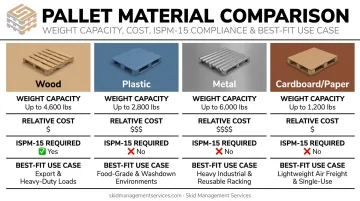
Matching Material to Transport Mode and Product
- Ocean freight, heavy or bulk goods: Wood or metal, depending on load weight
- Air freight, moisture-sensitive electronics: Plastic, for its impervious surface
- Food and beverage exports: Kiln-dried HT wood, which also resists moisture buildup in cold-storage environments
- Fragile, lightweight goods: Cardboard, when budget matters more than durability
Lumber grade matters here too. Softwood keeps costs down for standard loads, while hardwood and A-grade/premium clear lumber deliver the dimensional consistency needed for automated rack systems or pharmaceutical cGMP programs. Whatever the grade, kiln-dried heat treatment is the non-negotiable layer for export compliance.
Pallet Size, Weight Limits & Container Loading Capacity
Pallet dimensions aren't universal, and using the wrong footprint can create handling problems at the destination.
| Standard | Footprint | Typical Region |
|---|---|---|
| GMA | 48 x 40 in | United States |
| EPAL Euro pallet | 1200 x 800 mm | Europe |
| Australian standard | 1165 x 1165 mm | Australia |
Racking systems, forklifts, and dock equipment abroad are often built around the local standard. Shipping a US 48 x 40 in pallet into a facility racked for Euro pallets can mean wasted floor space or handling delays. Always confirm the receiving country's expected footprint before building your export program.
Height and Weight Guidelines
Loaded pallets should generally stay under 60 inches (five feet) tall. This isn't arbitrary — DHL notes that pallet builds above roughly 63.5 inches often require aircraft main-deck loading since belly-hold doors can't accommodate taller units. Staying within 60 inches also keeps loads more stable during strapping and transit.
Weight capacity varies by material and design:
- Wood: Up to roughly 4,600 lbs on heavy-duty manufacturer designs
- Plastic: Roughly 1,500 lbs dynamic on lightweight export models, though rackable plastic designs can reach 4,000 lbs
- Custom-engineered wood pallets (built for machinery or oversize freight) can be rated from 4,000 lbs up to 10,000+ lbs dynamic
How Many Pallets Fit in a 40ft Container?
Figures vary by loading method, but exporters commonly plan around 20 pallets floor-loaded in a single row, or up to 40 when double-stacked, using standard 48 x 40 in footprints. Actual counts shift based on cargo height, overhang, and weight distribution, so always confirm against your specific load plan.
Transport mode also drives footprint choice. Air freight often uses larger 96 x 125 in pallet builds (aircraft unit-load devices), while ocean and rail freight stick with the standard 48 x 40 in or Euro footprint for efficient container loading.
Skid Management Services builds across this full range, from standard GMA sizes to Euro-equivalent 1200 x 800 mm block pallets and fully custom dimensions for oversized or heavy machinery freight, all available in ISPM-15 heat-treated configurations.
Labeling, Documentation & Load Securing Best Practices
Even a perfectly treated, correctly sized pallet can get held at customs over a labeling gap or missing document. This is often the most avoidable point of failure in the entire export process.
Essential Label Elements
International palletized freight labels should include:
- Shipper and consignee information
- Serial Shipping Container Code (SSCC)
- Product description and quantity
- Handling instructions
Duplicate labels on at least two visible sides of the pallet. If one label gets damaged or obscured during transit, the second ensures the load is still identifiable.
Core Shipping Documents
Have these ready before the container leaves the dock:
- Commercial invoice: establishes value for customs assessment
- Packing list: itemizes contents, weights, and dimensions
- Bill of lading (or air waybill for air freight): the carrier's transport contract
- Customs declaration: required for US exports above the Schedule B threshold
- Phytosanitary certificate: where the destination country requires it for plants or plant products, though it's separate from the pallet's ISPM-15 stamp
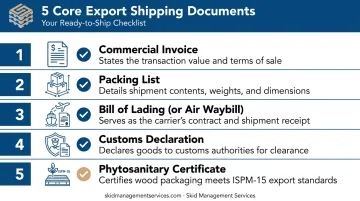
Load Securing Basics
Proper load securing protects both the cargo and the pallet's compliance status:
- Shrink or stretch wrap every load to prevent shifting
- Strap loads for added stability on longer transit routes
- Place heaviest items at the bottom to lower the center of gravity
- Protect moisture-sensitive cargo with barriers or ventilation, especially on ocean routes prone to condensation
Skid Management Services supplies the full packaging layer alongside its export pallets, including stretch film, PP/PET/steel strapping, corner boards, and pallet ID and hazmat labels. Exporters can source compliant pallets and the materials to secure them from a single vendor.
Frequently Asked Questions
What are the pallet requirements for international shipments?
Wood pallets need ISPM-15 heat treatment or fumigation with a compliant stamp. Beyond that, match your material and size to the destination country's standards and complete accurate labeling and documentation.
What is required for international shipments?
You'll need a commercial invoice, packing list, bill of lading, and customs declaration, plus a phytosanitary certificate where applicable. Packaging itself must be compliant and properly treated.
How many pallets can you fit in a 40ft shipping container?
Standard 48x40in pallets typically run around 20 in a single floor-loaded row, or up to 40 when double-stacked. Actual counts vary with cargo height and weight distribution.
What is ISPM-15 and why is it required?
ISPM-15 is the IPPC's international standard regulating wood packaging material to prevent the spread of invasive pests like the Asian longhorned beetle. It requires heat treatment or fumigation plus a compliant stamp.
Can I use plastic pallets for international shipping?
Yes. Plastic pallets are exempt from ISPM-15 and hold up well against moisture, though export-grade designs often cap around 1,500 lbs dynamic capacity and cost more upfront than wood. Most exporters still choose ISPM-15 heat-treated wood pallets for the better balance of cost, strength, and compliance ease.
What is the maximum height for pallets in international shipping?
Loaded pallets should generally stay under 60 inches (five feet) tall. Taller builds often require aircraft main-deck loading and can complicate strapping and stability during transit.