Introduction
Pallet design might seem like a minor detail, but it shapes everything from dock speed to product damage rates. The 4-way block pallet has become the go-to solution for operations that need forklifts and pallet jacks to enter from any side, no repositioning required.
That flexibility only pays off when the pallet is chosen deliberately. Too often, businesses default to whatever pallet their supplier has on hand, without understanding how construction affects accessibility, durability, and total cost. That gap in knowledge leads to slower loading docks, more handling damage, and higher long-term replacement costs.
This guide breaks down what a 4-way block pallet actually is, how it's built, where it delivers the most value, and what to weigh when choosing a supplier for your operation.
Key Takeaways
- True 4-way block pallets allow entry from all four sides, unlike 2-way stringers
- Solid block construction (9 support blocks) boosts load capacity and eases repairs
- Full-perimeter access speeds loading, simplifies staging, and cuts handling damage
- These pallets cost more upfront, but longer service life often lowers total costs
- Supplier reliability determines whether you actually see those savings
What Is a 4-Way Block Pallet?
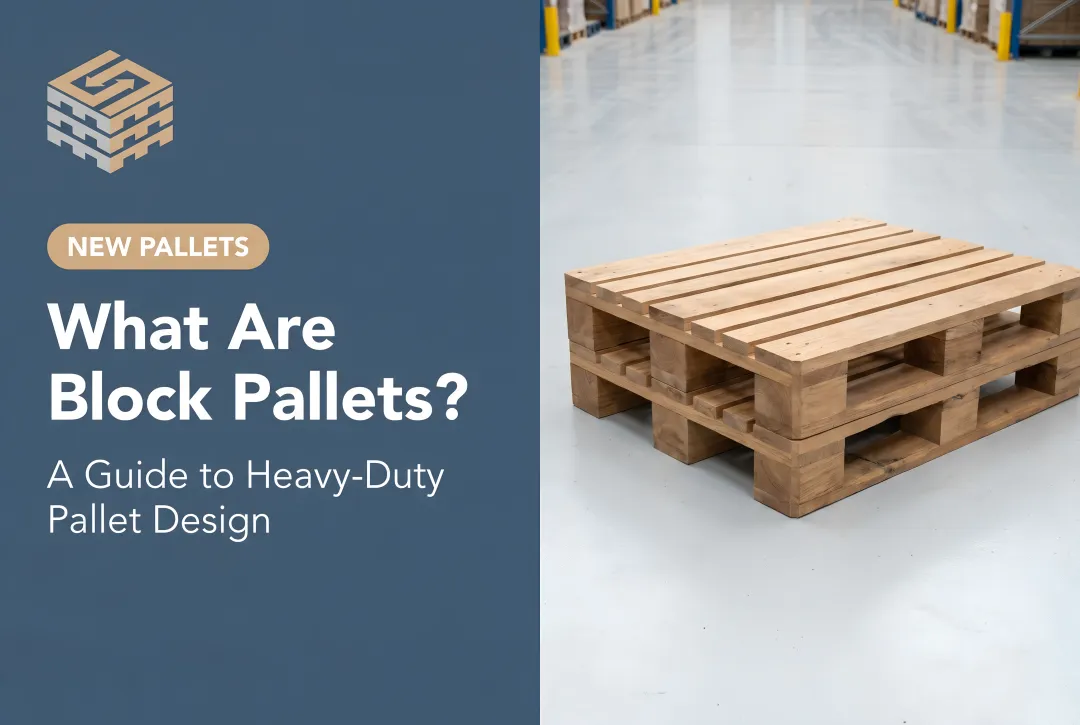
A 4-way block pallet is built with discrete support blocks, instead of solid beams, positioned so forks can enter from any of the four sides without repositioning the load. That's the core distinction: the blocks, not just the pallet's outer notches, create true full-perimeter access.
Deck boards rest on individual blocks rather than continuous stringer beams running the length of the pallet. Because there's no solid beam blocking the sides, a forklift or electric pallet jack can drive straight in from the front, back, or either side.
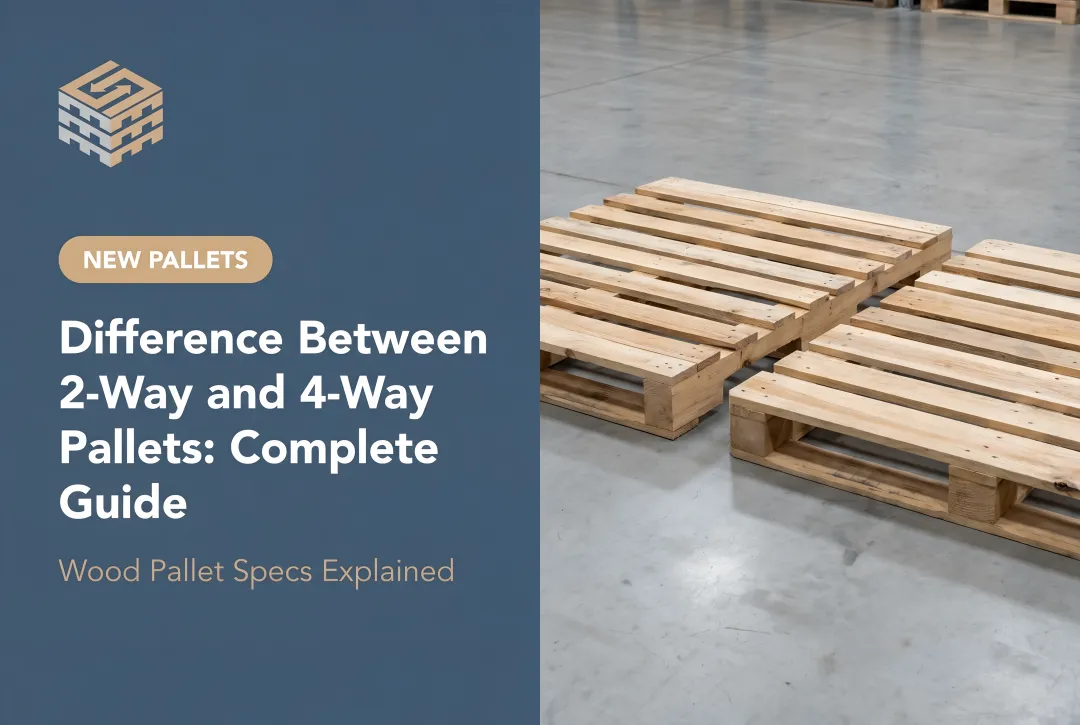
This matters because not every "4-way" pallet is a true block pallet. Notched stringer pallets cut small openings into the stringer beams to mimic side access, but the industry standard (ISO 445:2013) classifies these as partial 4-way pallets. The notches restrict fork size and approach angle in ways a true block design doesn't.
Block pallets generally fall into three configurations:
- Fully reversible — both faces are usable, so the pallet can be flipped and reloaded without checking orientation
- Non-reversible — one face is designed for loading, the other for support only
- Perimeter-base — a frame-style base runs the full perimeter, adding extra support for stacking or conveyor systems
Block Pallet vs. Stringer Pallet Construction
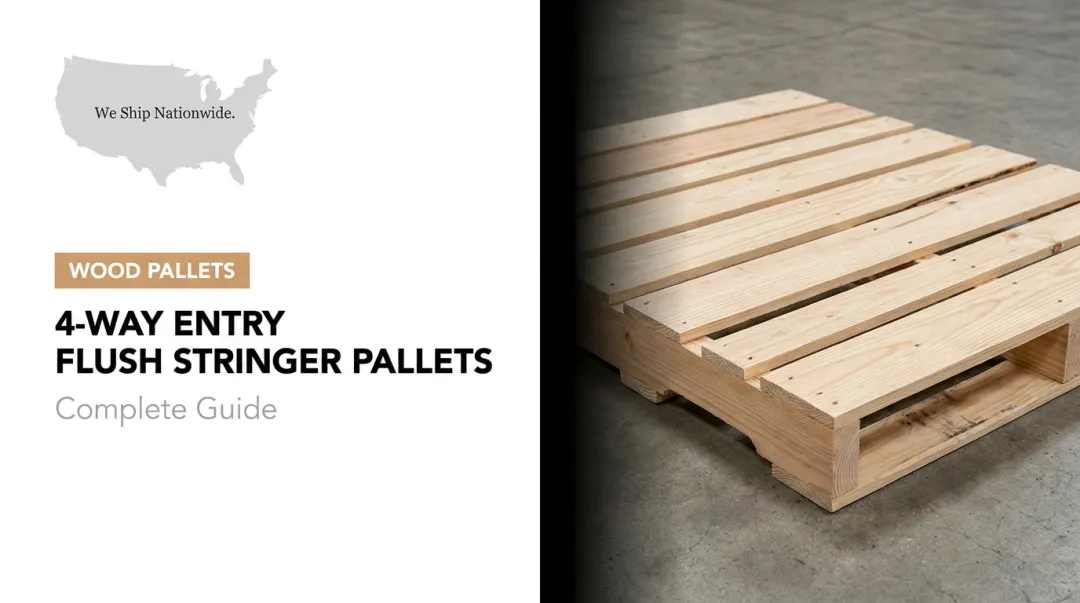
Stringer pallets rely on three or more long horizontal beams running the pallet's length. Forks can only enter from the two ends where the stringers stop, unless notches are cut in, and even then, access is still limited compared to a block design.
Block pallets swap those beams for individual support blocks arranged around the deck. There's no continuous beam blocking side entry, which is exactly why block construction has become the standard for heavy-duty, high-throughput operations where every side needs to be forklift-accessible.
Key Features & Specifications of 4-Way Block Pallets
Block Layout and Dimensions
Most 4-way block pallets use a 9-block configuration: four corner blocks, four edge-center blocks, and one center block supporting the deck boards. This layout is the industry standard, though custom block counts exist for specialized load requirements.
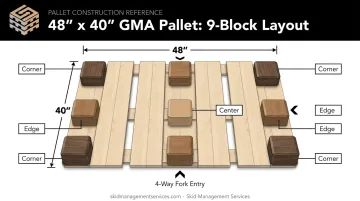
The most common footprint is the 48"x40" GMA size, widely used across grocery, retail, and general distribution supply chains in the U.S. That said, footprint alone doesn't tell you whether a pallet is block or stringer built — plenty of 48x40 pallets use stringer construction too.
Materials and Construction
Typical builds use:
- Softwood (pine, spruce, fir): the most cost-accessible option for moderate-load applications
- Hardwood (oak, maple) offers denser, more durable construction suited to heavy or repeat-use loads
- Mixed lumber blends cost efficiency with structural performance
- Kiln-dried, heat-treated (HT) lumber is required for export compliance and preferred for cold storage, where moisture resistance matters
Load Capacity and Weight
There's no single universal static-load range that applies to every block pallet, since capacity depends on the specific design, support condition, and fastener performance. As a reference point, EPAL's 9-block Euro pallet carries a 1,500 kg safe working load and weighs roughly 25 kg empty, useful context but not a stand-in for every model's rating.
Skid Management Services quotes load capacity per specification, since a 44"x44" IBC tote pallet and a 36"x36" brewery pallet aren't built to the same standard.
ISPM-15 Requirements for Export
Pallets shipped internationally with solid wood packaging must meet ISPM-15, which requires heat treatment to a core temperature of 56°C for at least 30 continuous minutes, along with debarking and a compliant ISPM-15 stamp showing the IPPC logo, country code, and treatment provider ID.
Skid Management Services sources treated pallets through USDA APHIS-recognized providers and offers stamp verification before export, since illegible or missing marks are grounds for rejection at the destination port.
Benefits of Using 4-Way Block Pallets
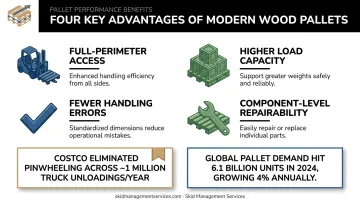
Full-perimeter access is the biggest operational win. Forklift operators don't have to reposition a load to line up with the right side. They drive in wherever it's convenient, speeding up loading and unloading at busy docks.
That flexibility carries over into warehouse layout too. Pallets can be staged without worrying about fork approach direction, simplifying how you organize racking and floor space.
Additional benefits include:
- Higher load capacity and durability compared to notched stringer alternatives, supporting heavier or bulkier freight
- Fewer handling errors: easier access means less mishandling and product damage during transport and storage
- Component-level repairability: individual blocks or deck boards can often be replaced instead of scrapping the whole pallet, extending usable life
Costco's experience backs this up. When the retailer began requiring block pallets in 2011 for incoming merchandise, it eliminated the need to "pinwheel" loads for four-side pallet-jack access, a process that had slowed unloading and increased damage risk across roughly one million truck unloadings a year.
Scale matters here too. Global pallet demand hit 6.1 billion units in 2024, with production projected to grow 4% annually through 2028 — a sign of how central efficient pallet handling has become across supply chains, block designs included.
Common Applications & Industries for 4-Way Block Pallets
Food and beverage distribution relies on fast turnaround and GMA-standard compatibility, making block construction a common fit for retailer-specific programs and automated handling lines.
Export and international shipping depend on ISPM-15 compliant block pallets to clear customs and avoid fumigation delays or rejected shipments at destination ports.
Other core use cases:
- Heavy industrial, chemical, and automotive handling, where higher load capacity matters most, such as 48x48 pallets for 55-gallon drums or 44x44 builds for IBC totes.
- Retail and grocery distribution centers that depend on standardized 4-way access for automated and semi-automated warehouse systems.
- Cold storage and frozen food operations, where kiln-dried block pallets resist moisture damage better than untreated alternatives.
Choosing the Right 4-Way Block Pallet Supplier
Not every supplier can deliver consistent quality at scale, especially during demand spikes. Look for three things:
- Consistent quality control across new and recycled inventory
- Competitive, transparent pricing based on lumber grade and specification
- Uninterrupted supply, even when order volume jumps unexpectedly
New vs. Recycled Block Pallets
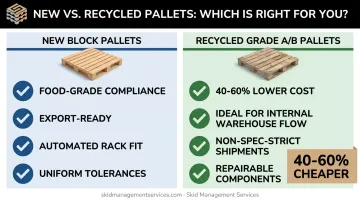
New block pallets make sense for food-grade, export, or automated rack applications where uniform tolerances matter. Recycled Grade A or Grade B pallets typically run 40-60% cheaper than new builds and work well for internal warehouse flow or non-spec-strict shipments. Because block construction allows individual components to be swapped out, repair candidates often return to usable condition instead of getting scrapped.
Skid Management Services supplies both, combining its own inventory with an expansive supplier network to avoid stockouts that disrupt JIT manufacturing lines or DC throughput. This dual-layer sourcing model (house stock plus network overflow) keeps delivery consistent for food and beverage clients like Campbell Snacks, Knouse Foods, and Hain Celestial Group, even during regional demand spikes.
For export programs moving through the Port of Baltimore corridor, the company also handles ISPM-15 stamp verification and re-stamping, so compliance doesn't become a bottleneck at the dock.
Frequently Asked Questions
What does "4-way pallet" mean?
A 4-way pallet allows forklift or pallet jack access from all four sides. This is achieved either through true block construction or notched stringers, though the two aren't structurally identical.
How many blocks are on a pallet?
Most 4-way block pallets use a 9-block configuration: four corner blocks, four edge-center blocks, and one center block supporting the deck.
What is the difference between a 4-way block pallet and a stringer pallet?
Stringer pallets use solid beams that limit entry to two sides (or partial access with notches). Block pallets use individual support blocks, enabling true four-sided entry.
How much weight can a 4-way block pallet hold?
Capacity depends on the specific design and support condition rather than a universal figure. As a reference, EPAL's 9-block Euro pallet is rated for a 1,500 kg (about 3,300 lb) safe working load.
Are 4-way block pallets more expensive than 2-way pallets?
Yes, generally. Block construction uses more material and involves more complex manufacturing, but the durability and repairability often offset that cost over the pallet's service life.
Can 4-way block pallets be repaired?
Yes. Individual blocks and deck boards can typically be replaced rather than discarding the entire pallet, which is one reason block pallets often last longer in rotation than fully welded or molded alternatives.