Yet many businesses still overpay for pallets or pick the wrong type. They don't know how material, size, and condition affect price and performance. This article breaks down pallet types, real-world industry uses, and what actually drives pricing, so you can buy with confidence instead of guesswork.
Key Takeaways
- Wood dominates U.S. pallet supply chains, though plastic, steel, and pressed-wood fill specific niches.
- Construction style (stringer vs. block) determines forklift entry points and load stability.
- Recycled Grade A and Grade B pallets typically cost 40-60% less than new stock.
- Export shipments require ISPM-15 heat-treated wood pallets stamped by an approved provider.
- Suppliers combining owned inventory with a broad network shield you from shortages.
What Are Industrial Pallets?
Industrial pallets are flat structural platforms built for stacking, storing, and transporting goods as a single load. Unlike consumer or one-time-use pallets, they're engineered for repeated cycles through warehouses, trucks, and racking systems.
Industry standards define a reusable pallet as one intended for multiple use cycles, distinguishing it from single-trip designs built solely for affordability on one-way shipments.
Every pallet, regardless of material, shares three core components:
- Deck boards — the top and bottom surfaces that carry the load
- Stringers or blocks — the structural members that support and distribute weight
- Fasteners — nails, screws, or adhesives that hold the assembly together
Standardized construction matters because it determines how much weight the pallet can safely carry, whether it fits your racking system, and how many trips it survives before failing. When people say "industrial" pallet, they mean a heavy-duty unit built for warehouse and shipping cycles, not a lightweight platform meant to be tossed after a single delivery.
Types of Industrial Pallets
Pallets are categorized two ways: by the material they're built from and by their construction style. Each combination suits different operational needs, from food-grade sanitation to heavy machinery transport.
Types by Material
| Material | Typical Capacity Range | Best For |
|---|---|---|
| Wood | ~2,500 lb (stringer) to 5,500 lb (block), 3-5 year lifespan | General warehousing, food & beverage, cost-sensitive programs |
| Plastic | 5,000-30,000 lb depending on design; can exceed 10 years of use | Food, pharma, export, cold-chain sanitation |
| Steel | 1,000-2,500 kg dynamic / 1,500-5,000 kg static | Heavy industrial, harsh or outdoor environments |
| Pressed wood | Up to 2,500 lb dynamic / 7,500 lb static | One-way or export shipments, not rack-stored |
Wood pallets remain the most widely used option in U.S. supply chains. They're cost-effective, repairable, and readily available in new or recycled condition. Plastic pallets cost more upfront but resist moisture and chemicals, making them a fit for food, pharmaceutical, and export applications where sanitation matters.
Metal pallets, typically steel, handle extreme loads and harsh conditions in heavy manufacturing settings. Skid Management Services (SMS) distributes steel sheet metal storage pallets for exactly these applications, alongside its core wood pallet line.
Corrugated and pressed-wood pallets trade durability for weight savings, making them a lower-cost choice for air freight or one-way domestic shipments. SMS also supplies custom paper pallets and compressed wood pallet blocks for lightweight, one-way programs where a standard wood pallet is more structure than the shipment needs.
Types by Construction and Size
Construction style determines how a forklift accesses the pallet:
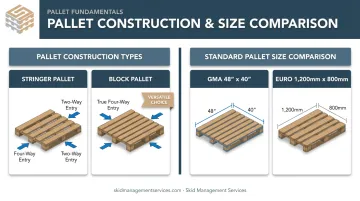
- Stringer pallets use three parallel wood beams for support. Notched versions add four-way access; unnotched versions allow entry from two sides only.
- Block pallets use block supports for true four-way entry from every side. This "Euro-style" build suits automated handling and rack storage better than stringer designs.
On sizing, the U.S. standard is the GMA 48x40 pallet, compatible with most racking systems and retailer receiving docks. The Euro pallet measures 1,200 x 800 mm (roughly 47.2 x 31.5 inches) and dominates European logistics. These footprints aren't interchangeable, so container loading and rack planning need to account for the actual dimensions in play.
Beyond GMA and Euro sizing, industrial buyers often need non-standard footprints:
- 48x48 for chemical drums (fits four 55-gallon drums in a 2x2 layout)
- 44x44 for 275- and 330-gallon IBC totes
- 42x42 for telecom cabinets and specialty chemical applications
- 36x36 for beer and craft beverage distribution
SMS builds all of these sizes, plus fully custom dimensions, in stringer, block, wing, or double-wing-stringer configurations.
Common Uses of Industrial Pallets
Pallet selection depends heavily on the industry moving the goods.
Food and beverage manufacturers need pallets that meet sanitation standards under FDA FSMA and GFSI schemes like SQF and BRCGS. Common audit risks include:
- Chemical residue from treated or contaminated wood
- Mold growth from improper drying or storage
- Loose fasteners that can contaminate product lines
That's why food producers often specify new kiln-dried, chemical-free wood pallets or sanitation-grade recycled stock. SMS's food-grade program, built for anchor clients like Campbell Snacks, Knouse Foods, Stauffer's of Lititz, Nissin Foods, Hain Celestial Group, and Plainville Farms, centers on exactly this specification.
Retail and consumer goods distribution relies on standardized GMA 48x40 sizing so pallets move efficiently through cross-docking and racking at big-box distribution centers. Walmart, Costco, Target, and Kroger each publish their own supplier pallet specs — miss the spec, and your shipment gets refused at the dock.
Manufacturing and industrial goods operations often need heavier-duty builds. Chemical plants use 48x48 drum pallets rated at 2,500-3,000+ lb dynamic capacity. Telecom and specialty chemical shippers lean on 42x42 pallets as a middle-spec option.
Export shipments face a hard requirement: wood packaging crossing international borders must meet ISPM-15 heat-treatment standards, meaning a minimum core temperature of 56°C sustained for 30 continuous minutes. A compliant stamp must include:
- The IPPC logo
- Country code
- Treatment provider ID
- Treatment code
Missing any element risks rejection at port. SMS runs a dedicated ISPM-15 program, including stamp verification and re-stamping, for exporters moving through the Port of Baltimore corridor.
Cold storage and frozen food operations favor kiln-dried or plastic pallets because moisture absorption in wood accelerates warping and mold under freeze-thaw cycling.
Industrial Pallet Pricing Explained
Pallet pricing swings widely based on material, condition, size, and order volume. Wood pallet manufacturing costs have actually been trending down: the Producer Price Index for wood pallet manufacturing fell from 222.2 in January 2023 to 194 by January 2024, a nearly 13% decline, driven largely by softer lumber prices.
What drives the price you pay:
- Lumber market fluctuations (softwood vs. hardwood, regional mill pricing)
- Custom sizing or treatment, including kiln-drying and ISPM-15 heat treatment
- Freight and transportation costs, especially for oversized or non-standard loads
- Pallet condition : new, Grade A recycled, Grade B recycled, or utility grade
New vs. recycled trade-offs:
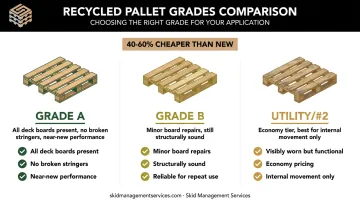
Recycled and remanufactured pallets typically run 40-60% cheaper than new stock. SMS grades recycled inventory into three tiers:
- Grade A: all deck boards present, no broken stringers, near-new performance
- Grade B: one or two minor board repairs, still fully structurally sound
- Utility/#2: economy-tier, best suited for internal facility movement rather than outbound shipping
For businesses with recurring pallet needs, volume matters. Programs running roughly 500+ pallets per month can access closed-loop pricing, where scheduled delivery and used-pallet pickup happen on the same trip and generate trade-in credit of 15-40% off new-pallet spend.
A supplier's network becomes a real advantage here. SMS combines its own Central PA inventory with an expansive supplier network, keeping pricing competitive even when regional lumber shortages or demand spikes hit competitors' single-source supply chains.
Buying isn't the only model. Businesses with highly variable outbound volume sometimes prefer pooling through programs like CHEP or PECO, though pool fees compound over time. SMS also offers pool-exit economics analysis at no cost for operators looking to move off pooled programs into direct ownership.
How to Choose the Right Industrial Pallet for Your Business
Start with three practical questions:
- What's the load weight and storage environment? Heavy machinery needs a higher dynamic capacity than boxed consumer goods; freezer environments demand kiln-dried, heat-treated wood construction built to resist moisture and temperature swings.
- Will pallets be reused or shipped one-way? Reusable programs justify a higher upfront spend on durable stringer or block pallets. One-way shipments favor lighter, lower-cost builds.
- What regulations apply? Food manufacturers need sanitation-grade or chemical-free treatment; exporters need ISPM-15 heat-treated and stamped pallets regardless of destination.
Don't stop at sticker price. Calculate total cost of ownership — a $12 wood pallet that survives three trips before failing may cost more per use than a $9 recycled pallet that holds up for five. Durability and reusability, not just the invoice number, determine your real per-trip cost.
Sourcing Industrial Pallets: Buying Tips and Supplier Selection
Choosing a supplier matters as much as choosing a pallet type. Evaluate potential vendors on three factors:
- Inventory availability across new, recycled, and custom-spec builds
- Delivery reliability, including same-day or same-week service for your region
- Scalability during demand surges or regional lumber shortages
A national provider with both owned inventory and a broad supplier network, like SMS, offers a practical hedge. When one supply channel tightens, the other absorbs the gap without leaving your dock empty. That combination keeps pricing competitive and delivery schedules intact during market volatility.
Before committing to a long-term contract, request sample quotes from two to three suppliers. Compare not just price per pallet, but grade consistency, ISPM-15 compliance documentation, and pickup/recycling terms if you're considering a closed-loop program.
Frequently Asked Questions
What are industrial pallets?
Industrial pallets are heavy-duty flat platforms built for repeated use in handling, storing, and transporting goods through commercial supply chains. They're distinct from disposable, one-time consumer pallets.
What is the difference between industrial pallets and euro pallets?
Standard U.S. industrial pallets measure 48x40 inches (the GMA standard), while Euro pallets measure 1,200 x 800mm. Euro pallets dominate European logistics; GMA pallets are the U.S. norm.
How many industrial pallets are in a 20ft container?
A standard 20-foot container typically fits approximately 9-10 American GMA pallets (48x40) or around 11 Euro pallets (1,200 x 800mm). Exact counts vary with cargo height and stacking method.
What are the two types of pallets?
The two primary construction types are stringer pallets, which allow two-way or notched four-way forklift entry, and block pallets, which offer true four-way entry from all sides.
How much do industrial pallets typically cost?
Pricing depends on material, size, and condition. New pallets cost more than Grade A or Grade B recycled pallets, which typically run 40-60% cheaper while remaining fully functional.
Are wood or plastic pallets better for industrial use?
Wood is more cost-effective and easily repaired, making it the default for most general warehouse and food-grade programs. Plastic costs more upfront but resists moisture and chemicals better, which suits food, pharma, and export applications.