Introduction
Plastic and wood pallets move nearly every product through the U.S. supply chain, from snack food and dairy shipments to pharmaceutical batches and industrial parts. Choose the wrong one, and you're not just picking a color of shrink wrap.
Material choice affects per-unit cost, how many loads a pallet handles before it fails, whether you meet hygiene and export regulations, and how often unplanned downtime disrupts your operation.
The scale of this decision is bigger than most buyers realize. In Modern Materials Handling's 2025 Pallet Report, 92% of 129 surveyed companies reported using wood pallets, while 28% reported using plastic (respondents could select both, so this reflects adoption, not a strict market split).
Wood remains the default. Plastic keeps gaining ground in specific niches.
This guide breaks down the real differences so you can match the material to your operation instead of guessing.
Key Takeaways
- Wood pallets cost less upfront and dominate one-way, high-volume, heavy-load shipments.
- Plastic pallets cost more initially but last longer, holding consistent dimensions for closed-loop, automated operations.
- The right pick depends on trip cycles, budget, regulations, and whether pallets return to you.
- Sustainability results vary by sourcing, treatment, and reuse — neither material wins outright.
Plastic vs Wood Pallets: Quick Comparison
Here's how the two materials stack up across the factors buyers care about most.
| Factor | Wood Pallets | Plastic Pallets |
|---|---|---|
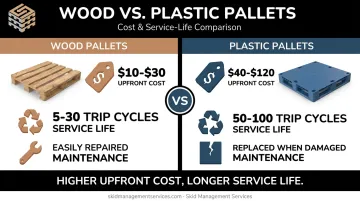
| Upfront cost (48x40 GMA) | $10–$30 per unit | $40–$120 per unit |
| Composition | Lumber and fasteners; weight shifts with moisture content | Molded HDPE/PP; uniform dimensions, lighter and consistent |
| Typical lifespan | Commonly modeled at 5–30 trip cycles | Commonly modeled at 50–100 trip cycles |
| Export compliance | Requires ISPM-15 heat treatment and stamping | No ISPM-15 requirement |
| Hygiene | Porous surface; harder to fully sanitize | Non-porous, washable surface |
| End-of-life | Repaired, remanufactured, or ground into mulch | Long service life, but recycling infrastructure is limited |
Cost: The Upfront Gap Is Real
According to a 2025 cost breakdown from MMP, new 48x40 GMA wood pallets typically run $10 to $30 each, while comparable plastic pallets run $40 to $120. That's roughly 2 to 8 times the sticker price before reinforcement, resin grade, or rack-load rating even enters the conversation.
Durability Trades Purchase Price for Cycle Count
Lifecycle research commonly models wood pallets at 5 to 30 trips and plastic pallets at 50 to 100 trips, with both ranges swinging wider depending on load type and handling conditions.
Wood cracks and splinters under rough forklift use, but repair crews patch it cheaply. Plastic resists cracking and moisture damage, yet crews usually replace it rather than repair it once it fails structurally.
Hygiene Favors Plastic, Compliance Depends on the Destination
Beyond how long a pallet lasts, its surface determines how easily it stays sanitary between loads. Plastic's non-porous surface makes it easier to wash down, and it skips ISPM-15 treatment entirely. Wood pallets can still meet FDA sanitary-transportation standards once heat-treated, but the porous surface demands more diligent cleaning protocols to stay compliant.
What Are Plastic Pallets?
Plastic pallets are molded from HDPE or PP resin into a single uniform unit, with no boards and no fasteners. Manufacturers turn to plastic when hygiene standards, automation compatibility, or closed-loop reuse matter more than upfront cost.
Several features drive that decision:
- Consistent dimensions: every pallet off the mold matches the next, meaning fewer jams when automated storage and retrieval systems pick, scan, or stack loads.
- Moisture resistance: no swelling, no splintering, no absorbed odors, which keeps tare weight predictable for freight billing.
- Chemical resistance: no absorption of spills, cleaning agents, or odors, supporting hygiene audits in food and pharma plants.
Common variations include:
- Nestable pallets stack inside each other when empty, saving space on return trips.
- Rackable pallets hold heavier loads in warehouse racking systems.
- Stackable pallets support straightforward floor storage.
- Hygienic or export-grade pallets handle washdown environments and food-safety compliance.
Use Cases of Plastic Pallets
Plastic fits best in closed-loop pooling systems, automated storage and retrieval operations, and production lines where hygiene audits are routine. Pharmaceutical manufacturing, dairy processing, and electronics assembly are the industries where plastic shows up most often.
A 2022 case from a global electronics and maintenance-products distributor shipping more than 44,000 parcels daily illustrates why the switch happens. Damaged and dimensionally inconsistent wood pallets kept jamming automated handling equipment and required manual reloading. After a trial run, the company replaced 6,110 wood pallets with dimensionally consistent plastic units to eliminate the debris and inconsistency disrupting its automation line.
That's the trade worth remembering: plastic earns its higher price tag when precision and repeat cycles do the heavy lifting, not when pallets ship once and disappear.
What Are Wood Pallets?
Wood pallets remain the default for the vast majority of U.S. shippers, and manufacturing and distribution operations lean on them hardest. Lower per-unit cost, easy repairability, nationwide availability, and high load capacity make wood the practical baseline for most freight.
That translates directly into operational impact:
- Lower capital outlay across large pallet fleets, since new GMA units run a fraction of plastic's price.
- Faster nationwide sourcing, since wood mills and pallet recyclers operate in nearly every region.
- Simple repairs: a cracked board gets swapped out in minutes instead of the whole unit getting scrapped.
Key Variations Buyers Should Know
- Stringer vs. block pallets: stringer construction is the classic U.S. build; block pallets offer true 4-way forklift entry.
- GMA 48"x40" standard: the most common size across U.S. retail and food distribution.
- Heat-treated (HT) vs. kiln-dried: HT meets ISPM-15 export requirements; kiln-dried controls moisture for cold storage and refrigerated programs.
- New vs. recycled/remanufactured: recycled pallets typically run 40-60% less than new while covering most internal and general-warehouse needs.
Lumber shortages hit regional pallet supply hard and fast. National suppliers such as Skid Management Services offset this by pairing owned inventory with a broad network of pallet suppliers, keeping wood pallets in supply even when a region runs short.
Use Cases of Wood Pallets
Wood fits best when the pallet doesn't need to make a return trip:
- One-way and export shipments that never come back to the shipper
- Heavy static warehouse storage
- High-volume distribution runs, including food manufacturing and snack or beverage packaging
Recycled wood pallets are frequently the lower-cost pick for local or one-way shipments, where short-term acquisition cost matters more than long-term cycle count. For a snack producer shipping thousands of pallets weekly to retail distribution centers that never return them, the math is simple: buying a $15 pallet once beats buying a $70 pallet that's never coming home.
Plastic vs Wood Pallets: Which Is Better for Your Business?
There's no universal winner. The right material depends on five factors:
- Trip cycles — how many times will this pallet actually get reused?
- Budget — can you absorb a higher per-unit cost for long-term savings?
- Hygiene and regulatory requirements — does your industry demand washdown sanitation or export certification?
- Automation compatibility — does your facility run AS/RS or robotic handling that needs dimensional precision?
- Loop type — is this a closed-loop system where pallets return, or an open, one-way flow?
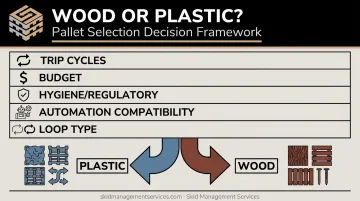
Choose wood if you prioritize low upfront cost, ship one-way or export loads, or need fast nationwide availability without long lead times.
Choose plastic if you run a closed-loop system that depends on automation precision or operates under strict hygiene standards.
Real-World Example: Choosing Wood Pallets for Cost-Efficient Distribution
Controlled testing backs up what most high-volume shippers already suspect. In a Virginia Tech packaging lab study reported by Food Logistics, a plastic pallet completed up to 200 handling cycles without failure. A standard wood stringer pallet, under the same repeated-handling sequence, averaged just 11 cycles.
That gap looks dramatic until you factor in the shipping pattern. Most food and beverage manufacturers, the kind SMS serves daily, don't need 200 cycles. Their pallets ship once to a retail distribution center and never return.
For that operating model, the math favors wood consistently:
- Recycled Grade A wood pallets typically deliver 40-60% cost savings versus new, at performance levels that easily cover single-trip outbound shipments.
- Closed-loop trade-in programs can offset 15-40% of new-pallet spend for companies running some returnable volume alongside one-way flow.
- Uninterrupted supply, drawn from both owned inventory and a broad supplier network, matters more than cycle count when a lumber shortage threatens a production schedule.
If your operation looks like this, high-volume, budget-conscious, or largely one-way, wood remains the practical choice.
Ready to lock in reliable, competitively priced wood pallets? Contact Skid Management Services at 717-202-0304 or Info@SkidManagementServices.com for a supply program backed by owned inventory and an expansive national supplier network built for uninterrupted delivery.
Conclusion
Neither material wins across the board. Wood suits cost-sensitive, high-volume, and one-way shipping operations, while plastic suits closed-loop, automated, or hygiene-critical production lines.
The right choice comes down to matching pallet material to your trip cycles, budget, and industry requirements, not picking whichever option sounds more modern. When you're ready to evaluate your packaging strategy, talk to a specialist like Skid Management Services, a national wood pallet and packaging distributor that can model pallet costs against your actual shipping pattern.
Frequently Asked Questions
Are plastic pallets better than wood pallets?
Neither is universally better. Plastic suits closed-loop, automated, or hygiene-sensitive operations, while wood is more practical for cost-conscious, high-volume, or one-way shipping.
Are plastic pallets worth the extra cost compared to wood pallets?
Plastic can pay off in closed-loop systems with many reuse cycles. For one-way or lower-volume shipping, wood's lower upfront cost usually wins out economically.
How long do plastic pallets last?
Industry studies commonly model plastic pallet lifespans at 50 to 100 trip cycles, though the range depends heavily on load type and handling conditions.
What is the average lifespan of a wood pallet?
Most models place wood pallet lifespans at 5 to 30 trip cycles before failure, while repairs like swapping a cracked board can extend usable life considerably.
Can wood pallets be recycled or reused?
Yes. Wood pallets are routinely repaired, remanufactured, or ground into mulch and other wood products once they reach the end of their usable life.
Are wood pallets safe for food and pharmaceutical shipping?
Heat-treated wood pallets can meet food safety and export standards, including ISPM-15; Skid Management Services supplies ISPM-15 heat-treated export pallets with stamp verification. Plastic is sometimes preferred for operations requiring frequent full washdown sanitation.