LTL (Less-Than-Truckload) means your freight shares trailer space with other shippers' loads. FTL (Full Truckload) means you're paying for the entire trailer, whether you fill it or not. The question shippers actually need answered is simple: how many pallets pushes you from one category into the other?
This guide breaks down the pallet count and weight thresholds carriers actually use, compares standard LTL, volume LTL, and FTL, and covers how pallet choice affects your freight class, your rate, and your risk of damage.
Key Takeaways
- Standard LTL shipments run 1 to 6 pallets, or under 12 linear feet of trailer space
- LTL carrier weight limits typically span 500 to 15,000 lbs, varying by carrier
- Loads beyond roughly 6-8 pallets often qualify for volume LTL or full truckload pricing instead
- Freight class, dimensions, and pallet condition all factor into your final LTL rate
- Sturdy, correctly sized pallets reduce the odds of reweigh fees, reclassification, and damage claims
How Many Pallets Is Considered LTL Shipping?
The widely cited industry guideline puts standard LTL at 1 to 6 pallets. On a standard 40" x 48" pallet footprint, six pallets arranged side by side take up roughly 12 linear feet of trailer space, according to NMFTA's guidance comparing LTL and full truckload shipping. That's the benchmark most shippers reference when estimating freight mode.
But here's the catch: carriers don't actually book freight by pallet count. They book by linear feet and weight. Pallet count is just a rough proxy that happens to work most of the time.
Why the six-pallet rule bends by carrier
Some carriers stretch their LTL classification further than others. A few will accept 8 to 10 pallets under standard LTL terms, depending on the freight's density and NMFC class. Low-density freight (think insulation or empty containers) eats up space fast and hits volume thresholds sooner. Dense freight (like canned goods or machinery parts) can pack more pallets into the same footprint and stay under the LTL ceiling longer.
Weight matters just as much as pallet count. Typical LTL shipments run from around 500 lbs up to 15,000 lbs, based on XPO's overview of less-than-truckload shipping. That ceiling isn't fixed either: some push it higher, others cap out lower. There's no single universal number, which is exactly why quoting tools ask for both pallet count and total weight before generating a rate.
Where LTL stops making sense
Pallet count and weight only tell part of the story: trailer space sets the real ceiling.
A standard 53-foot dry van trailer holds around 26 pallet positions at full capacity, per ArcBest's breakdown of dry van shipping capacity. Once your shipment starts approaching a third to half of that capacity, you're no longer a good fit for shared trailer space. That's when volume LTL or full truckload pricing takes over.
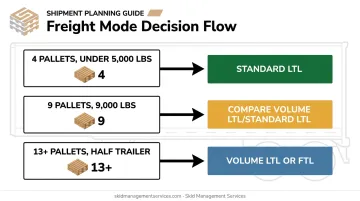
Quick self-check:
| Shipment Profile | Likely Fit |
|---|---|
| 4 pallets, under 5,000 lbs | Standard LTL |
| 9 pallets, 9,000 lbs | Compare volume LTL and standard LTL |
| Half the trailer (13+ pallets) | Volume LTL or full truckload |
The right call still depends on your specific lane and carrier, so treat these ranges as a starting point rather than a hard rule.
LTL vs. Volume LTL vs. Full Truckload: Comparing Pallet Thresholds
Once your shipment grows past the standard LTL range, you have two options: Volume LTL or Full Truckload. Here's how all three modes stack up against each other.
Standard LTL
This is the 1-6 pallet, under-12-linear-foot range most shippers use by default. Pricing runs through NMFC freight class, and your freight rides alongside multiple other shippers' loads in the same trailer. It's the most cost-effective option for smaller shipments, but it also means more handling touches at terminals along the route.
Volume LTL
Once you're pushing past six pallets, roughly filling half a trailer, Volume LTL often becomes the smarter option. Some carriers set their own specific thresholds here. Estes, for example, defines volume eligibility in its published freight guidelines as 5,000 lbs or more, or at least 8 linear feet of trailer space.
Pricing for Volume LTL usually shifts away from strict NMFC class-based rating toward a negotiated or per-shipment quote, since carriers are essentially selling you a chunk of otherwise unused trailer capacity. This mode tends to work best for larger, less time-sensitive shipments rather than urgent freight.
Full Truckload (FTL)
At the high end, once your freight approaches or exceeds roughly 24-30 pallets, you're typically reserving the entire trailer for a single shipment. FTL pricing is market-based, tied to lane, fuel costs, and capacity, rather than NMFC classification.
Quick comparison across all three:
| Mode | Pallet range | Pricing basis | Handling touches |
|---|---|---|---|
| Standard LTL | 1-6 pallets | NMFC freight class | Multiple terminal stops |
| Volume LTL | 6-24 pallets | Negotiated/per-shipment | Fewer stops than standard LTL |
| FTL | 24-30+ pallets | Market rate per mile | Direct, minimal handling |
FTL generally moves faster and with less damage risk since your freight isn't loaded and unloaded at multiple stops. Standard LTL takes longer and carries more handling exposure, but it's the cheapest option when you genuinely don't need a full trailer.
Factors That Influence Your LTL Pallet Count and Freight Class
Pallet count and weight only tell part of the story. Your NMFC freight class does a lot of the heavy lifting on price and eligibility.
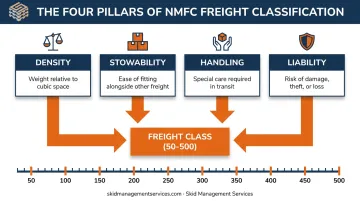
Four characteristics determine freight class:
- Density - weight relative to cubic volume; low-density freight generally costs more per pound to ship
- Stowability - how easily your freight fits alongside other shipments in the trailer
- Handling - how much care or special equipment your freight requires
- Liability - risk tied to value, fragility, or hazard classification
Carriers sort freight into 18 classes ranging from 50 to 500, with density playing an increasingly central role in class assignment.
Terminal reweighs can change your rate
Here's something a lot of shippers don't expect: the quote you get isn't always the final bill. Carriers reweigh and redimension freight at origin terminals using digital scales and dimensioner machines. If your submitted weight or dimensions don't match what the equipment measures, that triggers a reclassification, and often an added charge.
For example, a shipment quoted at class 70 can jump to class 100 if the terminal scale shows extra weight, adding hundreds of dollars to the final invoice.
This isn't rare. Weight and class discrepancies on bills of lading are common enough that carriers build entire fee schedules around correcting them. Getting your measurements right the first time avoids the surprise invoice later.
Special handling shrinks your practical pallet limit
Fragile goods, hazardous materials, and refrigerated freight all come with acceptance rules that can effectively lower how many pallets a carrier will take under standard LTL terms. A shipment that would otherwise fit comfortably at 6 pallets might get pushed toward volume LTL or FTL simply because it needs temperature control or hazmat handling, regardless of its actual size.
Do All LTL Shipments Need to Be Palletized? Preparing Freight the Right Way
Short answer: no, palletizing isn't a legal requirement. Longer answer: most LTL carriers, and even some truckload carriers, strongly prefer or effectively require it. Palletized freight moves through multiple terminal handoffs far more safely than loose freight, and it loads and unloads faster with a forklift.
Crated, boxed, or irregularly shaped freight can still move LTL if it's properly secured, but expect extra handling fees or a possible reclassification. Carriers have separate handling instructions for pallets, crates, drums, and loose pieces, and each comes with its own cost implications.
Why pallet quality matters more than shippers think
A structurally sound pallet, correctly sized and rated for the load, reduces damage claims and helps freight pass weight and dimension checks at the terminal.
A pallet that's warped, missing deck boards, or undersized for the load can shift in transit. That shift is exactly what triggers damage claims and reweigh disputes.
This is where sourcing consistency matters. Skid Management Services, a national provider of wood pallets and packaging products, works with food and beverage manufacturers and other high-volume shippers who need pallets that consistently meet carrier weight and dimension standards.
Between their own inventory and a broad supplier network, they keep pricing competitive and supply uninterrupted, so shippers aren't scrambling for pallets right before a shipment needs to move.

Freight prep checklist:
- Match pallet size and strength to your freight class - a GMA 48x40 works for most standard loads; heavier or oversized freight needs a higher-capacity build
- Stretch-wrap securely - loose wrap is one of the most common causes of in-transit shifting
- Label accurately - make sure your bill of lading reflects actual weight and dimensions, not estimates
- Choose the right grade - new or Grade A recycled pallets for outbound freight; utility grade is better reserved for internal handling only
Getting this right at the pallet level saves headaches down the line, whether that's avoiding a reweigh fee or keeping a damage claim from ever happening.
Frequently Asked Questions
How many pallets for an LTL shipment?
Most LTL shipments range from 1 to 6 pallets, or under about 12 linear feet of trailer space. Exact limits vary by carrier and freight class, so always confirm with your carrier before booking.
Does all LTL or TL freight have to be palletized?
Palletizing isn't legally mandatory, but most carriers strongly prefer or require it for faster handling and better damage protection. Crated or boxed freight can sometimes move LTL, though it may incur extra fees.
What's the difference between standard LTL and volume LTL?
Standard LTL typically covers 1-6 pallets priced by NMFC freight class. Volume LTL covers larger shipments, often 6-12 pallets or more, usually priced through a negotiated or per-shipment quote instead.
What happens if my shipment has more pallets than the LTL limit allows?
Carriers will generally reclassify the shipment as volume LTL or full truckload, which changes both the pricing structure and how your freight gets handled in transit.
How much can an LTL shipment weigh?
Common LTL weight ranges run from around 500 lbs up to 15,000 lbs, though this varies by carrier. Heavier loads usually need to move as full truckload instead.
Does the type of pallet affect my LTL freight class or rate?
Yes. Pallet quality, weight, and dimensions all factor into freight classification. Durable, correctly sized pallets help avoid reclassification fees, reweigh charges, and damage-related claims.