Introduction
A single pallet decision can trigger an FDA audit failure, a customs rejection, or a full product recall. Yet many pharmaceutical and food & beverage companies still source pallets the way they'd order office supplies — picking the cheapest standard option available.
Standard GMA pallets weren't designed with FSMA transportation rules, Good Distribution Practice (GDP) requirements, or ISPM-15 export compliance in mind.
Using the wrong pallet can mean contaminated products, rejected shipments at customs, failed sanitation audits, or, at worst, a product recall.
This article addresses two core problems:
- Standard off-the-shelf pallets create compliance gaps in regulated industries
- Many buyers don't fully understand what "food grade," "heat-treated," or "pharmaceutical-compliant" actually means for their pallet specifications
This guide covers the pallet and crate requirements for regulated industries, what the key standards actually require, and what to look for in a supplier.
TLDR
- Custom pallets are engineered to exact dimensions, load ratings, and regulatory specs — not just grabbed off a standard catalog
- FSMA classifies pallets as transportation equipment; they must be sanitary, suitable, and structurally sound for food transport
- ISPM-15 heat treatment kills pests for export compliance. It does not make a pallet food-grade or sterile.
- New pallets carry lower compliance risk than recycled ones in regulated industries due to unknown contamination history
- Supply continuity matters as much as specs; high-volume food manufacturers need a supplier network built for demand surges
Why Custom Pallets and Crates Matter for Regulated Industries
The Problem With Standard Pallets
The standard 48×40 GMA pallet was designed for general grocery and retail distribution. It handles stacked cases moving through conventional warehouse and retail supply chains. That's it.
It wasn't built for:
- Bulk dairy containers requiring heavier load ratings
- Bottled beverage cases with non-standard footprints
- Pharmaceutical equipment requiring full enclosure and moisture protection
- Automated racking systems with precise entry configuration requirements
- Cold chain products where board warping from moisture is a real failure mode
When a pallet doesn't match the load it carries, the consequences aren't just operational — they're measurable. A 2023 peer-reviewed packaging study found that large pallet overhang can reduce effective box compression strength by as much as 40%. That's product damage waiting to happen at scale.
What "Custom" Actually Means
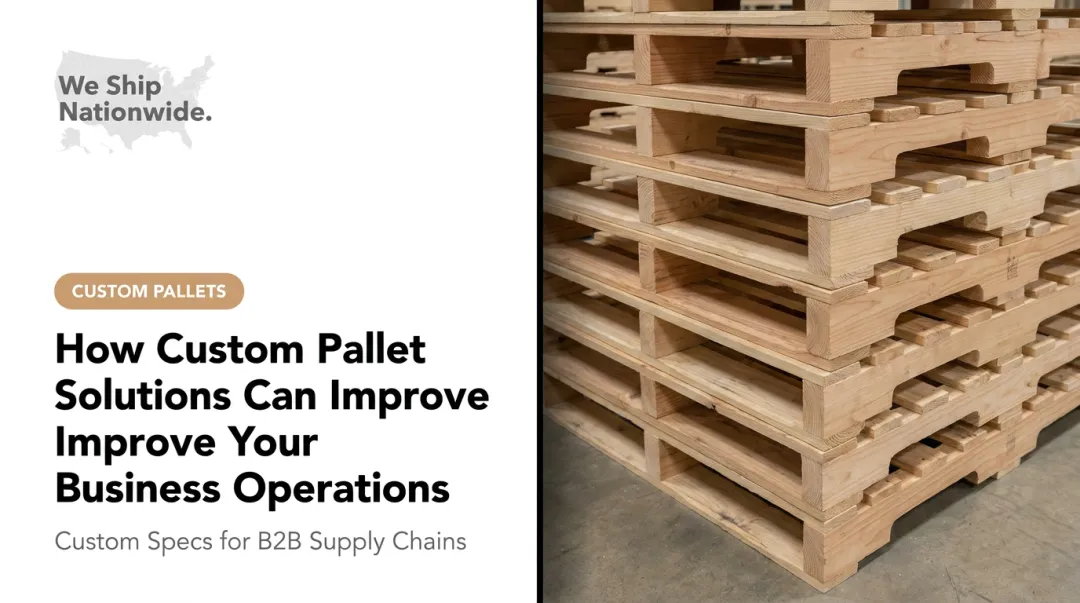
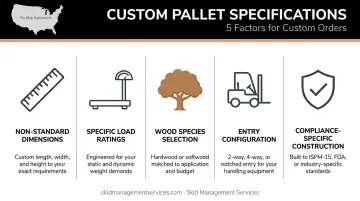
Custom pallets aren't exotic or special-order. They're pallets engineered to your actual load requirements — not a generic default. Customization typically involves:
- Non-standard dimensions — for products where the 48×40 footprint doesn't match case sizes
- Specific load ratings — verified through engineering analysis, not assumed from catalog specs
- Wood species selection — for moisture resistance, weight, or surface characteristics
- Entry configuration — two-way vs. four-way entry based on forklift access in your facility
- Compliance-specific construction — heat treatment for export, clean manufacturing for food/pharma
The Scale Argument
The U.S. wood pallet and skid manufacturing market is valued at $17.8 billion in 2026. That volume reflects how critical pallet specification is across the entire supply chain — and how much is at stake when specs are wrong.
For high-volume food manufacturers — snack producers, beverage distributors, canned goods suppliers — even small per-unit inefficiencies multiply across millions of units. A pallet that's two inches too wide for your racking system, or two hundred pounds under-rated for your load, doesn't fail once. It fails everywhere, every time.
Regulatory Requirements: FSMA, FDA, and ISPM-15 Explained
These standards are frequently misread in both directions — some buyers over-specify, others miss real compliance gaps. Here's what each actually requires.
FSMA and the Sanitary Transportation Rule
The FDA's Food Safety Modernization Act Sanitary Transportation Rule (21 CFR Part 1, Subpart O) classifies pallets as transportation equipment. That means they must be:
- Suitable and adequately cleanable for their intended use
- Maintained in sanitary condition so they don't make food unsafe
- Free from jagged edges or splinters that could puncture food packaging
The rule does not ban wood pallets or recycled pallets. It does not create a separate "food contact surface" classification for pallets. What it requires is condition-based compliance — that pallets in food transport are clean, structurally sound, and appropriate for what they're carrying.
The "Food Grade" Misconception
"Food grade" is not an official FDA pallet classification. There's no certification process, no stamp, no registration. The term generally refers to pallets that are clean, free from chemical contamination, and compliant with FSMA transportation requirements. A standard new wood pallet can qualify — provided it meets those condition standards.
This matters because buyers sometimes assume a heat-treated pallet is automatically food-safe. That's incorrect.
What ISPM-15 Actually Does (and Doesn't Do)
ISPM-15 is a phytosanitary standard managed by the International Plant Protection Convention. It requires that wood packaging material (pallets, crates, boxes, dunnage, cable drums) used in international trade be treated to eliminate pest risk.
The technical requirement: wood must reach a minimum core temperature of 56°C for at least 30 continuous minutes. Compliant pallets carry the official IPPC mark showing country code, producer/treatment-provider code, and treatment method.
What ISPM-15 does not do:
- Confer food safety certification
- Sterilize the pallet
- Satisfy pharmaceutical clean-room or GMP requirements
Shipments entering the U.S. with non-compliant wood packaging are subject to immediate export and potential CBP penalties. The same ISPM-15 requirement applies to wooden crates used in international trade — not just pallets.
Pharmaceutical GDP and GMP Requirements
FDA does not set a universal pallet dimension or species specification for pharmaceutical transport. The operative standard is contamination control under cGMP and Good Distribution Practice (GDP) guidelines.
FDA has documented cases where contamination was traced to wooden pallets used to transport drug packaging materials. The agency recommends manufacturers not store drug products or packaging near wood-derived materials unless adequate controls exist.
EU GDP guidelines go further, requiring written cleaning and maintenance procedures with supporting records for any transport containers carrying medicinal products.
For pharma logistics, that translates to:
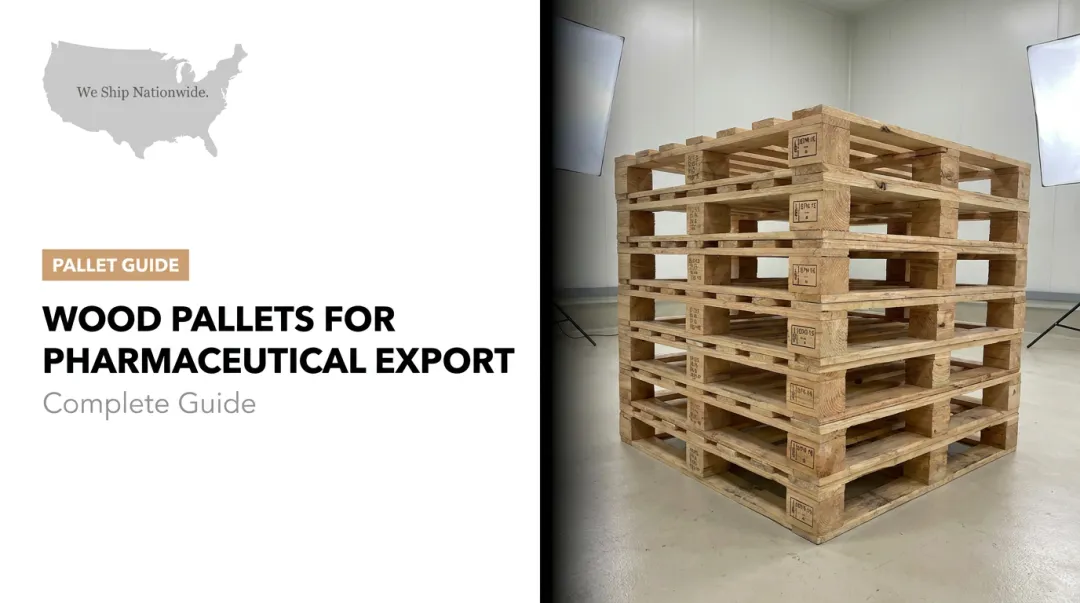
- New pallets with no prior chemical exposure
- Documented sourcing records for traceability
- Properly sealed crates for sensitive or sterile products
Industry-Specific Requirements: Food & Beverage vs. Pharmaceuticals
Food & Beverage: Pallet Specs by Sub-Sector
The 48×40 GMA pallet has a minimum 2,500 lb load capacity and four-way forklift entry — designed for general grocery retail. Many food & beverage producers need something different:
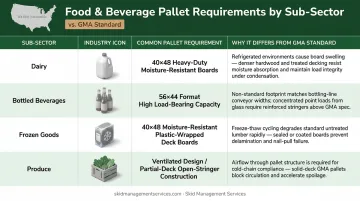
| Sub-Sector | Common Requirement | Why It Differs from GMA Standard |
|---|---|---|
| Dairy | 40×40 pallets, heavy-duty load rating | Bulk containers exceed standard footprint and weight |
| Bottled Beverages | 56×44 or 44×56 formats | Case footprints don't match 48×40; glass requires stable base |
| Frozen Goods | Moisture-resistant boards, dimensional stability | Temperature cycles cause warping in lower-grade wood |
| Produce | Ventilated designs | Air circulation required for freshness and cold chain integrity |
Heat-treated new wood pallets are the standard recommendation across all these sub-sectors — for pest control in distribution environments and for the cleanliness requirements FSMA demands. Dimensional compliance matters just as much as material choice. Robotic and conveyor-fed racking systems are calibrated to precise pallet specs, and a pallet that's off by half an inch doesn't just reduce efficiency — it can jam an entire line.
Pharmaceuticals: Pallets and Crates
Pharma sets a higher baseline for pallet sourcing. At minimum, compliant pharmaceutical pallets require:
- New pallets with no prior chemical exposure (to prevent TBA-type contamination events)
- Documented sourcing sufficient to satisfy a GDP audit
- Load-bearing reliability for heavy equipment and bulk medical supply shipments
When product value or fragility increases (lab instruments, diagnostic devices, compounded drugs in secondary packaging), an open pallet platform is often insufficient. Crates become the appropriate solution.
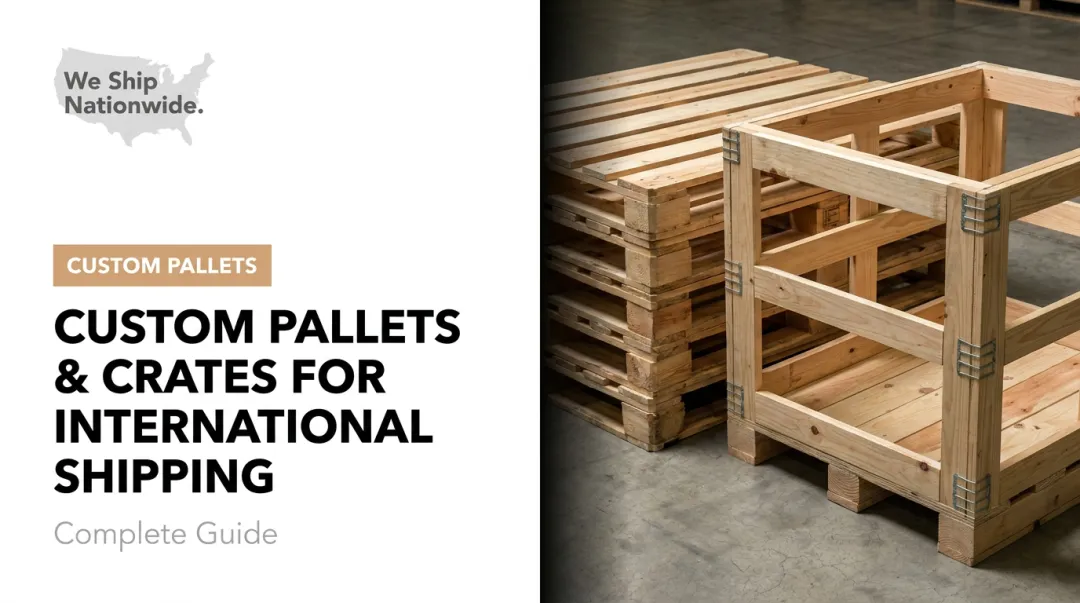
A wooden crate provides four-sided plus top-and-bottom enclosure, protecting contents from humidity, UV exposure, physical impact, and external contamination that a standard pallet cannot address.
ISPM-15-compliant crates are available for cross-border pharmaceutical shipments, applying the same export treatment and marking controls required for pallets.
New vs. Recycled Pallets: The Right Choice for Regulated Industries
FSMA doesn't categorically ban recycled pallets. The compliance test is condition-based: are the pallets suitable, adequately cleanable, and sanitary for their intended use?
The problem with recycled pallets in regulated applications isn't the rule — it's the provenance gap. You generally cannot verify:
- What cargo a recycled pallet previously carried
- Whether it was stored in a pest-contaminated environment
- Whether it was exposed to chemical spills or treated with prohibited substances
- Whether visible mold indicates a deeper contamination issue
That gap has real consequences. The FDA confirmed a pharmaceutical contamination event traced directly to wooden pallets used with drug packaging materials — a documented case, not a theoretical risk.
New pallets cost more per unit. That's the honest answer. But consider the math: a single product recall typically runs into the millions, and a failed FDA audit can halt production entirely. The incremental cost of new pallets across a full year's supply is a fraction of either outcome. For regulated industries, choosing new pallets is straightforward risk management — not a budget upgrade.
What to Look for in a Custom Pallet and Crate Supplier
Not all pallet suppliers have the experience or infrastructure to serve regulated industries. Here's what to evaluate:
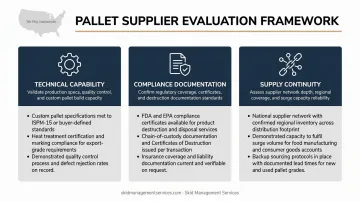
Technical capability:
- Can they engineer to exact dimensions, load ratings, and wood species — with documentation?
- Do they use tools like NWPCA's Pallet Design System for unit-load analysis?
- Are they a registered ISPM-15 heat treatment facility (or do they source from one)?
Compliance documentation:
- IPPC stamp verification and heat treatment records for export shipments
- Clean manufacturing process documentation for food and pharma customers
- Ability to provide compliance paperwork that would survive an FDA or GDP audit
Supply continuity:
- A single local supplier creates vulnerability when lumber markets spike or demand surges seasonally
- High-volume food manufacturers need a supplier — or supplier network — that can guarantee consistent availability without price volatility disrupting production
- Supplier networks that span multiple regions reduce both pricing exposure and fulfillment risk compared to single-source arrangements
Skid Management Services runs a national network of pallet and packaging suppliers built to deliver competitive pricing and uninterrupted supply. That model has supported food & beverage customers including Knouse Foods, Campbell Snacks, and Nissin through consistent, high-volume demand that local single-source suppliers often can't sustain.
For export shipments, Skid Management Services provides ISPM-15 heat-treated pallets with stamping and documentation to clear customs without delays.
Before committing to any supplier, request samples, compliance documentation (heat treatment records, IPPC stamp examples), and references from clients in your specific industry.
Frequently Asked Questions
What is the difference between a food grade pallet and a standard wood pallet?
"Food grade" isn't an official FDA classification — there's no certification or registration process behind the label. It generally refers to pallets that are clean, structurally sound, and free of chemical contamination, meeting FSMA's condition-based transportation requirements. A standard new GMA wood pallet can qualify if it meets those conditions.
Does heat treatment make a pallet safe for pharmaceutical use?
No. ISPM-15 heat treatment kills pests present at the time of treatment — it doesn't sterilize the pallet or certify it for pharmaceutical use. For pharma applications, new pallets with no prior chemical exposure and documented sourcing are the required baseline, independent of any export treatment.
When should food and beverage companies use wooden crates instead of pallets?
Crates are appropriate when products require full enclosure — fragile items like glass-bottled specialty goods, export shipments needing structural containment, or any product sensitive to moisture, impact, or external contamination. Pallets provide a loading platform; crates add physical protection around the product itself.
What certifications should I require from a pallet supplier for international food or pharma shipments?
Require ISPM-15 compliance with IPPC stamp verification, confirmation that heat treatment reached 56°C core temperature for at least 30 continuous minutes, and documentation that wood packaging is free from prohibited chemical treatments. For pharma, add GDP-compatible sourcing documentation.
Are new pallets always required for food and beverage shipping, or can recycled pallets be used?
FSMA permits recycled pallets when they are structurally sound and free from contamination. However, the unknown provenance of recycled pallets — previous cargo, storage conditions, chemical exposure — makes new pallets the lower-risk choice for regulated operations, where a contamination finding can trigger product holds, recalls, or FSMA violations.
What pallet dimensions are most commonly used in food and beverage distribution?
The 48×40 GMA pallet is the industry standard for general grocery and retail distribution. Producers with non-standard case sizes, automated racking, or export requirements often need custom dimensions. Dairy operations commonly use 40×40 pallets; bottled beverage lines often require 56×44 formats.